Yıldız, Bilge Can

Loading...
Profile Picture
Name Variants
B., Yildiz
B.C.Yildiz
Y., Bilge Can
B.C.Yıldız
Bilge Can, Yildiz
Yıldız,B.C.
Yildiz,B.C.
Bilge Can, Yıldız
Yıldız, Bilge Can
Y.,Bilge Can
Yildiz, Bilge Can
B.,Yıldız
Job Title
Araştırma Görevlisi
Email Address
bilge.yildiz@atilim.edu.tr
Main Affiliation
Airframe and Powerplant Maintenance
Status
Former Staff
Website
ORCID ID
Scopus Author ID
Turkish CoHE Profile ID
Google Scholar ID
WoS Researcher ID

Sustainable Development Goals

SDG data is not available
This researcher does not have a Scopus ID.
This researcher does not have a WoS ID.
Scholarly Output

2

Articles

2

Views / Downloads

8/0

Supervised MSc Theses

0

Supervised PhD Theses

0

WoS Citation Count

30

Scopus Citation Count

13

Patents

0

Projects

0

WoS Citations per Publication

15.00

Scopus Citations per Publication

6.50

Open Access Source

2

Supervised Theses

0

JournalCount
Journal of Optics1
Nanophotonics1
Current Page: 1 / 1

Scopus Quartile Distribution

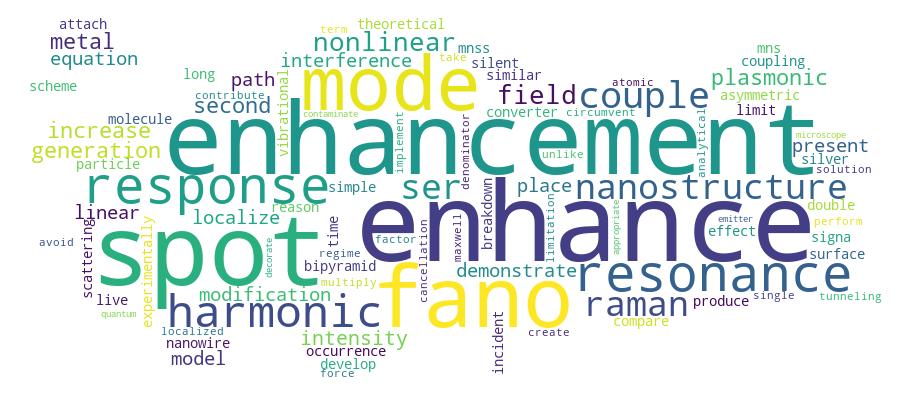
Competency Cloud

GCRIS Competency Cloud

Scholarly Output Search Results

Now showing 1 - 2 of 2
  • Article
    Citation - WoS: 21
    Silent Enhancement of Sers Signa Without Increasing Hot Spot Intensities
    (Walter de Gruyter Gmbh, 2018) Postaci, Selen; Yildiz, Bilge Can; Bek, Alpan; Tasgin, Mehmet Emre
    Plasmonic nanostructures enhance nonlinear response, such as surface enhanced Raman scattering (SERS), by localizing the incident field into hot spots. The localized hot spot field can be enhanced even further when linear Fano resonances take place in a double resonance scheme. However, hot spot enhancement is limited with the modification of the vibrational modes, the breakdown of the molecule, and the tunneling regime. Here, we present a method which can circumvent these limitations. Our analytical model and solutions of 3D Maxwell equations show that: enhancement due to the localized field can be multiplied by a factor of 10(2)-10(3). Moreover, this can be performed without increasing the hot spot intensity which also avoids the modification of the Raman modes. Unlike linear Fano resonances, here, we create a path interference in the nonlinear response. We demonstrate on a single equation that enhancement takes place due to cancellation of the contributing terms in the denominator of the SERS response. Our method can be implemented on an atomic force microscope tip, decorated (or "contaminated") with appropriate quantum emitters.
  • Article
    Citation - WoS: 9
    Citation - Scopus: 13
    Enhanced Second Harmonic Generation From Coupled Asymmetric Plasmonic Metal Nanostructures
    (Iop Publishing Ltd, 2015) Yildiz, Bilge Can; Tasgin, Mehmet Emre; Abak, Musa Kurtulus; Coskun, Sahin; Unalan, Husnu Emrah; Bek, Alpan
    We experimentally demonstrate that two coupled metal nanostructures (MNSs), a silver nanowire and bipyramid, can produce similar to 30 times enhanced second harmonic generation compared to the particles alone. We develop a simple theoretical model, presenting the path interference effects in the nonlinear response of coupled MNSs. We show that the reason for such an enhancement can be the occurrence of a Fano resonance due to the coupling of the converter MNS to the long-lived mode of the attached MNS.