
Erden, Zühal
Loading...
Profile URL
Name Variants
E.,Zuhal
E., Zühal
E., Zuhal
Zuhal, Erden
Zühal Erden
Erden,Zuhal
E.,Zühal
Erden, Zuhal
Z., Erden
Erden Z.
Erden, Zühal
Zühal, Erden
Erden,Z.
Z.,Erden
E., Zühal
E., Zuhal
Zuhal, Erden
Zühal Erden
Erden,Zuhal
E.,Zühal
Erden, Zuhal
Z., Erden
Erden Z.
Erden, Zühal
Zühal, Erden
Erden,Z.
Z.,Erden
Job Title
Doçent Doktor
Email Address
zuhal.erden@atilim.edu.tr
Main Affiliation
Mechatronics Engineering
Status
Website
ORCID ID
Scopus Author ID
Turkish CoHE Profile ID
Google Scholar ID
WoS Researcher ID
Sustainable Development Goals
 1
1NO POVERTY
0
Research Products
 2
2ZERO HUNGER
0
Research Products
 3
3GOOD HEALTH AND WELL-BEING
0
Research Products
 4
4QUALITY EDUCATION
1
Research Products
 5
5GENDER EQUALITY
0
Research Products
 6
6CLEAN WATER AND SANITATION
0
Research Products
 7
7AFFORDABLE AND CLEAN ENERGY
0
Research Products
 8
8DECENT WORK AND ECONOMIC GROWTH
0
Research Products
 9
9INDUSTRY, INNOVATION AND INFRASTRUCTURE
5
Research Products
 10
10REDUCED INEQUALITIES
0
Research Products
 11
11SUSTAINABLE CITIES AND COMMUNITIES
0
Research Products
 12
12RESPONSIBLE CONSUMPTION AND PRODUCTION
0
Research Products
 13
13CLIMATE ACTION
0
Research Products
 14
14LIFE BELOW WATER
0
Research Products
 15
15LIFE ON LAND
0
Research Products
 16
16PEACE, JUSTICE AND STRONG INSTITUTIONS
0
Research Products
 17
17PARTNERSHIPS FOR THE GOALS
0
Research Products

This researcher does not have a Scopus ID.

This researcher does not have a WoS ID.

Scholarly Output
29
Articles
13
Views / Downloads
137/4243
Supervised MSc Theses
7
Supervised PhD Theses
1
WoS Citation Count
36
Scopus Citation Count
52
Patents
0
Projects
2
WoS Citations per Publication
1.24
Scopus Citations per Publication
1.79
Open Access Source
6
Supervised Theses
8
| Journal | Count |
|---|---|
| Makina Tasarım ve Imalat Dergisi | 2 |
| Control Engineering and Applied Informatics | 2 |
| 20th Annual International Conference on Mechatronics and Machine Vision in Practice, M2VIP 2013 -- 20th Annual International Conference on Mechatronics and Machine Vision in Practice, M2VIP 2013 -- 20 September 2013 through 20 September 2013 -- Ankara -- 102276 | 1 |
| ASME 2010 10th Biennial Conference on Engineering Systems Design and Analysis, ESDA2010 -- ASME 2010 10th Biennial Conference on Engineering Systems Design and Analysis, ESDA2010 -- 12 July 2010 through 14 July 2010 -- Istanbul -- 84828 | 1 |
| Computer Applications in Engineering Education | 1 |
Current Page: 1 / 4
Scopus Quartile Distribution
Competency Cloud
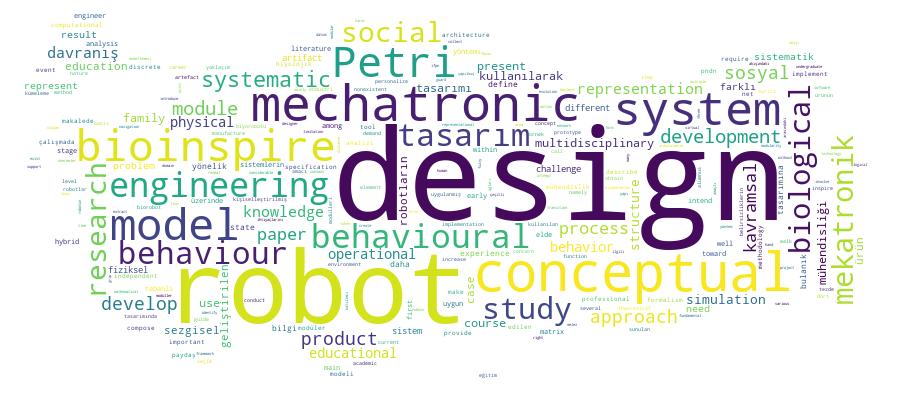
6 results
Scholarly Output Search Results
Now showing 1 - 6 of 6
Article Citation - WoS: 5Citation - Scopus: 8Biological System Analysis in Bioinspired Conceptual Design (bicd) for Bioinspired Robots(Romanian Soc Control Tech informatics, 2011) Eroglu, Aylin Konez; Eroğlu, Aylin Konez; Erden, Zuhal; Erden, Zühal; Erden, Abdulkadir; Erden, Abdulkadir; Eroğlu, Aylin Konez; Erden, Zühal; Erden, Abdulkadir; Department of Mechatronics Engineering; Department of Mechatronics Engineering; Mechatronics Engineering; Mechatronics Engineering; Department of Mechatronics Engineering; Mechatronics EngineeringBioinspired design (BID) provides a systematic way for bioinspired applications. Although several BID approaches as well as some tools and databases are available in the literature, the studies on BID are still challenging for designers and/or engineers because of limitations of current BID approaches. There are mainly two directions related with these limitations. One of them is the representation of knowledge on biological systems and the second is the problem of transforming this knowledge into engineering domain. These limitations expose two questions; firstly, "What knowledge is required to describe biological systems?" and "How this knowledge is represented?" and secondly, "How this knowledge is transformed into the engineering domain?". This paper presents a study which aims to answer the first question about knowledge required to represent biological systems. This knowledge is obtained during "Analysis of Biological Systems" stage of a new suggested bioinspired conceptual design (BICD) procedure.Article Citation - WoS: 2Citation - Scopus: 4State-Based Conceptual Design in Mechatronics Via Petri Nets: a Case Study for an Educational Robot(Romanian Soc Control Tech informatics, 2011) Erden, Zuhal; Mechatronics EngineeringUse of state-based models to represent artifact behaviors at conceptual design is a challenging area for design research. Conceptual design of mechatronic systems needs a multi-domain approach in which the "logical behavior" of a mechatronic design artifact is described without any physical realization. This paper presents a case study on state-based representation for the intended behavior of a non-existent robot at early conceptual level. The behavior is defined through a demonstrative scenario and represented as states and state transitions independent of any physical embodiment. Discrete Event System Specification (DEVS) and Petri Net formalism are used for the model. This representational model is first step towards the development of a virtual prototype for the logical behavior of robot design.Article Citation - WoS: 13Citation - Scopus: 15Behavioural Representation and Simulation of Design Concepts for Systematic Conceptual Design of Mechatronic Systems Using Petri Nets(Taylor & Francis Ltd, 2014) Araz, Macit; Erden, ZuhalThe systematic representation of design concepts is an important requirement for computational support during the conceptual design stage within the process of product development. Behavioural simulation of design concepts is used as a systematic representation framework, and behavioural representation is based on modelling and simulating the behaviour of a design artefact at the conceptual level to perform an overall function, leading to behaviour-based conceptual design. The behaviour-based conceptual design approach is critical for mechatronic systems since they require synergistic integration starting from the initial conceptual design phase. The present study is focused on behavioural representation and simulation of design concepts via discrete event system specification formalism and Petri Nets so as to contribute to systematic conceptual design in mechatronic systems. The paper introduces a representation framework for the behaviour-based conceptual design of mechatronic systems and its implementation on five selected case studies, among laboratory-level educational robots. In addition to Petri Net modelling and computer simulations, the implementation also includes physical simulations of the intended operational behaviours for educational robots on a distributed physical structure called the desktop design model'. In this paper, implementation on one of these case studies, namely the frog robot', is presented in detail.Article Citation - WoS: 1Citation - Scopus: 1Development of Behavioural Modules for Mechatronic Product Families Using the 3d Design Structure Matrix Approach(Ios Press, 2019) Erden, ZuhalIncreased competition in the global market has forced companies to diversify their product ranges to meet the customers' changing needs and adopt product development strategies for "mass customization", which requires designing modular products. Product modularity is achieved via platform-based systems, in which various combinations of different modules are assembled within a common platform. In the literature, there is a considerable amount of research on modularity for mechanical products. Yet, research on modularity of smart systems, such as mechatronic products, is quite limited. Therefore, the objective of this research is to develop fundamental behavioural modules to facilitate the systematic design of platform-based mechatronic product families for mass customization. Being developed using the state-event model of mechatronic systems at an early design stage, these modules enable a behavioural adaptation of smart systems through a systematic formal structure. In this study, fundamental mechatronic behaviour modules are developed using a modified form of Design Structure Matrix (DSM) existing in the literature. DSM is adopted to mechatronic systems as a 3D matrix, which includes sensorial, motoric and cognitive behaviours. Symbolic representations of mechatronic behaviour modules are generated and used for describing robot tasks. The mechatronic behaviour modules developed in this study are implemented on a demonstrative task-based robot family model composed of guide robots for museums and shopping malls, a guard robot, a house-cleaning robot and companion robots for children, the elderly and pets.Conference Object Citation - WoS: 1Representation of the Operational Behaviour of an Educational Robot at Conceptual Design Using Petri Nets(Amer Soc Mechanical Engineers, 2010) Erden, ZuhalIncreasing demand for computational support at conceptual design makes behavioural modeling a challenging area for design research. This is mainly because a behavioural model of a nonexistent design artifact at conceptual level is the basis for behavioural simulation and resulting computational design support. Behavioural models are particularly important for top-down of multidisciplinary products such as mechatronic systems. During the conceptual design of such systems, intended "operational behaviour" of the artifact is described without any physical realization. As design stages become more concrete, operational behaviour can be refined so as to represent well defined mathematical descriptions of corresponding physical behaviours. In this study, a model for representing the intended operational behaviour of a nonexistent educational robot, namely a rabbit robot, is presented for conceptual design. The operational behaviour of the robot is defined as composed of states and state transitions independent of any physical embodiment. Discrete Event System Specification (DEVS) and Petri Net formalism are used for the model. This representational model is the first step towards the development of a virtual prototype for the operational behaviour of an educational robot.Conference Object Citation - WoS: 1BIOINSPIRED CONCEPTUAL DESIGN (BICD): CONCEPTUAL DESIGN OF A GRASSHOPPER-LIKE JUMPING MECHANISM AS A CASE STUDY(design Soc, 2011) Eroglu, Aylin Konez; Erden, Zuhal; Erden, AbdulkadirThe evolution process of nature creates highly effective, power efficient, and perfectly structured biological systems. These excellent systems provide an inexhaustible source for engineers and scientists who desire to inspire ideas, processes, structures, functions, and behaviors from biological domain and implement them into engineering domain. This approach is called "Bioinspired" and challenging for engineers. However, some problems of the practical approaches are observed. One of the problems is "ad hoc" nature of the process. Each bioinspired design product has resulted in a differing design process and a generalization was not possible. Another problem rises due to the terminology difference between engineers and biologists. To overcome these problems, a need for a systematic bioinspired design (BID) process was realized in early 2000s and since then, considerable research on the BID methodology has been progressed. Within the context of BID, this paper introduces a new approach on bioinspired conceptual design (BICD) procedure for hybrid bioinspired robots which can be inspired from multiple biological systems. An illustrative case study is given in the paper.
