Eliküçük Yıldırım, Nilgün

Loading...
Profile Picture
Name Variants
Elikucuk Yildirim, Nilgun
Nilgün Eliküçük Yıldırım
Eliküçük Yıldırım,N.
Eliküçük Yildirim N.
Nilgun, Elikucuk Yildirim
E., Nilgün
Eliküçük Yıldırım, Nilgün
Elikucuk Yildirim,N.
E. Y. Nilgun
N.,Elikucuk Yildirim
Nilgün, Eliküçük Yıldırım
N.,Eliküçük Yıldırım
E.,Nilgün
E. Y. Nilgün
E.Y.Nilgün
E.,Nilgun
E., Nilgun
N., Eliküçük Yıldırım
Elikucuk Yildirim,Nilgun
N., Elikucuk Yildirim
Yildirim, Nilgun Elikucuk
Yıldırım, Nilgün Eliküçük
Job Title
Doçent Doktor
Email Address
nilgun.eyildirim@atilim.edu.tr
Main Affiliation
Energy Systems Engineering
Status
Website
Scopus Author ID
Turkish CoHE Profile ID
Google Scholar ID
WoS Researcher ID

Sustainable Development Goals

2

ZERO HUNGER
ZERO HUNGER Logo

0

Research Products

11

SUSTAINABLE CITIES AND COMMUNITIES
SUSTAINABLE CITIES AND COMMUNITIES Logo

0

Research Products

14

LIFE BELOW WATER
LIFE BELOW WATER Logo

3

Research Products

6

CLEAN WATER AND SANITATION
CLEAN WATER AND SANITATION Logo

0

Research Products

1

NO POVERTY
NO POVERTY Logo

1

Research Products

5

GENDER EQUALITY
GENDER EQUALITY Logo

0

Research Products

9

INDUSTRY, INNOVATION AND INFRASTRUCTURE
INDUSTRY, INNOVATION AND INFRASTRUCTURE Logo

6

Research Products

16

PEACE, JUSTICE AND STRONG INSTITUTIONS
PEACE, JUSTICE AND STRONG INSTITUTIONS Logo

3

Research Products

17

PARTNERSHIPS FOR THE GOALS
PARTNERSHIPS FOR THE GOALS Logo

17

Research Products

15

LIFE ON LAND
LIFE ON LAND Logo

0

Research Products

10

REDUCED INEQUALITIES
REDUCED INEQUALITIES Logo

2

Research Products

7

AFFORDABLE AND CLEAN ENERGY
AFFORDABLE AND CLEAN ENERGY Logo

0

Research Products

8

DECENT WORK AND ECONOMIC GROWTH
DECENT WORK AND ECONOMIC GROWTH Logo

3

Research Products

4

QUALITY EDUCATION
QUALITY EDUCATION Logo

0

Research Products

12

RESPONSIBLE CONSUMPTION AND PRODUCTION
RESPONSIBLE CONSUMPTION AND PRODUCTION Logo

0

Research Products

3

GOOD HEALTH AND WELL-BEING
GOOD HEALTH AND WELL-BEING Logo

0

Research Products

13

CLIMATE ACTION
CLIMATE ACTION Logo

0

Research Products
Documents

8

Citations

47

h-index

4

Documents

7

Citations

50

Scholarly Output

35

Articles

10

Views / Downloads

374/2609

Supervised MSc Theses

24

Supervised PhD Theses

0

WoS Citation Count

46

Scopus Citation Count

47

WoS h-index

4

Scopus h-index

4

Patents

0

Projects

0

WoS Citations per Publication

1.31

Scopus Citations per Publication

1.34

Open Access Source

4

Supervised Theses

24

Google Analytics Visitor Traffic

JournalCount
Southeast European and Black Sea Studies2
Democratization2
Bilig1
Bilig / Türk Dünyası Sosyal Bilimler Dergisi1
Pacific Focus1
Current Page: 1 / 2

Scopus Quartile Distribution

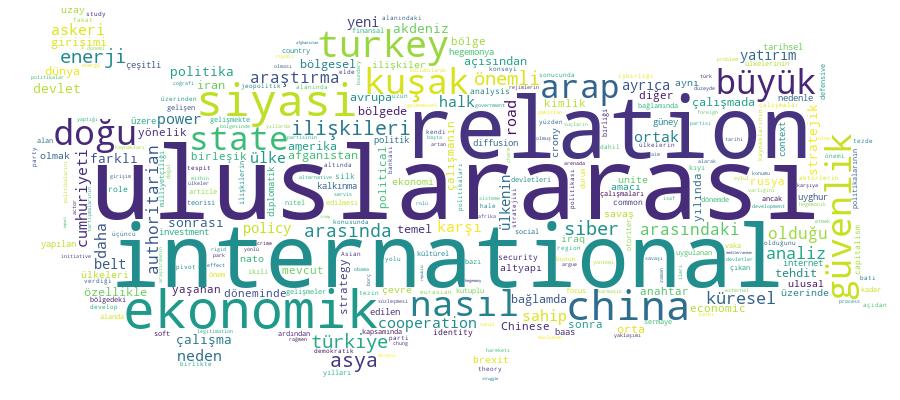
Competency Cloud

GCRIS Competency Cloud

Scholarly Output Search Results

Now showing 1 - 10 of 10
  • Article
    Citation - WoS: 7
    Citation - Scopus: 5
    Use/Misuse of Chinese Bri Investment? Bri-Related Crony Capitalism in Turkey
    (Routledge Journals, Taylor & Francis Ltd, 2023) Yildirim, Nilgun Elikucuk; Yilmaz, Gozde
    Crony capitalism as a type of capitalism entailing the close relations of political authorities and business circles based on mutual profit maximization is not a new phenomenon in Turkey. However, crony relations have accelerated with the Justice and Development Party (Adalet Kalkinma Partisi - AKP) rule. Despite growing scholarly work on crony relations in the AKP era, the literature remains inward-oriented without analysing the external dimension of crony capitalism, which this article intends to alleviate by providing an analysis of crony capitalism and bringing back the external dimension through an analysis of Belt and Road Initiative (BRI)-related crony relations. It argues that the case of Turkey demonstrates how the BRI is used to feed instrumental cronyism without the promotion of China and how recipient countries use and misuse Chinese BRI investments to create alternative resources for the government's cronies.
  • Article
    KUŞAK ve YOL GİRİŞİMİNİN FİNANSMANI: ÇİN’İN BORÇ TUZAĞI MI?
    (2020) Yıldırım, Nilgün Eliküçük
    Çin’in 21. yüzyıldaki en büyük altyapı yatırım girişimi olan Kuşak ve Yol Girişimi (KYG), Çin devlet kapitalizmi modelinin uluslararasında bir yatırım modeline dönüştürülmesinin ilk nüvesidir. Girişimin devlet-destekli yatırım girişimi olarak adlandırılmasına yol açan en önemli sebep, girişimdeki projelerin finansmanının Çin devlet ticari ve politika bankaları ve ulusal varlık fonları tarafından sağlanmasıdır. Fakat altyapı finansmanının ülke garantili tercihli krediler yoluyla sağlanması özellikle az gelişmiş ve gelişmekte olan ülkelerin borçlarını ödeyememeleri durumunda Çin kamu teşebbüsleriyle borç-öz sermaye takası anlaşmaları yapmalarına yol açmaktadır. Çin’in stratejik noktaları ele geçirmek için küçük ekonomileri bilinçli bir şekilde aşırı KYG borçlanmasına itmesi olarak tanımlanan borç tuzağı, KYG’nin aslında siyasi bir proje olduğu tartışmalarının merkezinde yer almaktadır. Bu çalışmada, öncelikle bankalar ve ulusal varlık fonlarının analiziyle Çin’in devlet sermayesini KYG finansmanına nasıl aktardığı ele alınacaktır. Ardından borç sıkıntına düşen ülkelerdeki projelerin Çin için stratejik bir önem arz edip etmediği analiz edilecektir.
  • Article
    Çin’in Uluslararası Kimlik Trilemması: Gelişmekte Olan Ülke, Bölgesel Güç Ya Da Büyük Güç?
    (2019) Yıldırım, Nilgün Eliküçük
    Çin dış politikasında sabit bir ülke kimliğinden ziyade aynı anda farklı birçok kimlik benimsemektedir. Çin Üçüncü Dünya ile ilişkilerinde hala gelişmekte olan ülke kimliğini kullanırken, periferisinde bölgesel güç rolünü oynamaktadır. Uluslararası alanda ise büyük güçlere atfedilen uluslararası sorumluluk prensibini üstlenmektedir. Bu bağlamda Çin’in gelişmekte olan ülke mi, bölgesel güç mü ya da küresel anlamda büyük güç mü olduğu konusunda kesinlik yoktur. Çin’in dış politikada birden çok kimliğe aynı anda bürünmesi, uluslararası ilişkiler akademisi tarafından tartışılan küresel kimliklerin bir ya da birkaçının benimsenmesi sonucudur. Uluslararası kimlik tartışmalarının odak noktası ise düşük profil stratejisinin temel taşlarından biri olan “juebu dangtou” yani asla “lider olma/liderlik yapma” prensibidir. Bu çalışma da, Çin akademisindeki uluslararası kimlik tartışmalarını, gelişmekte olan ülke, bölgesel güç ve büyük güç kimliği olarak üç kategoride ele alacağım. Çalışmanın temel önermesi, Xi Jinping’in “başarı için mücadele” stratejisinin şekillenmesinde akademideki kimlik tartışmalarının etkili olduğudur. Ayrıca bu tartışmalar Çin’in hangi siyasi coğrafya üzerinden etki alanı yaratmak isteyeceğini gözlemlemek için de oldukça yararlıdır.
  • Article
    Citation - Scopus: 4
    Legitimation, Co-Optation, and Survival: Why Is Turkey Silent on China’s Persecution of Uyghurs?
    (Routledge, 2023) Eliküçük Yıldırım,N.
    China built internment camps officially referred to as training centres within the scope of a policy for countering extremism and terrorism in the Xinjiang Uyghur Autonomous Region in 2017. While the repression imposed by China on Uyghurs in these camps has attracted the response of the international community, there has been neither a public protest nor a meaningful government response to China in Turkey, despite it having been the voice of Uyghurs on international platforms before 2017. This study aims to identify the reasons for Turkey's silence on the persecution of Uyghurs by utilizing the legitimation and co-optation strategies of the authoritarian stability framework. The Turkish government’s legitimation strategies of “rallying around the flag” via anti-Americanism and the economic expectations of China to boost its performance-based legitimacy are evaluated as reasons for the government’s silence on the Uyghur cause. Moreover, it is also discussed how formal and informal co-optation strategies of the government with nationalist and Eurasianist parties are playing a role as a bolstering mechanism of its silence policy on Uyghurs. © 2023 Informa UK Limited, trading as Taylor & Francis Group.
  • Article
    Citation - WoS: 5
    Citation - Scopus: 7
    China's Charm Defensive: Image Protection by Acquiring Mass Entertainment
    (Wiley, 2020) Yildirim, Nilgun Elikucuk; Aslan, Mesut
    Focusing on discussion of China's soft power resources, this article argues that China performs two kinds of soft power strategies in developing and developed countries: offensive and defensive, respectively. While China's charm offensive aims to consolidate her comprehensive power through a development model, aid, investment, traditional culture, foreign policy, and international broadcasting in developing countries, the defensive aspect of China's soft power strategy aims to soften the rise of China with traditional culture by introducing appealing parts of Chinese culture through investments and international broadcasting in Western countries. China applies classical soft power tools in developing countries while she endeavors to protect her image in Western countries defensively. China's alternative defensive approach to soft power is mostly implemented through the acquisition of media outlets, and via the entertainment sector and gaming industry by Chinese-owned companies. However, even in the defensive and offensive bifurcation, if charm attacks result in failure, China could turn take a defensive stance in developing countries.
  • Article
    Citation - WoS: 8
    Citation - Scopus: 5
    Rigid Boundaries Between Turkey and China: Is Political Mobility Possible?
    (Routledge Journals, Taylor & Francis Ltd, 2021) Yildirim, Nilgun Elikucuk
    This article examines the rigid boundaries in relations between China and Turkey by applying social identity theory to international relations. It evaluates different networks of political alliance and external cultural-ethnic ties as rigid boundaries between the two countries. Turkey-China relations have been shaped by both inter-systemic and inter-state dynamics. Therefore, to show how social context and the permeability of social structure have affected the nature of bilateral relations, this article divides relations into two historical contexts of Cold War and post-Cold War periods. It concludes that it will be hard to go beyond rigid boundaries as long as each side has its own solutions to problems between the two countries.
  • Article
    Citation - WoS: 21
    Citation - Scopus: 20
    Authoritarian Diffusion or Cooperation? Turkey's Emerging Engagement With China
    (Routledge Journals, Taylor & Francis Ltd, 2020) Yilmaz, Gozde; Elikucuk Yildirim, Nilgun
    With the recent trend of autocratization in the world, scholars have begun to focus on authoritarian diffusion, cooperation, and autocracy promotion. Despite still being at an early stage theoretically and empirically, this expansion of diffusion literature has informed us about the possibilities of authoritarian diffusion and cooperation. In contrast to the recent focus on regional patterns of authoritarian diffusion and cooperation, this article explores a global process of authoritarian cooperation between Turkey and China. Focusing on the growing economic and political linkages between Turkey and China, we argue that, rather than authoritarian diffusion or autocracy promotion from China to Turkey, the increasing pragmatic cooperation among authoritarian states is the new game in town, shaped by interest-driven calculations to bolster power internally and internationally.
  • Article
    Citation - WoS: 4
    Citation - Scopus: 3
    Turkey in Between the Eu and China: From Europeanization To Cooperation With China
    (Routledge Journals, Taylor & Francis Ltd, 2023) Yilmaz, Gozde; Yildirim, Nilgun Elikucuk
    Turkey has been on the path of EU membership since the 2000s, and the democratization process was well underway during the initial years of its candidacy. However, this trend was reversed substantially, with Turkey growing increasingly authoritarian during the 2010s. This substantial democratic backsliding has led to increasing authoritarian cooperation with the authoritarian powers on the rise, one of which is China, whose increasing engagement and cooperation with Turkey marked an alternative gravity centre for Turkey to be pulled by. This article argues that Turkey, in line with the worsening domestic authoritarianism, has been engaging with the authoritarian powers for survival rather than engaging with the EU, which provided legitimacy to the rule of the AKP during the initial years of its rule.
  • Article
    Çin’in Avrasya Rüyası Olarak İpek Yolu Ekonomik Kuşağı: Ortak Kimlik mi Ortak Korku Mu?
    (2019) Yıldırım, Nilgün Eliküçük
    İpek Yolu Ekonomik Kuşağı Çin’in Avrasya Ekseni stratejisinin anahtar bileşenidir. Bu çalışmada Çin’in Avrasya Ekseni stratejisi, sosyal kimlik teorisi perspektifinden bir yaratıcılık stratejisi olarak ele alınmıştır. Çin, yaratıcılık stratejisinde başarılı olabilmek için, İpek Yolu Ekonomik Kuşağı ülkeleriyle Çin Rüyası üzerinden ortak bir grup kimliği oluşturmaya çalışmaktadır. Fakat Çin Rüyası, Orta Asya Türk Toplumları ve Uygurlar tarafından ortak bir kimlik olarak algılanmamaktadır. Orta Asya Devletleri, Çin’in bölgedeki varlığını, ekonomik ve jeo-stratejik olarak olumlu karşılarken, Çinli göçünün yol açacağı demografik değişimlerden ve kültürel etkiden korkmaktadırlar. Bu yüzden, Çin Rüyası, İpek Yolu Ekonomik Kuşağında yer alan Türk toplumlarının ortak kimliğinden ziyade ortak korkusudur. Bu korku uzun vadede girişimin başarısını engelleyecek en önemli faktörlerden biridir
  • Article
    Citation - WoS: 1
    Citation - Scopus: 1
    Silk Road Economic Belt as China's Eurasian Dream: Common Identity or Common Fear?
    (Ahmet Yesevi Univ, 2019) Yildirim, Nilgun Elikucuk
    The Silk Road Economic Belt is the key component of China's Eurasian Pivot strategy. In this study, China's Eurasian Pivot is approached as a creativity strategy from the perspective of social identity theory. In order to succeed in its creativity strategy, China is trying to create a common in-group identity with the Silk Road Economic Belt countries through the Chinese Dream. However, the Chinese Dream is not perceived as a common identity by Central Asians and Uyghurs. While Central Asians respond China's economic presence in the region positively, they are afraid of demographic changes and cultural influences that Chinese migration will cause. Therefore, the Chinese Dream has been a common fear for Turkic societies along the Silk Road Economic Belt rather than common identity. This fear could be one of the most important factors that will prevent the success of China's Eurasian Pivot in the long run.