Eseller, Kemal Efe

Loading...
Profile Picture
Name Variants
Eseller, K. E.
K., Eseller
E.,Kemal Efe
Eseller, Kemal Efe
Eseller,K.E.
Kemal Efe, Eseller
K.E.Eseller
E., Kemal Efe
K.,Eseller
Job Title
Profesör Doktor
Email Address
efe.eseller@atilim.edu.tr
Main Affiliation
Department of Electrical & Electronics Engineering
Status
Former Staff
Website
ORCID ID
Scopus Author ID
Turkish CoHE Profile ID
Google Scholar ID
WoS Researcher ID

Sustainable Development Goals

NO POVERTY1
NO POVERTY
0
Research Products
ZERO HUNGER2
ZERO HUNGER
0
Research Products
GOOD HEALTH AND WELL-BEING3
GOOD HEALTH AND WELL-BEING
0
Research Products
QUALITY EDUCATION4
QUALITY EDUCATION
0
Research Products
GENDER EQUALITY5
GENDER EQUALITY
0
Research Products
CLEAN WATER AND SANITATION6
CLEAN WATER AND SANITATION
0
Research Products
AFFORDABLE AND CLEAN ENERGY7
AFFORDABLE AND CLEAN ENERGY
2
Research Products
DECENT WORK AND ECONOMIC GROWTH8
DECENT WORK AND ECONOMIC GROWTH
1
Research Products
INDUSTRY, INNOVATION AND INFRASTRUCTURE9
INDUSTRY, INNOVATION AND INFRASTRUCTURE
2
Research Products
REDUCED INEQUALITIES10
REDUCED INEQUALITIES
0
Research Products
SUSTAINABLE CITIES AND COMMUNITIES11
SUSTAINABLE CITIES AND COMMUNITIES
1
Research Products
RESPONSIBLE CONSUMPTION AND PRODUCTION12
RESPONSIBLE CONSUMPTION AND PRODUCTION
1
Research Products
CLIMATE ACTION13
CLIMATE ACTION
1
Research Products
LIFE BELOW WATER14
LIFE BELOW WATER
0
Research Products
LIFE ON LAND15
LIFE ON LAND
0
Research Products
PEACE, JUSTICE AND STRONG INSTITUTIONS16
PEACE, JUSTICE AND STRONG INSTITUTIONS
0
Research Products
PARTNERSHIPS FOR THE GOALS17
PARTNERSHIPS FOR THE GOALS
0
Research Products
This researcher does not have a Scopus ID.
This researcher does not have a WoS ID.
Scholarly Output

22

Articles

12

Views / Downloads

29/99

Supervised MSc Theses

5

Supervised PhD Theses

2

WoS Citation Count

363

Scopus Citation Count

450

Patents

0

Projects

0

WoS Citations per Publication

16.50

Scopus Citations per Publication

20.45

Open Access Source

5

Supervised Theses

7

JournalCount
Food Chemistry2
Laser-Induced Breakdown Spectroscopy, Second Edition2
Spectrochimica Acta Part B: Atomic Spectroscopy2
Inventions1
Biomedical Optics Express1
Current Page: 1 / 3

Scopus Quartile Distribution

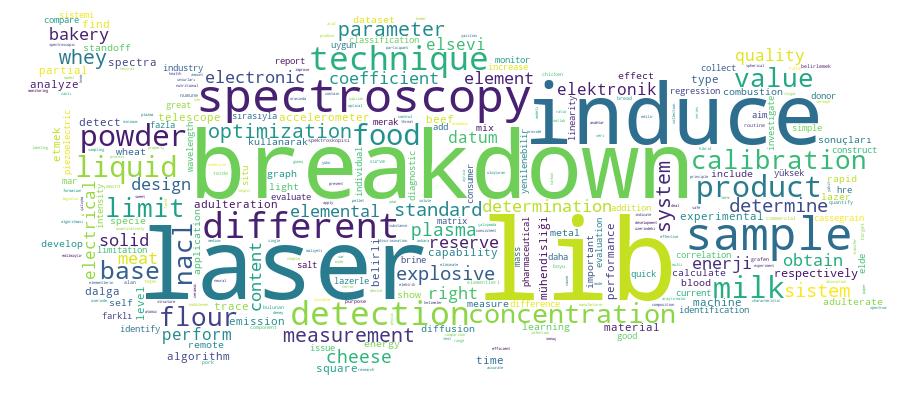
Competency Cloud

GCRIS Competency Cloud

Scholarly Output Search Results

Now showing 1 - 2 of 2
  • Article
    Citation - Scopus: 1
    Performance Evaluation of Self-Mixing Interferometer With the Ceramic Type Piezoelectric Accelerometers
    (de Gruyter Poland Sp Z O O, 2022) Berberoglu, Halil; Tiken, Mehmet; Eseller, Kemal Efe; Orhan, Elif; Candan, Can
    In this article, reconstructed displacement from the self-mixing signal is compared with the displacement obtained by the ceramic shear mode design piezoelectric accelerometer. Piezoelectric accelerometers are widely accepted due to the low output noise and wide frequency range, but nevertheless it is not contact-free. Self-mixing interferometric signals due to the vibrating target on which an accelerometer is attached are acquired by an external silicon type photodetector. The laser light hits directly the accelerometer as a target which is driven by the sum of two different sinusoidal frequencies of 150 and 300 Hz with different voltage levels.
  • Article
    Citation - WoS: 6
    Citation - Scopus: 6
    Comparison of Different Calibration Techniques of Laser Induced Breakdown Spectroscopy in Bakery Products: on Nacl Measurement
    (Springer, 2021) Bilge, Gonca; Eseller, Kemal Efe; Berberoglu, Halil; Sezer, Banu; Tamer, Ugur; Boyaci, Ismail Hakki
    Laser induced breakdown spectroscopy (LIBS) is a rapid optical spectroscopy technique for elemental determination, which has been used for quantitative analysis in many fields. However, the calibration involving atomic emission intensity and sample concentration, is still a challenge due to physical-chemical matrix effect of samples and fluctuations of experimental parameters. To overcome these problems, various chemometric data analysis techniques have been combined with LIBS technique. In this study, LIBS was used to show its potential as a routine analysis for Na measurements in bakery products. A series of standard bread samples containing various concentrations of NaCl (0.025%-3.5%) was prepared to compare different calibration techniques. Standard calibration curve (SCC), artificial neural network (ANN) and partial least square (PLS) techniques were used as calibration strategies. Among them, PLS was found to be more efficient for predicting the Na concentrations in bakery products with an increase in coefficient of determination value from 0.961 to 0.999 for standard bread samples and from 0.788 to 0.943 for commercial products.