Uluğ, Naime

Loading...
Profile Picture
Name Variants
U.,Naime
Naime, Uluğ
Naime, Ulug
N.,Uluğ
U., Naime
N., Uluğ
N.,Ulug
Ulug, Naime
Uluğ N.
Ulug,N.
Uluğ, Naime
Ulug N.
Uluğ,N.
N., Ulug
Job Title
Doktor Öğretim Üyesi
Email Address
naime.ulug@atilim.edu.tr
Main Affiliation
Department of Therapy and Rehabilitation
Status
Website
ORCID ID
Scopus Author ID
Turkish CoHE Profile ID
Google Scholar ID
WoS Researcher ID

Sustainable Development Goals

2

ZERO HUNGER
ZERO HUNGER Logo

0

Research Products

14

LIFE BELOW WATER
LIFE BELOW WATER Logo

0

Research Products

17

PARTNERSHIPS FOR THE GOALS
PARTNERSHIPS FOR THE GOALS Logo

0

Research Products

5

GENDER EQUALITY
GENDER EQUALITY Logo

1

Research Products

16

PEACE, JUSTICE AND STRONG INSTITUTIONS
PEACE, JUSTICE AND STRONG INSTITUTIONS Logo

2

Research Products

8

DECENT WORK AND ECONOMIC GROWTH
DECENT WORK AND ECONOMIC GROWTH Logo

0

Research Products

4

QUALITY EDUCATION
QUALITY EDUCATION Logo

0

Research Products

6

CLEAN WATER AND SANITATION
CLEAN WATER AND SANITATION Logo

0

Research Products

7

AFFORDABLE AND CLEAN ENERGY
AFFORDABLE AND CLEAN ENERGY Logo

0

Research Products

10

REDUCED INEQUALITIES
REDUCED INEQUALITIES Logo

0

Research Products

11

SUSTAINABLE CITIES AND COMMUNITIES
SUSTAINABLE CITIES AND COMMUNITIES Logo

0

Research Products

9

INDUSTRY, INNOVATION AND INFRASTRUCTURE
INDUSTRY, INNOVATION AND INFRASTRUCTURE Logo

0

Research Products

1

NO POVERTY
NO POVERTY Logo

0

Research Products

3

GOOD HEALTH AND WELL-BEING
GOOD HEALTH AND WELL-BEING Logo

4

Research Products

12

RESPONSIBLE CONSUMPTION AND PRODUCTION
RESPONSIBLE CONSUMPTION AND PRODUCTION Logo

0

Research Products

13

CLIMATE ACTION
CLIMATE ACTION Logo

0

Research Products

15

LIFE ON LAND
LIFE ON LAND Logo

0

Research Products
Documents

15

Citations

377

h-index

7

Documents

14

Citations

252

Scholarly Output

18

Articles

11

Views / Downloads

39/0

Supervised MSc Theses

7

Supervised PhD Theses

0

WoS Citation Count

19

Scopus Citation Count

20

WoS h-index

2

Scopus h-index

2

Patents

0

Projects

0

WoS Citations per Publication

1.06

Scopus Citations per Publication

1.11

Open Access Source

7

Supervised Theses

7

Google Analytics Visitor Traffic

JournalCount
Medicine2
European Journal of Pain1
İzmir Kâtip Çelebi Üniversitesi Sağlık Bilimleri Fakültesi Dergisi1
Journal of Bodywork and Movement Therapies1
Journal of Health Sciences and Medicine (Online)1
Current Page: 1 / 2

Scopus Quartile Distribution

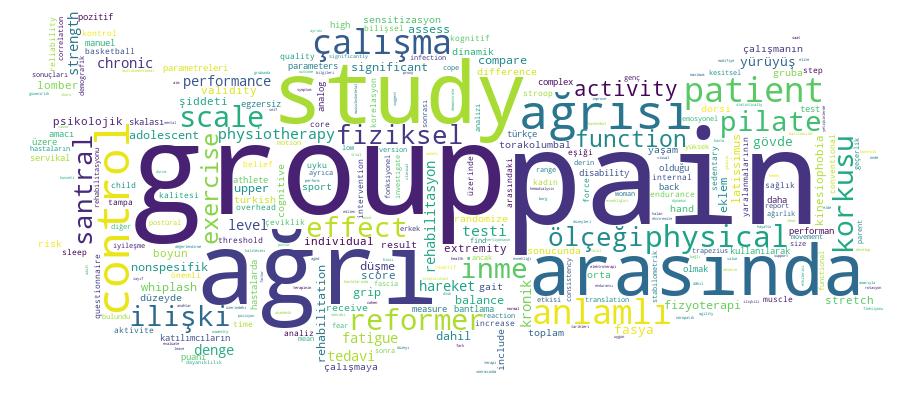
Competency Cloud

GCRIS Competency Cloud

Scholarly Output Search Results

Now showing 1 - 2 of 2
  • Article
    Role of Latissimus Dorsi-Thoracolumbar Fascia Complex Stretching on Pain and Pain-Related Parameters in Patients With Chronic Low Back Pain: A Randomised Clinical Trial
    (Wiley, 2025) Ulug, Naime; Kodak, Seyde Busra; Kodak, Muhammed Ihsan; Aslan, Sema Nur
    Background Fascial stretching is gaining interest as a potential intervention for pain management. However, evidence regarding the effect of latissimus dorsi-thoracolumbar fascia (LD-TLF) complex stretching in patients with chronic low back pain (CLBP) remains limited. Therefore, this study aimed to investigate the effects of LD-TLF complex stretching on pain-related factors and disability in patients with CLBP. Methods Thirty patients with CLBP were randomly assigned to a study group (n = 15; 7 men, 8 women) and a control group (n = 15; 7 men, 8 women). The study group received 4 weeks of LD-TLF complex stretching in combination with conventional physiotherapy, while the control group received conventional physiotherapy only. Outcomes were assessed before and after the interventions, including primary measures of pain pressure thresholds (PPT) at thoracolumbar fascia levels (L1, L3 and 12th costa), and secondary measures included the Pain Sensitivity Questionnaire (PSQ), the effects of pain on daily activities measured by the Brief Pain Inventory (BPI), and disability assessed by the Oswestry Disability Questionnaire (ODQ). Results Pre- and post-treatment PPTs, at the L1, L3 vertebrae and 12th costa levels, demonstrated significant differences between the study group and control groups. Post-treatment thresholds were significantly higher compared to pre-treatment thresholds (p < 0.001, eta p(2) = 0.67; p < 0.001, eta p(2) = 0.61; p < 0.001, eta p(2) = 0.74). Additionally, significant improvements were found in PSC, BPI and ODQ scores in the study group compared to the control group (p < 0.05). Conclusion The results of this study suggest that stretching the LD-TLF complex may be a beneficial addition to the conventional physiotherapy approach for patients with CLBP. Specifically, LD-TLF complex stretching, when used in combination with conventional physiotherapy, appears to provide improved pain thresholds, decreased pain sensitivity and pain during activity, as well as reduced disability compared to conventional physiotherapy alone in patients with CLBP.
  • Article
    Development and Validation of an ICF-Based New Scale-Atilim Kinesiophobia Scale: A Methodological Study
    (Lippincott Williams & Wilkins, 2025) Ulug, Naime; Parmaksiz, Ayhan; Begen, Sena Nur; Can Karahan, Zehra; Yilmaz, Seval; Adali, Mehmet Fatih; Kilic, Erden; Er, Dudu Melek
    It is important to assess kinesiophobia, which increases the risk of disability by limiting physical activity. In this cross-sectional study, we aimed to develop a scale that assesses kinesiophobia with the multidimensional structure of International Classification of Functioning, Disability and Health (ICF). Atilim Kinesiophobia Scale (AKS) was developed in Turkish by an expert panel using questionnaires replied by 367 subjects. Finally, 38 questions based on the sub-domains of the ICF described by World Health Organization. In the scope of this cross-sectional study content validity and reliability were assessed; construct validity (both convergent and divergent validity) was checked against Tampa Kinesiophobia Scale-17 and Visual Analog Scale. AKS demonstrated good internal consistency and convergent validity, with significant correlations observed with the Tampa Scale for Kinesiophobia-17 (r = 0.478, P < .001). Divergent validity was supported by insignificant correlations with the Visual Analog Scale (r = 0.019, P = .855). The Cronbach alpha coefficient of 0.862 indicates a high level of internal consistency for the AKS. Based on these findings, the final version of AKS was refined to include 4 factors and 14 items, demonstrating good internal validity. We developed and validated the AKS to assess kinesophobia in patients with acute and/or chronic musculoskeletal pain. This new ICF-based scale can be used to assess kinesiophobia; however further studies are required to prove its validity and reliability in other languages.