
Mısra, Sanjay
Loading...

Profile URL
Name Variants
M.,Sanjay
Misra, Sanjay
Mısra,S.
Mısra, Sanjay
Misra,S.
S.,Misra
Sanjay, Mısra
Sanjay, Misra
S., Misra
S.,Mısra
M., Sanjay
Misra, S.
Misra, Sanjay
Mısra,S.
Mısra, Sanjay
Misra,S.
S.,Misra
Sanjay, Mısra
Sanjay, Misra
S., Misra
S.,Mısra
M., Sanjay
Misra, S.
Job Title
Profesör Doktor
Email Address
sanjay.misra@atilim.edu.tr
Main Affiliation
Computer Engineering
Status
Website
ORCID ID
Scopus Author ID
Turkish CoHE Profile ID
Google Scholar ID
WoS Researcher ID
Sustainable Development Goals
 1
1NO POVERTY
3
Research Products
 2
2ZERO HUNGER
5
Research Products
 3
3GOOD HEALTH AND WELL-BEING
2
Research Products
 4
4QUALITY EDUCATION
6
Research Products
 5
5GENDER EQUALITY
2
Research Products
 6
6CLEAN WATER AND SANITATION
1
Research Products
 7
7AFFORDABLE AND CLEAN ENERGY
8
Research Products
 8
8DECENT WORK AND ECONOMIC GROWTH
11
Research Products
 9
9INDUSTRY, INNOVATION AND INFRASTRUCTURE
11
Research Products
 10
10REDUCED INEQUALITIES
2
Research Products
 11
11SUSTAINABLE CITIES AND COMMUNITIES
1
Research Products
 12
12RESPONSIBLE CONSUMPTION AND PRODUCTION
3
Research Products
 13
13CLIMATE ACTION
7
Research Products
 14
14LIFE BELOW WATER
10
Research Products
 15
15LIFE ON LAND
0
Research Products
 16
16PEACE, JUSTICE AND STRONG INSTITUTIONS
4
Research Products
 17
17PARTNERSHIPS FOR THE GOALS
9
Research Products

This researcher does not have a Scopus ID.

This researcher does not have a WoS ID.

Scholarly Output
199
Articles
133
Views / Downloads
63/0
Supervised MSc Theses
3
Supervised PhD Theses
0
WoS Citation Count
2629
Scopus Citation Count
3894
Patents
0
Projects
0
WoS Citations per Publication
13.21
Scopus Citations per Publication
19.57
Open Access Source
53
Supervised Theses
3
| Journal | Count |
|---|---|
| Acta Polytechnica Hungarica | 12 |
| Tehnicki Vjesnik | 8 |
| Lecture Notes in Computer Science (including subseries Lecture Notes in Artificial Intelligence and Lecture Notes in Bioinformatics) -- 2011 International Conference on Computational Science and Its Applications, ICCSA 2011 -- 20 June 2011 through 23 June 2011 -- Santander -- 85480 | 5 |
| Journal of Physics: Conference Series -- 3rd International Conference on Computing and Applied Informatics 2018, ICCAI 2018 -- 18 September 2018 through 19 September 2018 -- Medan, Sumatera Utara -- 149865 | 4 |
| Lecture Notes in Computer Science (including subseries Lecture Notes in Artificial Intelligence and Lecture Notes in Bioinformatics) -- 12th International Conference on Computational Science and Its Applications, ICCSA 2012 -- 18 June 2012 through 21 June 2012 -- Salvador de Bahia -- 90945 | 4 |
Current Page: 1 / 22
Scopus Quartile Distribution
Competency Cloud
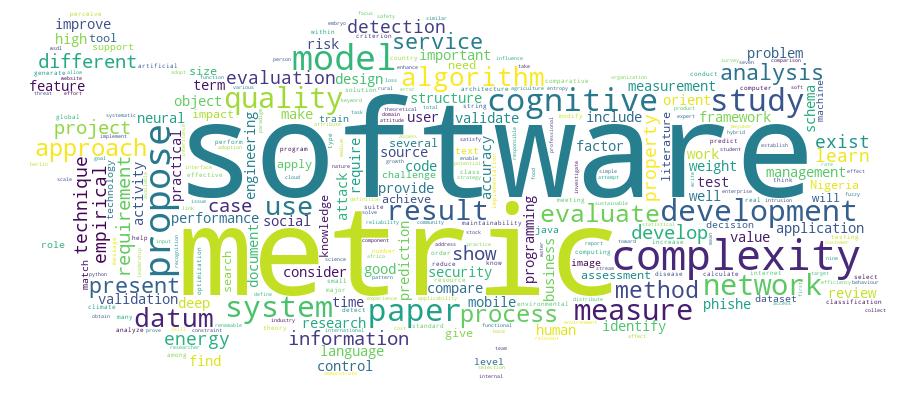
59 results
Scholarly Output Search Results
Now showing 1 - 10 of 59
Conference Object Citation - Scopus: 3A Discussion on Is and Software Measurement Terminology Flexibility as an Example(Institute of Electrical and Electronics Engineers Inc., 2010) Pusatli,O.T.; Misra,S.Closeness in meaning of the terms in the information systems and software engineering May result in discussion of using proper affiliated terms while covering the scope of research. An example is touched in this exploratory study, which discusses flexibility and its affiliated terms: changeability, adaptability, compatibility, flexibility, expandability, extendibility, extensibility and portability. A risk of misinterpretation due to the variety of the usage of the term is noted whereas the adoption of the term has shown that the literature does not have such examples to a serious level; but this review informs about missing discussions in the research reports in the literature due to omitting or ignoring affiliated terms of the keywords. Another product of this paper is to provide basis for future studies in the flexibility as a quality factor in the software measurement. © 2010 IEEE.Conference Object Comparative Study of Cognitive Complexity Measures(Ieee, 2008) Misra, Sanjay; Mısra, Sanjay; Akman, Ibrahim; Akman, Kamil İbrahim; Mısra, Sanjay; Akman, Kamil İbrahim; Computer Engineering; Computer EngineeringComplexity metrics are used to predict critical information about reliability and maintainability of software systems. Cognitive complexity measure based on cognitive informatics, plays an important role in understanding the fundamental characteristics of software, therefore directly affects the understandability and maintainability of software systems. In this paper, we compared available cognitive complexity measures and evaluated cognitive weight complexity measure in terms of Weyuker's properties.Conference Object Citation - Scopus: 4Effective Project Leadership in Computer Science and Engineering(Springer-Verlag Berlin, 2009) Cafer,F.; Misra,S.Project leaders are the most important individuals in projects. A project leader should follow some thinking styles and values which can lead his or her team to success. There is a common notion among software specialists that the more complex a project manager thinks, the better his leadership is. In this paper, we discuss the significance of simple thinking in project leadership. If the leader thinks in a simple way, then the risk of being suffocated in details is less. Complex thinking brings out greater risks of losing the general control of the system because of spending too much time and effort on details and, as a result, more confusion. Not only simplicity, but also psychological factors are important in guiding teams and developing projects in the most effective way. Here, we present a set of qualities for a good project leader in software engineering. In addition to that, we also demonstrate how cognitive and ethical issues affect leadership qualities. © 2009 Springer Berlin Heidelberg.Conference Object Citation - Scopus: 23Modified cognitive complexity measure(Springer Verlag, 2006) Misra,S.In cognitive functional size measure, the functional size is proportional to weighted cognitive complexity of all internal BCS's and number of input and output. This paper proposes the modification in cognitive functional size complexity measure. The proposed complexity measure is proportional to total occurrence of operators and operands and all internal BCS's. The operators and operands are equally important in design consideration. Thus, the contribution of the operators, operands and cognitive aspects complete the definition of a complexity measure in terms of cognitive. Accordingly, a new formula is developed for calculating the modified cognitive complexity measure. An attempt has also been made to evaluate modified cognitive complexity measure in terms of nine Weyuker's properties, through examples. It has been found that seven of nine Weyuker's properties have been satisfied by the modified cognitive complexity measure and hence establishes as a well-structured one. © Springer-Verlag Berlin Heidelberg 2006.Conference Object Citation - Scopus: 3A Multi-Paradigm Complexity Metric (mcm)(2011) Misra,S.; Akman,I.; Cafer,F.Huge amount of researches and software metrics have been proposed for procedural and object-oriented languages. However, there are only few metrics available in the literature related with multi-paradigm programming languages. In this paper, we propose a metric to evaluate the code written in multi-paradigm language. Our proposed metric can be used for most of the programming paradigms, including both procedural and object-oriented languages. © 2011 Springer-Verlag.Conference Object Citation - Scopus: 67A Step by Step Guide for Choosing Project Topics and Writing Research Papers in Ict Related Disciplines(Springer Science and Business Media Deutschland GmbH, 2021) Misra,S.ICT is fast-growing and changing field. A lot of researches are being done in various area of ICT, and results are presented in various platforms like conferences, journal and books. This is common observations in the publications from developing countries (especially in sub – Saharan africa) are not being published in reputed and established publishers even their technical/experiments are good. This is due to lack of several factors including professional presentation, the novelty of the topic, quality of literature review etc. This work guides final year bachelor’s students, PG students (masters and PhD) and young researchers, especially working in computing-related disciplines, on how to convert their project works into quality publications. The authors provide details on how these researchers can select suitable project topics, do a proper review, write up the key components of a paper and present their results in an appropriate form (that is, writing style starting from abstract to conclusion). This paper also presents and guides on how to write various types of review papers. © 2020, Springer Nature Switzerland AG.Conference Object Citation - Scopus: 9A unique complexity metric(Springer-Verlag Berlin, 2008) Misra,S.; Akman,I.Metrics, in general, are defined as "a quantitative measure of the degree to which a system, component, or process possesses a given attribute". Complexity metrics are used to predict critical information about reliability and maintainability of software systems. This paper proposes complexity metric, which includes all major factors responsible for complexity. We validated our metric against the principles of measurement theory since the measurement theory has been proposed and extensively used in the literature as a means to evaluate the software engineering metrics. The scale of the metric is investigated through Extensive structure. It is found that the proposed measure is on ratio scale. The applicability of the proposed measure is tested through test cases and comparative study. © 2008 Springer-Verlag Berlin Heidelberg.Conference Object Citation - Scopus: 13Predicting Web Service Maintainability Via Object-Oriented Metrics: a Statistics-Based Approach(2012) Coscia,J.L.O.; Crasso,M.; Mateos,C.; Zunino,A.; Misra,S.The Service-Oriented Computing paradigm enables the construction of distributed systems by assembling loosely coupled pieces of software called services, which have clear interfaces to their functionalities. Service interface descriptions have many aspects, such as complexity and quality, all of which can be measured. This paper presents empirical evidence showing that services interfaces maintainability can be predicted by applying traditional software metrics in service implementations. A total of 11 source code level metrics and 5 service interface metrics have been statistically correlated using 154 real world services. © 2012 Springer-Verlag.Conference Object Citation - Scopus: 4An Improved Feature Selection Method for Short Text Classification(Institute of Physics Publishing, 2019) Abayomi-Alli,O.; Misra,S.; Matthews,V.O.; Odusami,M.; Abayomi-Alli,A.; Ahuja,R.; Maskeliunas,R.Text has become one of the widest means of communication on mobile devices due to cheap rate and convenience for instance short text, web document, emails, instant messages. The exponential growth of text documents shared among users globally has increased the threat of misclassification associated with mobile devices such as Spam, Phishing, License to kill, Malware and privacy issues. Existing studies have shown that the major problem associated with text message classification is the poor representation of feature thus reducing accuracy and increasing f-measure rate. Thus, a modified Genetic Algorithm (GA) for improve feature selection and Artificial Immune System (AIS) algorithm was proposed for effective text classification in mobile short messages. The system will be deployed on an Android OS. © 2019 Published under licence by IOP Publishing Ltd.Conference Object A unique complexity metric(2008) Misra,S.; Akman,I.Metrics, in general, are defined as "a quantitative measure of the degree to which a system, component, or process possesses a given attribute". Complexity metrics are used to predict critical information about reliability and maintainability of software systems. This paper proposes complexity metric, which includes all major factors responsible for complexity. We validated our metric against the principles of measurement theory since the measurement theory has been proposed and extensively used in the literature as a means to evaluate the software engineering metrics. The scale of the metric is investigated through Extensive structure. It is found that the proposed measure is on ratio scale. The applicability of the proposed measure is tested through test cases and comparative study. © 2008 Springer-Verlag Berlin Heidelberg.
