
Mısra, Sanjay
Loading...

Profile URL
Name Variants
M.,Sanjay
Misra, Sanjay
Mısra,S.
Mısra, Sanjay
Misra,S.
S.,Misra
Sanjay, Mısra
Sanjay, Misra
S., Misra
S.,Mısra
M., Sanjay
Misra, S.
Misra, Sanjay
Mısra,S.
Mısra, Sanjay
Misra,S.
S.,Misra
Sanjay, Mısra
Sanjay, Misra
S., Misra
S.,Mısra
M., Sanjay
Misra, S.
Job Title
Profesör Doktor
Email Address
sanjay.misra@atilim.edu.tr
Main Affiliation
Computer Engineering
Status
Website
ORCID ID
Scopus Author ID
Turkish CoHE Profile ID
Google Scholar ID
WoS Researcher ID
Sustainable Development Goals
 1
1NO POVERTY
3
Research Products
 2
2ZERO HUNGER
5
Research Products
 3
3GOOD HEALTH AND WELL-BEING
2
Research Products
 4
4QUALITY EDUCATION
6
Research Products
 5
5GENDER EQUALITY
2
Research Products
 6
6CLEAN WATER AND SANITATION
1
Research Products
 7
7AFFORDABLE AND CLEAN ENERGY
8
Research Products
 8
8DECENT WORK AND ECONOMIC GROWTH
11
Research Products
 9
9INDUSTRY, INNOVATION AND INFRASTRUCTURE
11
Research Products
 10
10REDUCED INEQUALITIES
2
Research Products
 11
11SUSTAINABLE CITIES AND COMMUNITIES
1
Research Products
 12
12RESPONSIBLE CONSUMPTION AND PRODUCTION
3
Research Products
 13
13CLIMATE ACTION
7
Research Products
 14
14LIFE BELOW WATER
10
Research Products
 15
15LIFE ON LAND
0
Research Products
 16
16PEACE, JUSTICE AND STRONG INSTITUTIONS
4
Research Products
 17
17PARTNERSHIPS FOR THE GOALS
9
Research Products

This researcher does not have a Scopus ID.

This researcher does not have a WoS ID.

Scholarly Output
199
Articles
133
Views / Downloads
686/271
Supervised MSc Theses
3
Supervised PhD Theses
0
WoS Citation Count
2629
Scopus Citation Count
3894
Patents
0
Projects
0
WoS Citations per Publication
13.21
Scopus Citations per Publication
19.57
Open Access Source
53
Supervised Theses
3
| Journal | Count |
|---|---|
| Acta Polytechnica Hungarica | 12 |
| Tehnicki Vjesnik | 8 |
| Lecture Notes in Computer Science (including subseries Lecture Notes in Artificial Intelligence and Lecture Notes in Bioinformatics) -- 2011 International Conference on Computational Science and Its Applications, ICCSA 2011 -- 20 June 2011 through 23 June 2011 -- Santander -- 85480 | 5 |
| Journal of Physics: Conference Series -- 3rd International Conference on Computing and Applied Informatics 2018, ICCAI 2018 -- 18 September 2018 through 19 September 2018 -- Medan, Sumatera Utara -- 149865 | 4 |
| Lecture Notes in Computer Science (including subseries Lecture Notes in Artificial Intelligence and Lecture Notes in Bioinformatics) -- 12th International Conference on Computational Science and Its Applications, ICCSA 2012 -- 18 June 2012 through 21 June 2012 -- Salvador de Bahia -- 90945 | 4 |
Current Page: 1 / 22
Scopus Quartile Distribution
Competency Cloud
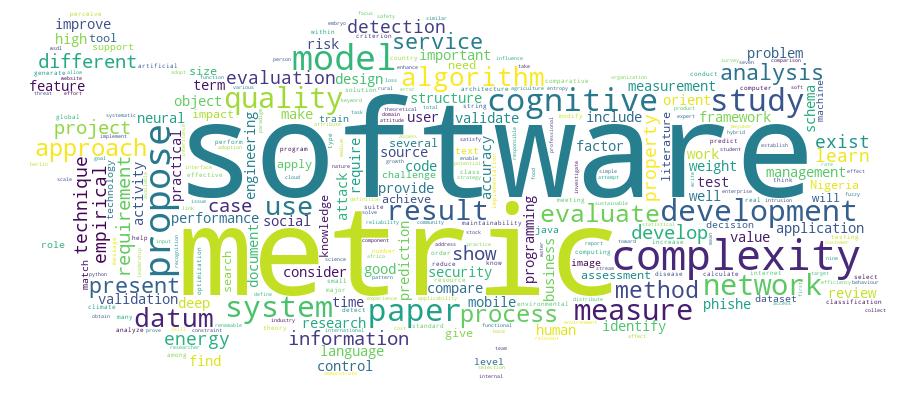
157 results
Scholarly Output Search Results
Now showing 1 - 10 of 157
Conference Object Citation - Scopus: 7Measuring Complexity of Object Oriented Programs(2008) Mısra, Sanjay; Misra,S.; Akman,I.; Mısra, Sanjay; Computer Engineering; Computer EngineeringIn this paper, a metric for object oriented language is formulated and validated. On the contrary of the other metrics used for object oriented programming (OOPs), the proposed metric calculates the complexity of a class at method level and hence considers the internal architecture of the classes, subclasses and member functions. The proposed metric is evaluated against Weyuker's proposed set of measurement principles through examples and validated through experimentation, case study and comparative study with similar measures. The practical usefulness of the metric is evaluated by a practical framework. © 2008 Springer-Verlag Berlin Heidelberg.Article Citation - WoS: 11Citation - Scopus: 17Software Measurement Activities in Small and Medium Enterprises: an Empirical Assessment(Budapest Tech, 2011) Pusatli, O. Tolga; Misra, Sanjay; Tolga Pusatli, O.; Computer EngineeringAn empirical study for evaluating the proper implementation of measurement/metric programs in software companies in one area of Turkey is presented. The research questions are discussed and validated with the help of senior software managers (more than 15 years' experience) and then used for interviewing a variety of medium and small scale software companies in Ankara. Observations show that there is a common reluctance/lack of interest in utilizing measurements/metrics despite the fact that they are well known in the industry. A side product of this research is that internationally recognized standards such as ISO and CMMI are pursued if they are a part of project/job requirements; without these requirements, introducing those standards to the companies remains as a long-term target to increase quality.Review Citation - WoS: 3Citation - Scopus: 9An Empirical Evaluation of Software Quality Assurance Practices and Challenges in a Developing Country: a Comparison of Nigeria and Turkey(Springer international Publishing Ag, 2016) Sowunmi, Olaperi Yeside; Mısra, Sanjay; Misra, Sanjay; Fernandez-Sanz, Luis; Crawford, Broderick; Soto, Ricardo; Mısra, Sanjay; Computer Engineering; Computer EngineeringBackground: The importance of quality assurance in the software development process cannot be overemphasized because its adoption results in high reliability and easy maintenance of the software system and other software products. Software quality assurance includes different activities such as quality control, quality management, quality standards, quality planning, process standardization and improvement amongst others. The aim of this work is to further investigate the software quality assurance practices of practitioners in Nigeria. While our previous work covered areas on quality planning, adherence to standardized processes and the inherent challenges, this work has been extended to include quality control, software process improvement and international quality standard organization membership. It also makes comparison based on a similar study carried out in Turkey. The goal is to generate more robust findings that can properly support decision making by the software community. The qualitative research approach, specifically, the use of questionnaire research instruments was applied to acquire data from software practitioners. Results: In addition to the previous results, it was observed that quality assurance practices are quite neglected and this can be the cause of low patronage. Moreover, software practitioners are neither aware of international standards organizations or the required process improvement techniques; as such their claimed standards are not aligned to those of accredited bodies, and are only limited to their local experience and knowledge, which makes it questionable. The comparison with Turkey also yielded similar findings, making the results typical of developing countries. The research instrument used was tested for internal consistency using the Cronbach's alpha, and it was proved reliable. Conclusion: For the software industry in developing countries to grow strong and be a viable source of external revenue, software assurance practices have to be taken seriously because its effect is evident in the final product. Moreover, quality frameworks and tools which require minimum time and cost are highly needed in these countries.Article Citation - WoS: 8Citation - Scopus: 10Cobol Systems Migration To Soa: Assessing Antipatterns and Complexity(Kaunas Univ Technology, 2019) Mateos, Cristian; Zunino, Alejandro; Flores, Andres; Misra, SanjaySOA and Web Services allow users to easily expose business functions to build larger distributed systems. However, legacy systems - mostly in COBOL - are left aside unless applying a migration approach. The main approaches are direct and indirect migration. The former implies wrapping COBOL programs with a thin layer of a Web Service oriented language/platform. The latter needs reengineering COBOL functions to a modern language/platform. In our previous work, we presented an intermediate approach based on direct migration where developed Web Services are later refactored to improve the quality of their interfaces. Refactorings mainly capture good practices inherent to indirect migration. For this, antipatterns for WSDL documents (common bad practices) are detected to prevent issues related to WSDLs understanding and discoverability. In this paper, we assess antipatterns of Web Services' WSDL documents generated upon the three migration approaches. In addition, generated Web Services' interfaces are measured in complexity to attend both comprehension and interoperability. We apply a metric suite (by Baski & Misra) to measure complexity on services interfaces - i.e., WSDL documents. Migrations of two real COBOL systems upon the three approaches were assessed on antipatterns evidences and the complexity level of the generated SOA frontiers - a total of 431 WSDL documents.Article Citation - WoS: 6Citation - Scopus: 9Experimental Simulation-Based Performance Evaluation of an Sms-Based Emergency Geolocation Notification System(Hindawi Ltd, 2017) Osebor, Isibor; Misra, Sanjay; Omoregbe, Nicholas; Adewumi, Adewole; Fernandez-Sanz, LuisIn an emergency, a prompt response can save the lives of victims. This statement generates an imperative issue in emergency medical services (EMS). Designing a system that brings simplicity in locating emergency scenes is a step towards improving response time. This paper therefore implemented and evaluated the performance of an SMS-based emergency geolocation notification system with emphasis on its SMS delivery time and the system's geolocation and dispatch time. Using the RAS metrics recommended by IEEE for evaluation, the designed system was found to be efficient and effective as its reliability stood within 62.7% to 70.0% while its availability stood at 99% with a downtime of 3.65 days/year.Conference Object Citation - WoS: 1Plagiarism Detection in Software Using Efficient String Matching(Springer-verlag Berlin, 2012) Pandey, Kusum Lata; Agarwal, Suneeta; Misra, Sanjay; Prasad, RajeshString matching refers to the problem of finding occurrence(s) of a pattern string within another string or body of a text. It plays a vital role in plagiarism detection in software codes, where it is required to identify similar program in a large populations. String matching has been used as a tool in a software metrics, which is used to measure the quality of software development process. In the recent years, many algorithms exist for solving the string matching problem. Among them, Berry-Ravindran algorithm was found to be fairly efficient. Further refinement of this algorithm is made in TVSBS and SSABS algorithms. However, these algorithms do not give the best possible shift in the search phase. In this paper, we propose an algorithm which gives the best possible shift in the search phase and is faster than the previously known algorithms. This algorithm behaves like Berry-Ravindran in the worst case. Further extension of this algorithm has been made for parameterized string matching which is able to detect plagiarism in a software code.Conference Object Citation - Scopus: 22An Improved Model for Alleviating Layer Seven Distributed Denial of Service Intrusion on Webserver(Institute of Physics Publishing, 2019) Odusami,M.; Misra,S.; Adetiba,E.; Abayomi-Alli,O.; Damasevicius,R.; Ahuja,R.Application layer or Layer Seven Distributed Denial of service (L7DDoS) intrusion is one of the greatest threats that intrusion a webserver. The hackers have different motives which could be for Extortion, Exfiltration e.t.c Researchers have employed several methods to prevent L7DDoS intrusion especially using machine learning. Although Machine learning techniques has proven to be very effective with high detection accuracy, the approach still find it difficult to detect Hyper Text Transfer Protocol (HTTP) based botnet traffic on web server with high false positive rate. The adoption of deep learning based technique using Long Short Term Memory (LSTM) will alleviate this problem. © 2019 Published under licence by IOP Publishing Ltd.Conference Object Comparative Study of Cognitive Complexity Measures(Ieee, 2008) Misra, Sanjay; Mısra, Sanjay; Akman, Ibrahim; Akman, Kamil İbrahim; Mısra, Sanjay; Akman, Kamil İbrahim; Computer Engineering; Computer EngineeringComplexity metrics are used to predict critical information about reliability and maintainability of software systems. Cognitive complexity measure based on cognitive informatics, plays an important role in understanding the fundamental characteristics of software, therefore directly affects the understandability and maintainability of software systems. In this paper, we compared available cognitive complexity measures and evaluated cognitive weight complexity measure in terms of Weyuker's properties.Conference Object A Model for Measuring Cognitive Complexity of Software(Springer Verlag, 2008) Misra,S.; Akman,I.This paper proposes a model for calculating cognitive complexity of a code. This model considers all major factors responsible for (cognitive) complexity. The practical applicability of the measure is evaluated through experimentation, test cases and comparative study. © 2008 Springer-Verlag Berlin Heidelberg.Article Citation - WoS: 38Citation - Scopus: 59Career Abandonment Intentions among Software Workers(Wiley, 2014) Colomo-Palacios, Ricardo; Casado-Lumbreras, Cristina; Misra, Sanjay; Soto-Acosta, PedroWithin the software development industry, human resources have been recognized as one of the most decisive and scarce resources. Today, the retention of skilled IT (information technology) personnel is a major issue for employers and recruiters as well, since IT career abandonment is a common practice and means not only the loss of personnel, knowledge, and skills, but also the loss of business opportunities. This article seeks to discover the main motivations young practitioners abandon the software career. To achieve this objective, two studies were conducted. The first study was qualitative (performed through semistructured interviews) and intended to discover the main variables affecting software career abandonment. The second study was quantitative, consisting of a Web-based survey developed from the output of the first study and administered to a sample of 148 IT practitioners. Results show that work-related, psychological, and emotional variable are the most relevant group of variables explaining IT career abandonment. More specifically, the three most important variables that motivate employees to abandon the career are effort-reward imbalance, perceived workload, and emotional exhaustion. In contrast, variables such as politics and infighting, uncool work, and insufficient resources influence to a lesser extent the decision to leave the career. (c) 2012 Wiley Periodicals, Inc.
