Mısra, Sanjay

Loading...
Profile Picture
Name Variants
M.,Sanjay
Misra, Sanjay
Mısra,S.
Mısra, Sanjay
Misra,S.
S.,Misra
Sanjay, Mısra
Sanjay, Misra
S., Misra
S.,Mısra
M., Sanjay
Misra, S.
Job Title
Profesör Doktor
Email Address
sanjay.misra@atilim.edu.tr
Main Affiliation
Computer Engineering
Status
Website
ORCID ID
Scopus Author ID
Turkish CoHE Profile ID
Google Scholar ID
WoS Researcher ID

Sustainable Development Goals

NO POVERTY1
NO POVERTY
3
Research Products
ZERO HUNGER2
ZERO HUNGER
5
Research Products
GOOD HEALTH AND WELL-BEING3
GOOD HEALTH AND WELL-BEING
2
Research Products
QUALITY EDUCATION4
QUALITY EDUCATION
6
Research Products
GENDER EQUALITY5
GENDER EQUALITY
2
Research Products
CLEAN WATER AND SANITATION6
CLEAN WATER AND SANITATION
1
Research Products
AFFORDABLE AND CLEAN ENERGY7
AFFORDABLE AND CLEAN ENERGY
8
Research Products
DECENT WORK AND ECONOMIC GROWTH8
DECENT WORK AND ECONOMIC GROWTH
11
Research Products
INDUSTRY, INNOVATION AND INFRASTRUCTURE9
INDUSTRY, INNOVATION AND INFRASTRUCTURE
11
Research Products
REDUCED INEQUALITIES10
REDUCED INEQUALITIES
2
Research Products
SUSTAINABLE CITIES AND COMMUNITIES11
SUSTAINABLE CITIES AND COMMUNITIES
1
Research Products
RESPONSIBLE CONSUMPTION AND PRODUCTION12
RESPONSIBLE CONSUMPTION AND PRODUCTION
3
Research Products
CLIMATE ACTION13
CLIMATE ACTION
7
Research Products
LIFE BELOW WATER14
LIFE BELOW WATER
10
Research Products
LIFE ON LAND15
LIFE ON LAND
0
Research Products
PEACE, JUSTICE AND STRONG INSTITUTIONS16
PEACE, JUSTICE AND STRONG INSTITUTIONS
4
Research Products
PARTNERSHIPS FOR THE GOALS17
PARTNERSHIPS FOR THE GOALS
9
Research Products
This researcher does not have a Scopus ID.
This researcher does not have a WoS ID.
Scholarly Output

199

Articles

133

Views / Downloads

63/0

Supervised MSc Theses

3

Supervised PhD Theses

0

WoS Citation Count

2629

Scopus Citation Count

3894

Patents

0

Projects

0

WoS Citations per Publication

13.21

Scopus Citations per Publication

19.57

Open Access Source

53

Supervised Theses

3

JournalCount
Acta Polytechnica Hungarica12
Tehnicki Vjesnik8
Lecture Notes in Computer Science (including subseries Lecture Notes in Artificial Intelligence and Lecture Notes in Bioinformatics) -- 2011 International Conference on Computational Science and Its Applications, ICCSA 2011 -- 20 June 2011 through 23 June 2011 -- Santander -- 854805
Journal of Physics: Conference Series -- 3rd International Conference on Computing and Applied Informatics 2018, ICCAI 2018 -- 18 September 2018 through 19 September 2018 -- Medan, Sumatera Utara -- 1498654
Lecture Notes in Computer Science (including subseries Lecture Notes in Artificial Intelligence and Lecture Notes in Bioinformatics) -- 12th International Conference on Computational Science and Its Applications, ICCSA 2012 -- 18 June 2012 through 21 June 2012 -- Salvador de Bahia -- 909454
Current Page: 1 / 22

Scopus Quartile Distribution

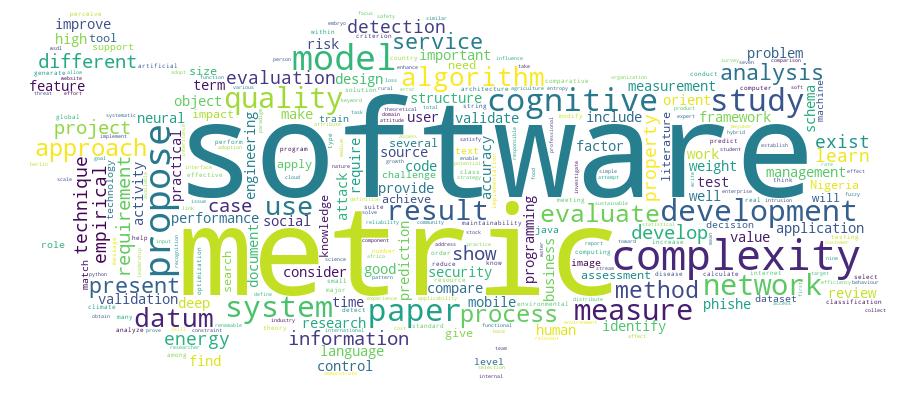
Competency Cloud

GCRIS Competency Cloud

Scholarly Output Search Results

Now showing 1 - 10 of 36
  • Conference Object
    Measuring Complexity of Object Oriented Programs
    (Springer-Verlag Berlin, 2008) Misra,S.; Akman,I.
    In this paper, a metric for object oriented language is formulated and validated. On the contrary of the other metrics used for object oriented programming (OOPs), the proposed metric calculates the complexity of a class at method level and hence considers the internal architecture of the classes, subclasses and member functions. The proposed metric is evaluated against Weyuker's proposed set of measurement principles through examples and validated through experimentation, case study and comparative study with similar measures. The practical usefulness of the metric is evaluated by a practical framework. © 2008 Springer-Verlag Berlin Heidelberg.
  • Conference Object
    Citation - WoS: 1
    A Cognitive Evaluation for Meetings in Software Development Process
    (Springer-verlag Berlin, 2009) Misra, Sanjay; Akman, Ibrahim
    Software development; includes number of different type of meetings in the whole development process. The cognitive activities also play an important role in decision making activities in these meetings since they are carried out, by human being. In this paper, we evaluated the relevance of meetings in different phases of the software development process with reference to cognitive aspects.
  • Conference Object
    Citation - WoS: 3
    Effective Project Leadership in Computer Science and Engineering
    (Springer-verlag Berlin, 2009) Cafer, Ferid; Misra, Sanjay
    Project leaders are the most important individuals in projects. A project leader should follow some thinking styles and values which can lead his or her team to success. There is a common notion among software specialists that the more complex a project manager thinks, the better his leadership is. In this paper, we discuss the significance of simple thinking in project leadership. If the leader thinks in a simple way, then the risk of being suffocated in details is less. Complex thinking brings out greater risks of losing the general control of the system because of spending too much time and effort on details and, as a result, more confusion. Not only simplicity, but also psychological factors are important in guiding teams and developing projects in the most effective way. Here, we present a set of qualities for a good project leader in software engineering. In addition to that, we also demonstrate how cognitive and ethical issues affect leadership qualities.
  • Conference Object
    Citation - Scopus: 6
    Weyuker's Properties, Language Independency and Object Oriented Metrics
    (2009) Misra,S.
    Weyuker proposed the nine properties to evaluate software complexity measures at a time when procedural languages were dominant; however, several researchers have used these properties to evaluate object oriented metrics although the object-oriented (OO) features are entirely different in nature. In this paper, we evaluate each of Weyuker's properties for its effective evaluation and relevance for OO metrics. In addition, we evaluate eleven OO metrics against language independency and additive property. A set of additional properties for object oriented metrics are also summarized in this paper. © 2009 Springer Berlin Heidelberg.
  • Conference Object
    Weak Measurement Theory and Modified Cognitive Complexity Measure
    (insticc-inst Syst Technologies information Control & Communication, 2007) Misra, Sanjay; Kilic, Huerevren; Computer Engineering
    Measurement is one of the problems in the area of software engineering. Since traditional measurement theory has a major problem in defining empirical observations on software entities in terms of their measured quantities, Morasca has tried to solve this problem by proposing Weak Measurement theory. In this paper, we tried to evaluate the applicability of weak measurement theory by applying it on a newly proposed Modified Cognitive Complexity Measure (MCCM). We also investigated the applicability of Weak Extensive Structure for deciding on the type of scale for MCCM. It is observed that the MCCM is on weak ratio scale.
  • Conference Object
    Comparative Study of Cognitive Complexity Measures
    (Ieee, 2008) Misra, Sanjay; Mısra, Sanjay; Akman, Ibrahim; Akman, Kamil İbrahim; Mısra, Sanjay; Akman, Kamil İbrahim; Computer Engineering; Computer Engineering
    Complexity metrics are used to predict critical information about reliability and maintainability of software systems. Cognitive complexity measure based on cognitive informatics, plays an important role in understanding the fundamental characteristics of software, therefore directly affects the understandability and maintainability of software systems. In this paper, we compared available cognitive complexity measures and evaluated cognitive weight complexity measure in terms of Weyuker's properties.
  • Conference Object
    Citation - WoS: 1
    Error Density Metrics for Business Process Model
    (Ieee, 2009) Tonbul, Gokcen; Misra, Sanjay
    In this paper, metrics for business process model (BPM), are proposed, which are capable to measure the usability and effectiveness of BPMs. The proposed model is adapting error density metrics to BPMs by considering the similarities between the conceptual characteristics of BPMs and software products. We applied seven software metrics for evaluating quality of business processes/process models. Results show that our metrics help the organization to improve their process, as weighted measurements are indicators for unexpected situations/behaviour for business processes.
  • Conference Object
    Citation - WoS: 3
    Measuring Complexity of Object Oriented Programs
    (Springer-verlag Berlin, 2008) Misra, Sanjay; Akman, Ibrahim
    In this paper, a metric for object oriented language is formulated and validated. On the contrary of the other metrics used for object oriented programming (OOPS), the proposed metric calculates the complexity of a class at method level and hence considers the internal architecture of the classes, subclasses and member functions. The proposed metric is evaluated against Weyuker's proposed set of measurement principles through examples and validated through experimentation, case study and comparative study with similar measures. The practical usefulness of the metric is evaluated by a practical framework.
  • Conference Object
    Citation - WoS: 3
    A Cognitive Requirement Specification Model
    (Ieee, 2009) Cafer, Ferid; Misra, Sanjay
    Eliciting/Gathering information from the customers in requirement phase is the most crucial task in the development of the software development process, because this phase builds the base for the success or failure of any software product. Requirements specification process highly depends on the knowledge and mental abilities of the customers. In this paper, we are proposing a cognitive requirement specification model based on the cognitive classification of customers.
  • Conference Object
    Citation - WoS: 16
    Modified Cognitive Complexity Measure
    (Springer-verlag Berlin, 2006) Misra, Sanjay
    In cognitive functional size measure, the functional size is proportional to weighted cognitive complexity of all internal BCS's and number of input and output. This paper proposes the modification in cognitive functional size complexity measure. The proposed complexity measure is proportional to total occurrence of operators and operands and all internal BCS's. The operators and operands are equally important in design consideration. Thus, the contribution of the operators, operands and cognitive aspects complete the definition of a complexity measure in terms of cognitive. Accordingly, a new formula is developed for calculating the modified cognitive complexity measure. An attempt has also been made to evaluate modified cognitive complexity measure in terms of nine Weyuker's properties, through examples. It has been found that seven of nine Weyuker's properties have been satisfied by the modified cognitive complexity measure and hence establishes as a well-structured one.