Mısra, Sanjay

Loading...
Profile Picture
Name Variants
M.,Sanjay
Misra, Sanjay
Mısra,S.
Mısra, Sanjay
Misra,S.
S.,Misra
Sanjay, Mısra
Sanjay, Misra
S., Misra
S.,Mısra
M., Sanjay
Misra, S.
Job Title
Profesör Doktor
Email Address
sanjay.misra@atilim.edu.tr
Main Affiliation
Computer Engineering
Status
Website
ORCID ID
Scopus Author ID
Turkish CoHE Profile ID
Google Scholar ID
WoS Researcher ID

Sustainable Development Goals

NO POVERTY1
NO POVERTY
3
Research Products
ZERO HUNGER2
ZERO HUNGER
5
Research Products
GOOD HEALTH AND WELL-BEING3
GOOD HEALTH AND WELL-BEING
2
Research Products
QUALITY EDUCATION4
QUALITY EDUCATION
6
Research Products
GENDER EQUALITY5
GENDER EQUALITY
2
Research Products
CLEAN WATER AND SANITATION6
CLEAN WATER AND SANITATION
1
Research Products
AFFORDABLE AND CLEAN ENERGY7
AFFORDABLE AND CLEAN ENERGY
8
Research Products
DECENT WORK AND ECONOMIC GROWTH8
DECENT WORK AND ECONOMIC GROWTH
11
Research Products
INDUSTRY, INNOVATION AND INFRASTRUCTURE9
INDUSTRY, INNOVATION AND INFRASTRUCTURE
11
Research Products
REDUCED INEQUALITIES10
REDUCED INEQUALITIES
2
Research Products
SUSTAINABLE CITIES AND COMMUNITIES11
SUSTAINABLE CITIES AND COMMUNITIES
1
Research Products
RESPONSIBLE CONSUMPTION AND PRODUCTION12
RESPONSIBLE CONSUMPTION AND PRODUCTION
3
Research Products
CLIMATE ACTION13
CLIMATE ACTION
7
Research Products
LIFE BELOW WATER14
LIFE BELOW WATER
10
Research Products
LIFE ON LAND15
LIFE ON LAND
0
Research Products
PEACE, JUSTICE AND STRONG INSTITUTIONS16
PEACE, JUSTICE AND STRONG INSTITUTIONS
4
Research Products
PARTNERSHIPS FOR THE GOALS17
PARTNERSHIPS FOR THE GOALS
9
Research Products
This researcher does not have a Scopus ID.
This researcher does not have a WoS ID.
Scholarly Output

199

Articles

133

Views / Downloads

719/275

Supervised MSc Theses

3

Supervised PhD Theses

0

WoS Citation Count

2781

Scopus Citation Count

4091

Patents

0

Projects

0

WoS Citations per Publication

13.97

Scopus Citations per Publication

20.56

Open Access Source

53

Supervised Theses

3

JournalCount
Acta Polytechnica Hungarica12
Tehnicki Vjesnik8
Lecture Notes in Computer Science (including subseries Lecture Notes in Artificial Intelligence and Lecture Notes in Bioinformatics) -- 2011 International Conference on Computational Science and Its Applications, ICCSA 2011 -- 20 June 2011 through 23 June 2011 -- Santander -- 854805
Journal of Physics: Conference Series -- 3rd International Conference on Computing and Applied Informatics 2018, ICCAI 2018 -- 18 September 2018 through 19 September 2018 -- Medan, Sumatera Utara -- 1498654
Lecture Notes in Computer Science (including subseries Lecture Notes in Artificial Intelligence and Lecture Notes in Bioinformatics) -- 12th International Conference on Computational Science and Its Applications, ICCSA 2012 -- 18 June 2012 through 21 June 2012 -- Salvador de Bahia -- 909454
Current Page: 1 / 22

Scopus Quartile Distribution

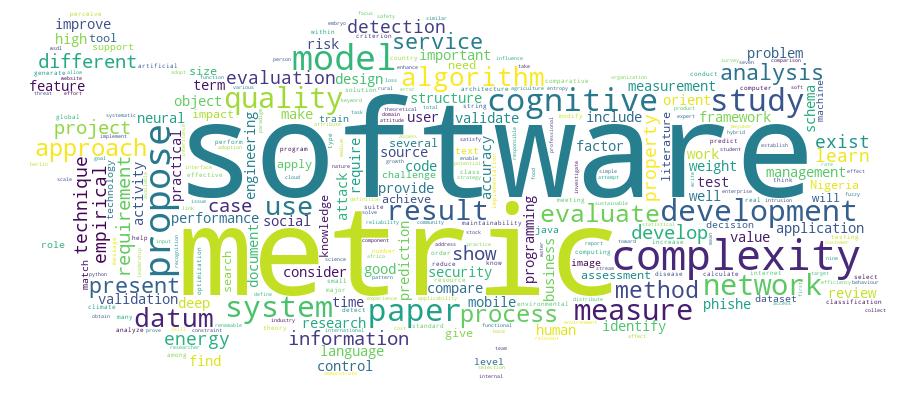
Competency Cloud

GCRIS Competency Cloud

Scholarly Output Search Results

Now showing 1 - 1 of 1
  • Article
    Citation - WoS: 13
    ASSESSING COGNITIVE COMPLEXITY IN JAVA-BASED OBJECT-ORIENTED SYSTEMS: METRICS AND TOOL SUPPORT
    (Slovak Acad Sciences inst informatics, 2016) Crasso, Marco; Mateos, Cristian; Zunino, Alejandro; Misra, Sanjay; Polvorin, Pablo
    Software cognitive complexity refers to how demanding the mental process of performing tasks such as coding, testing, debugging, or modifying source code is. Achieving low levels of cognitive complexity is crucial for ensuring high levels of software maintainability, which is one of the most rewardful software quality attributes. Therefore, in order to control and ensure software maintainability, it is first necessary to accurately quantify software cognitive complexity. In this line, this paper presents a software metric to assess cognitive complexity in Object Oriented (OO) systems, and particularly those developed in the Java language, which is very popular among OO programming languages. The proposed metric is based on a characterization of basic control structures present in Java systems. Several algorithms to compute the metric and their materialization in the Eclipse IDE are also introduced. Finally, a theoretical validation of the metric against a framework specially designed to validate software complexity metrics is presented, and the applicability of the tool is shown by illustrating the metric in the context of ten real world Java projects and relevant metrics from the well-known Chidamber-Kemerer metric suite.