Gökdoğan, Bengisu Yalçınkaya

Loading...
Profile Picture
Name Variants
Gökdoğan,B.Y.
G., Bengisu Yalçınkaya
G.,Bengisu Yalçınkaya
Gökdoğan B.
G., Bengisu Yalcinkaya
Gokdogan B.
B.,Gökdoğan
G.,Bengisu Yalcinkaya
Bengisu Yalcinkaya, Gokdogan
Gokdogan, Bengisu Yalcinkaya
B. Y. Gokdogan
Bengisu Yalçınkaya, Gökdoğan
B. Y. Gökdoğan
B.Y.Gökdoğan
Yalcinkaya B.
Gökdoğan, Bengisu Yalçınkaya
Gokdogan,B.Y.
B.Y.Gokdogan
Yalcinkaya, Bengisu
B., Gokdogan
Job Title
Araştırma Görevlisi
Email Address
bengisu.yalcinkaya@atilim.edu.tr
Main Affiliation
Electrical-Electronics Engineering
Status
Website
Scopus Author ID
Turkish CoHE Profile ID
Google Scholar ID
WoS Researcher ID

Sustainable Development Goals

SDG data is not available
Documents

14

Citations

39

h-index

4

Documents

14

Citations

30

Scholarly Output

14

Articles

9

Views / Downloads

64/48

Supervised MSc Theses

0

Supervised PhD Theses

0

WoS Citation Count

30

Scopus Citation Count

39

Patents

0

Projects

0

WoS Citations per Publication

2.14

Scopus Citations per Publication

2.79

Open Access Source

4

Supervised Theses

0

JournalCount
30th IEEE Signal Processing and Communications Applications Conference (SIU) -- MAY 15-18, 2022 -- Safranbolu, TURKEY2
Wireless Personal Communications2
Computer Applications in Engineering Education1
Electronics1
IEEE International Black Sea Conference on Communications and Networking (IEEE BlackSeaCom) -- MAY 24-28, 2021 -- ELECTR NETWORK1
Current Page: 1 / 3

Scopus Quartile Distribution

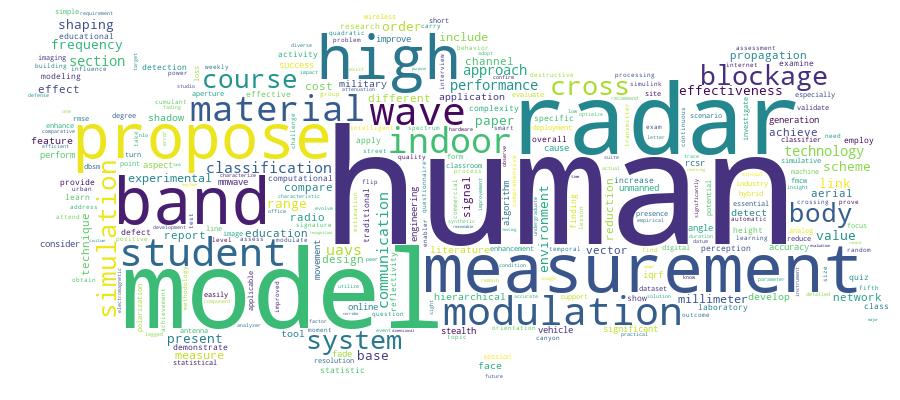
Competency Cloud

GCRIS Competency Cloud

Scholarly Output Search Results

Now showing 1 - 2 of 2
  • Article
    Low Signature UAVs: Radar Cross Section Analysis, Simulation, and Measurement in X-Band
    (Springer London Ltd, 2025) Unalir, Dizdar; Yalcinkaya, Bengisu; Aydin, Elif
    The increasing prevalence of unmanned aerial vehicles (UAVs) is driving the development of radar systems capable of detecting them. This hampers the deployment of UAVs in military operations. While radar cross section reduction (RCSR) can be a valuable solution, the research on this subject is inadequate. This paper presents an RCSR approach adopting a shaping technique for UAVs, demonstrating the proposed approach's efficacy through simulations and actual experimental measurements performed in X-Band on a four-legged UAV model. Using electromagnetic computational instruments, the shaping is applied to the designed UAV model with parameter-based simulations, the simulated radar cross section (RCS) values are derived, and the comparative analysis of these instruments is conducted. Experimental measurements are performed in laboratory conditions using a vector network analyzer. Actual measurement results are validated by simulative findings with the examination of the influence of frequency, polarization, and aspect angle on RCS. The demonstrated measuring approach allows cost-effective and easily applicable research on RCS in X-Band, a commonly utilized frequency range in military. An average RCSR of 10 dBsm has been accomplished with the presented shaping approach.
  • Conference Object
    Citation - WoS: 2
    Citation - Scopus: 2
    Radar Cross Section Studies of Low Signature UAVs in X-Band: Simulation, Measurement and Performance Evaluation
    (IEEE, 2024) Unalir, Dizdar; Gokdogan, Bengisu Yalcinkaya; Aydin, Elif
    In this study, the effectiveness of a radar cross section (RCS) reduction method based on a proposed shaping technique for four-legged unmanned aerial vehicles (UAV) has been proven with simulation tools and experimental measurements in X-Band. Simulative RCS values were obtained with CST and HFSS electromagnetic calculation tools, and the advantages of these tools compared to each other were examined. Experimental measurements were carried out in a laboratory environment with a vector network analyzer (VNA) and confirmed with simulation results. The effects of frequency, polarization and aspect angle factors on RCS were examined. It has been shown that with the proposed measurement method, low-cost and easily applicable RCS analysis can be performed in X-Band, one of the frequency bands frequently used in the defense industry. With the proposed shaping method, RCS reduction in the range of 5-10 dBsm was achieved.