
Turan, Mehmet
Loading...
Profile URL
Name Variants
T., Mehmet
Turan M.
M.,Turan
Turan,Mehmet
Mehmet, Turan
T.,Mehmet
Turan A.
Mehmet Turan
M., Turan
Turan, Mehmet
Turan,M.
Turan, M.
Turan M.
M.,Turan
Turan,Mehmet
Mehmet, Turan
T.,Mehmet
Turan A.
Mehmet Turan
M., Turan
Turan, Mehmet
Turan,M.
Turan, M.
Job Title
Profesör Doktor
Email Address
mehmet.turan@atilim.edu.tr
Main Affiliation
Mathematics
Status
Website
ORCID ID
Scopus Author ID
Turkish CoHE Profile ID
Google Scholar ID
WoS Researcher ID
Sustainable Development Goals
 1
1NO POVERTY
0
Research Products
 2
2ZERO HUNGER
0
Research Products
 3
3GOOD HEALTH AND WELL-BEING
1
Research Products
 4
4QUALITY EDUCATION
0
Research Products
 5
5GENDER EQUALITY
0
Research Products
 6
6CLEAN WATER AND SANITATION
0
Research Products
 7
7AFFORDABLE AND CLEAN ENERGY
0
Research Products
 8
8DECENT WORK AND ECONOMIC GROWTH
0
Research Products
 9
9INDUSTRY, INNOVATION AND INFRASTRUCTURE
0
Research Products
 10
10REDUCED INEQUALITIES
0
Research Products
 11
11SUSTAINABLE CITIES AND COMMUNITIES
0
Research Products
 12
12RESPONSIBLE CONSUMPTION AND PRODUCTION
0
Research Products
 13
13CLIMATE ACTION
0
Research Products
 14
14LIFE BELOW WATER
0
Research Products
 15
15LIFE ON LAND
0
Research Products
 16
16PEACE, JUSTICE AND STRONG INSTITUTIONS
0
Research Products
 17
17PARTNERSHIPS FOR THE GOALS
0
Research Products

This researcher does not have a Scopus ID.

This researcher does not have a WoS ID.

Scholarly Output
55
Articles
44
Views / Downloads
245/2928
Supervised MSc Theses
5
Supervised PhD Theses
2
WoS Citation Count
83
Scopus Citation Count
96
Patents
0
Projects
0
WoS Citations per Publication
1.51
Scopus Citations per Publication
1.75
Open Access Source
13
Supervised Theses
7
| Journal | Count |
|---|---|
| Mathematica Slovaca | 3 |
| Mathematical Methods in the Applied Sciences | 3 |
| Quaestiones Mathematicae | 2 |
| Results in Mathematics | 2 |
| Bulletin of the Malaysian Mathematical Sciences Society | 2 |
Current Page: 1 / 8
Scopus Quartile Distribution
Competency Cloud
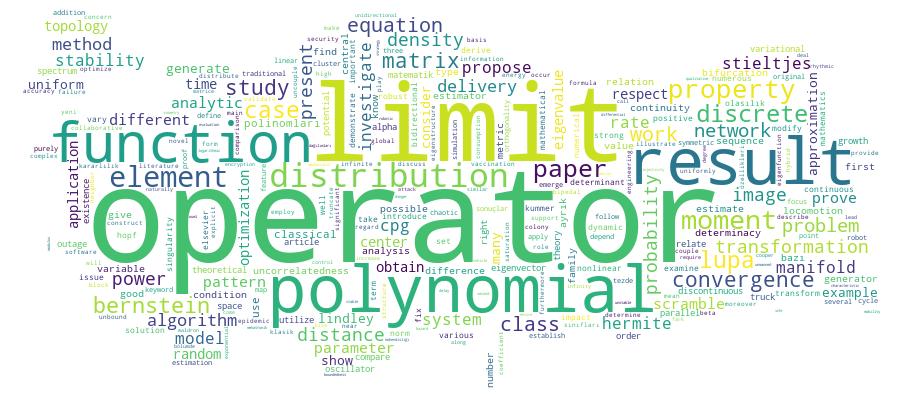
3 results
Scholarly Output Search Results
Now showing 1 - 3 of 3
Article On the Image of the Limit Q-Durrmeyer Operator(Academic Press Inc Elsevier Science, 2026) Ostrovska, Sofiya; Turan, MehmetThe focus of this work is on the properties of the q-Durrmeyer operators Mn,q, n E N, and M infinity,q introduced, for q E (0, 1), by V. Gupta and H. Wang. First, it is shown that, for each f E C[0, 1], the sequence {Mn,q f}nEN converges to M infinity,q f uniformly on [0, 1] with a rate not slower than Cq, fqn, which refines the previously available result by V. Gupta and H. Wang, and implies the possibility of an analytic continuation for M infinity,q f into a neighbourhood of [0, 1]. Further investigation shows that M infinity,q f admits an analytic continuation as an entire function regardless of f E C[0, 1]. Finally, the growth estimates for these functions are received and applied to describe the point spectrum of M infinity,q. The paper also addresses the significant differences between the properties of M infinity,q and the previously (c) 2025 Elsevier Inc. All rights are reserved, including those for text and data mining, AI training, and similar technologies.Article The Saturation of Convergence for the Complex q-durrmeyer Polynomials(Springer Basel Ag, 2025) Gurel, Ovgu; Ostrovska, Sofiya; Turan, MehmetThe aim of this paper is to establish a saturation result for the complex q-Durrmeyer polynomials (Dn,qf)(z)\documentclass[12pt]{minimal} \usepackage{amsmath} \usepackage{wasysym} \usepackage{amsfonts} \usepackage{amssymb} \usepackage{amsbsy} \usepackage{mathrsfs} \usepackage{upgreek} \setlength{\oddsidemargin}{-69pt} \begin{document}$$(D_{n,q}f)(z)$$\end{document}, where q is an element of(0,1)\documentclass[12pt]{minimal} \usepackage{amsmath} \usepackage{wasysym} \usepackage{amsfonts} \usepackage{amssymb} \usepackage{amsbsy} \usepackage{mathrsfs} \usepackage{upgreek} \setlength{\oddsidemargin}{-69pt} \begin{document}$$q \in (0,1)$$\end{document}, f is an element of C[0,1].\documentclass[12pt]{minimal} \usepackage{amsmath} \usepackage{wasysym} \usepackage{amsfonts} \usepackage{amssymb} \usepackage{amsbsy} \usepackage{mathrsfs} \usepackage{upgreek} \setlength{\oddsidemargin}{-69pt} \begin{document}$$f \in C[0,1].$$\end{document} It is known that the sequence {(Dn,qf)(z)}n is an element of N\documentclass[12pt]{minimal} \usepackage{amsmath} \usepackage{wasysym} \usepackage{amsfonts} \usepackage{amssymb} \usepackage{amsbsy} \usepackage{mathrsfs} \usepackage{upgreek} \setlength{\oddsidemargin}{-69pt} \begin{document}$$\{(D_{n,q}f)(z)\}_{n \in {\mathbb {N}}}$$\end{document} converges uniformly on any compact set in C\documentclass[12pt]{minimal} \usepackage{amsmath} \usepackage{wasysym} \usepackage{amsfonts} \usepackage{amssymb} \usepackage{amsbsy} \usepackage{mathrsfs} \usepackage{upgreek} \setlength{\oddsidemargin}{-69pt} \begin{document}$${\mathbb {C}}$$\end{document} to the limit function (D infinity,qf)(z)\documentclass[12pt]{minimal} \usepackage{amsmath} \usepackage{wasysym} \usepackage{amsfonts} \usepackage{amssymb} \usepackage{amsbsy} \usepackage{mathrsfs} \usepackage{upgreek} \setlength{\oddsidemargin}{-69pt} \begin{document}$$(D_{\infty ,q}f)(z)$$\end{document}, which, therefore, is entire. Previously, the rate of this convergence has been estimated as O(qn)\documentclass[12pt]{minimal} \usepackage{amsmath} \usepackage{wasysym} \usepackage{amsfonts} \usepackage{amssymb} \usepackage{amsbsy} \usepackage{mathrsfs} \usepackage{upgreek} \setlength{\oddsidemargin}{-69pt} \begin{document}$$O(q<^>n)$$\end{document}, n ->infinity.\documentclass[12pt]{minimal} \usepackage{amsmath} \usepackage{wasysym} \usepackage{amsfonts} \usepackage{amssymb} \usepackage{amsbsy} \usepackage{mathrsfs} \usepackage{upgreek} \setlength{\oddsidemargin}{-69pt} \begin{document}$$n \rightarrow \infty . $$\end{document} In the present article, this result is refined to derive Voronovskaya-type formula and to demonstrate that this rate is o(qn)\documentclass[12pt]{minimal} \usepackage{amsmath} \usepackage{wasysym} \usepackage{amsfonts} \usepackage{amssymb} \usepackage{amsbsy} \usepackage{mathrsfs} \usepackage{upgreek} \setlength{\oddsidemargin}{-69pt} \begin{document}$$o(q<^>n)$$\end{document}, n ->infinity\documentclass[12pt]{minimal} \usepackage{amsmath} \usepackage{wasysym} \usepackage{amsfonts} \usepackage{amssymb} \usepackage{amsbsy} \usepackage{mathrsfs} \usepackage{upgreek} \setlength{\oddsidemargin}{-69pt} \begin{document}$$n \rightarrow \infty $$\end{document} on a set possessing an accumulation point if and only if f takes on the same value at all qj\documentclass[12pt]{minimal} \usepackage{amsmath} \usepackage{wasysym} \usepackage{amsfonts} \usepackage{amssymb} \usepackage{amsbsy} \usepackage{mathrsfs} \usepackage{upgreek} \setlength{\oddsidemargin}{-69pt} \begin{document}$$q<^>j$$\end{document}, j is an element of N0\documentclass[12pt]{minimal} \usepackage{amsmath} \usepackage{wasysym} \usepackage{amsfonts} \usepackage{amssymb} \usepackage{amsbsy} \usepackage{mathrsfs} \usepackage{upgreek} \setlength{\oddsidemargin}{-69pt} \begin{document}$$j \in {\mathbb {N}}_{0}$$\end{document}.Article How Analytic Properties of Functions Influence Their Images Under the Limit q-Stancu Operator(Springer Basel AG, 2026) Gurel, Ovgu; Ostrovska, Sofiya; Turan, MehmetIn the study of various q-versions of the Bernstein polynomials, a significant attention is paid to their limit operators. The present work focuses on the impact of the limit q-Stancu operator Sq infinity,alpha on the analytic properties of functions when 0 < q < 1 and alpha > 0. It is shown that for every f is an element of C[0, 1], the function S-q,(alpha infinity)fadmits an analytic continuation into the disk {z : z+alpha/(1-q) < 1+ alpha/(1-q)}. In addition, it is proved that the more derivatives f has at x = 1, the wider this disk becomes. Further, if f is infinitely differentiable at x = 1, then the function S-q,(alpha infinity)fis entire. Finally, some growth estimates for (S-q,(alpha infinity)f)(z) are obtained.
