
Turan, Mehmet
Loading...
Profile URL
Name Variants
T., Mehmet
Turan M.
M.,Turan
Turan,Mehmet
Mehmet, Turan
T.,Mehmet
Turan A.
Mehmet Turan
M., Turan
Turan, Mehmet
Turan,M.
Turan, M.
Turan M.
M.,Turan
Turan,Mehmet
Mehmet, Turan
T.,Mehmet
Turan A.
Mehmet Turan
M., Turan
Turan, Mehmet
Turan,M.
Turan, M.
Job Title
Profesör Doktor
Email Address
mehmet.turan@atilim.edu.tr
Main Affiliation
Mathematics
Status
Website
ORCID ID
Scopus Author ID
Turkish CoHE Profile ID
Google Scholar ID
WoS Researcher ID
Sustainable Development Goals
 1
1NO POVERTY
0
Research Products
 2
2ZERO HUNGER
0
Research Products
 3
3GOOD HEALTH AND WELL-BEING
1
Research Products
 4
4QUALITY EDUCATION
0
Research Products
 5
5GENDER EQUALITY
0
Research Products
 6
6CLEAN WATER AND SANITATION
0
Research Products
 7
7AFFORDABLE AND CLEAN ENERGY
0
Research Products
 8
8DECENT WORK AND ECONOMIC GROWTH
0
Research Products
 9
9INDUSTRY, INNOVATION AND INFRASTRUCTURE
0
Research Products
 10
10REDUCED INEQUALITIES
0
Research Products
 11
11SUSTAINABLE CITIES AND COMMUNITIES
0
Research Products
 12
12RESPONSIBLE CONSUMPTION AND PRODUCTION
0
Research Products
 13
13CLIMATE ACTION
0
Research Products
 14
14LIFE BELOW WATER
0
Research Products
 15
15LIFE ON LAND
0
Research Products
 16
16PEACE, JUSTICE AND STRONG INSTITUTIONS
0
Research Products
 17
17PARTNERSHIPS FOR THE GOALS
0
Research Products

This researcher does not have a Scopus ID.

This researcher does not have a WoS ID.

Scholarly Output
55
Articles
44
Views / Downloads
74/155
Supervised MSc Theses
5
Supervised PhD Theses
2
WoS Citation Count
83
Scopus Citation Count
99
Patents
0
Projects
0
WoS Citations per Publication
1.51
Scopus Citations per Publication
1.80
Open Access Source
13
Supervised Theses
7
| Journal | Count |
|---|---|
| Mathematica Slovaca | 3 |
| Mathematical Methods in the Applied Sciences | 3 |
| Quaestiones Mathematicae | 2 |
| Results in Mathematics | 2 |
| Bulletin of the Malaysian Mathematical Sciences Society | 2 |
Current Page: 1 / 8
Scopus Quartile Distribution
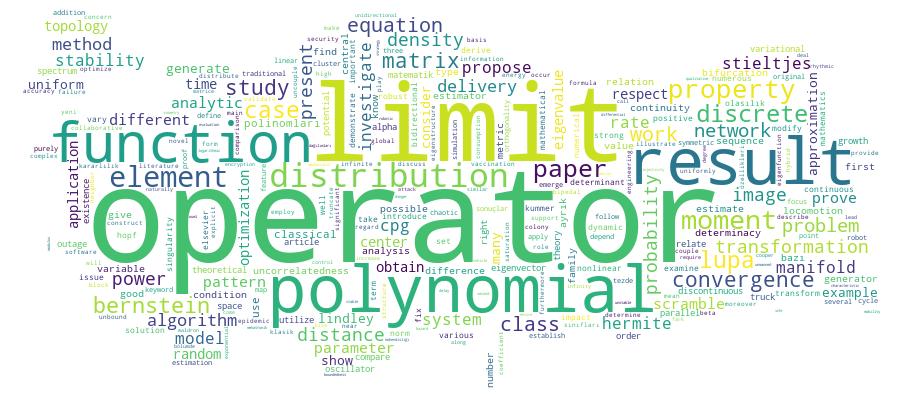
Competency Cloud
28 results
Scholarly Output Search Results
Now showing 1 - 10 of 28
Article Citation - WoS: 4Citation - Scopus: 5Stability Analysis of an Epidemic Model With Vaccination and Time Delay(Wiley, 2023) Turan, Mehmet; Adiguzel, Rezan Sevinik; Koc, F.; Sevinik Adıgüzel, RezanThis paper presents an epidemic model with varying population, incorporating a new vaccination strategy and time delay. It investigates the impact of vaccination with respect to vaccine efficacy and the time required to see the effects, followed by determining how to control the spread of the disease according to the basic reproduction ratio of the disease. Some numerical simulations are provided to illustrate the theoretical results.Article Citation - WoS: 1Citation - Scopus: 1The Distance Between Two Limit q-bernstein Operators(Rocky Mt Math Consortium, 2020) Ostrovska, Sofiya; Turan, MehmetFor q is an element of (0, 1), let B-q denote the limit q-Bernstein operator. The distance between B-q and B-r for distinct q and r in the operator norm on C[0, 1] is estimated, and it is proved that 1 <= parallel to B-q - B-r parallel to <= 2, where both of the equalities can be attained. Furthermore, the distance depends on whether or not r and q are rational powers of each other. For example, if r(j) not equal q(m) for all j, m is an element of N, then parallel to B-q - B-r parallel to = 2, and if r = q(m) for some m is an element of N, then parallel to B-q - B-r parallel to = 2(m - 1)/m.Article Citation - WoS: 1Citation - Scopus: 1On the q-moment Determinacy of Probability Distributions(Malaysian Mathematical Sciences Soc, 2020) Ostrovska, Sofiya; Turan, MehmetGiven 0Article A Decomposition of the Limit Q-Bernstein Type Operators Via a Universal Factor(Springer Basel AG, 2026) Ostrovska, Sofiya; Pirimoglu, Lutfi Atahan; Turan, MehmetThe focus of this work is on the properties of the unifying operator Uq\documentclass[12pt]{minimal} \usepackage{amsmath} \usepackage{wasysym} \usepackage{amsfonts} \usepackage{amssymb} \usepackage{amsbsy} \usepackage{mathrsfs} \usepackage{upgreek} \setlength{\oddsidemargin}{-69pt} \begin{document}$$U_q$$\end{document} on C[0, 1], which serves as a universal left factor in a decomposition of the limit q-Bernstein type operators, L infinity,q\documentclass[12pt]{minimal} \usepackage{amsmath} \usepackage{wasysym} \usepackage{amsfonts} \usepackage{amssymb} \usepackage{amsbsy} \usepackage{mathrsfs} \usepackage{upgreek} \setlength{\oddsidemargin}{-69pt} \begin{document}$$L_{\infty ,q}$$\end{document}. More precisely, the factorization L infinity,q=Uq degrees TL\documentclass[12pt]{minimal} \usepackage{amsmath} \usepackage{wasysym} \usepackage{amsfonts} \usepackage{amssymb} \usepackage{amsbsy} \usepackage{mathrsfs} \usepackage{upgreek} \setlength{\oddsidemargin}{-69pt} \begin{document}$$L_{\infty ,q}= U_q\circ T_L$$\end{document}, where TL\documentclass[12pt]{minimal} \usepackage{amsmath} \usepackage{wasysym} \usepackage{amsfonts} \usepackage{amssymb} \usepackage{amsbsy} \usepackage{mathrsfs} \usepackage{upgreek} \setlength{\oddsidemargin}{-69pt} \begin{document}$$T_L$$\end{document} is a linear operator on C[0, 1] depending on L, holds. It is shown that this factorization facilitates the derivation of new results and/or the simplification of proofs for the known ones.Article Citation - WoS: 1Citation - Scopus: 1Shape-Preserving Properties of the Limit q-durrmeyer Operator(Academic Press inc Elsevier Science, 2024) Yilmaz, Ovgu Gurel; Ostrovska, Sofiya; Turan, Mehmet; Gürel Yılmaz, ÖvgüThe present work aims to establish the shape-preserving properties of the limit q- Durrmeyer operator, D q for 0 < q < 1. It has been proved that the operator is monotonicity- and convexity-preserving. What is more, it maps a function m - convex along {q (j)}(infinity)(j =0) to a function m - convex along any sequence { xq( j )}(infinity)(j =0) , x is an element of (0, 1). (c) 2024 Elsevier Inc. All rights reserved.Article Citation - WoS: 1Citation - Scopus: 1On the Rate of Convergence for the q-durrmeyer Polynomials in Complex Domains(Walter de Gruyter Gmbh, 2024) Gurel, Ovgu; Ostrovska, Sofiya; Turan, MehmetThe q-Durrmeyer polynomials are one of the popular q-versions of the classical operators of approximation theory. They have been studied from different points of view by a number of researchers. The aim of this work is to estimate the rate of convergence for the sequence of the q-Durrmeyer polynomials in the case 0 < q < 1. It is proved that for any compact set D subset of C, the rate of convergence is O(q(n)) as n -> infinity. The sharpness of the obtained result is demonstrated.Article On the Injectivity With Respect To q of the Lupas q-transform(Taylor & Francis Ltd, 2024) Yilmaz, Ovgue Gurel; Ostrovska, Sofiya; Turan, Mehmet; Gurel Yilmaz, OvguThe Lupas q-transform has first appeared in the study of the Lupas q-analogue of the Bernstein operator. Given 0 < q < 1 and f is an element of C[0, 1], the Lupas q-transform is defined by Lambda(q)(f; x) Pi(infinity)(k=0) 1/1 + q(k)x Sigma(k=0)f(1 - q(k))q(k(k-1)/2)x(k)/(1 - q)(1 - q(2)) center dot center dot center dot (1 - q(k)), x >= 0. During the last decades, this transform has been investigated from a variety of angles, including its analytical, geometric features, and properties of its block functions along with their sums. As opposed to the available studies dealing with a fixed value of q, the present work is focused on the injectivity of Lambda(q) with respect to parameter q. More precisely, the conditions on f such that equality Lambda(q)(f; x) = Lambda(r)(f; x); x >= 0 implies q = r have been established.Article Citation - WoS: 2Citation - Scopus: 2On the eigenfunctions of the q-Bernstein operators(Springer Basel Ag, 2023) Ostrovska, Sofiya; Turan, MehmetThe eigenvalue problems for linear operators emerge in various practical applications in physics and engineering. This paper deals with the eigenvalue problems for the q-Bernstein operators, which play an important role in the q-boson theory of modern theoretical physics. The eigenstructure of the classical Bernstein operators was investigated in detail by S. Cooper and S. Waldron back in 2000. Some of their results were extended for other Bernstein-type operators, including the q-Bernstein and the limit q-Bernstein operators. The current study is a pursuit of this research. The aim of the present work is twofold. First, to derive for the q-Bernstein polynomials analogues of the Cooper-Waldron results on zeroes of the eigenfunctions. Next, to present in detail the proof concerning the existence of non-polynomial eigenfunctions for the limit q-Bernstein operator.Article Citation - WoS: 2Citation - Scopus: 2The Impact of the Limit q-durrmeyer Operator on Continuous Functions(Springer Heidelberg, 2024) Yilmaz, Ovgu Gurel; Ostrovska, Sofiya; Turan, Mehmet; Gurel Yilmaz, OvguThe limit q-Durrmeyer operator, D-infinity,D-q, was introduced and its approximation properties were investigated by Gupta (Appl. Math. Comput. 197(1):172-178, 2008) during a study of q-analogues for the Bernstein-Durrmeyer operator. In the present work, this operator is investigated from a different perspective. More precisely, the growth estimates are derived for the entire functions comprising the range of D-infinity,D-q. The interrelation between the analytic properties of a function f and the rate of growth for D(infinity,q)f are established, and the sharpness of the obtained results are demonstrated.Article How Analytic Properties of Functions Influence Their Images Under the Limit q-Stancu Operator(Springer Basel AG, 2026) Gurel, Ovgu; Ostrovska, Sofiya; Turan, MehmetIn the study of various q-versions of the Bernstein polynomials, a significant attention is paid to their limit operators. The present work focuses on the impact of the limit q-Stancu operator Sq infinity,alpha on the analytic properties of functions when 0 < q < 1 and alpha > 0. It is shown that for every f is an element of C[0, 1], the function S-q,(alpha infinity)fadmits an analytic continuation into the disk {z : z+alpha/(1-q) < 1+ alpha/(1-q)}. In addition, it is proved that the more derivatives f has at x = 1, the wider this disk becomes. Further, if f is infinitely differentiable at x = 1, then the function S-q,(alpha infinity)fis entire. Finally, some growth estimates for (S-q,(alpha infinity)f)(z) are obtained.

- «
- 1 (current)
- 2
- 3
- »