Oymak, Hüseyin

Loading...
Profile Picture
Name Variants
Oymak, Hueseyin
Oymak,H.
Huseyin, Oymak
Oymak, H.
O., Hüseyin
H., Oymak
O.,Hüseyin
Oymak, Hüseyn
H.,Oymak
O.,Huseyin
O., Huseyin
Hüseyin, Oymak
Oymak, Huseyin
Oymak H.
Oymak, Hüseyin
Job Title
Doçent Doktor
Email Address
huseyin.oymak@atilim.edu.tr
Main Affiliation
Electrical-Electronics Engineering
Status
Website
ORCID ID
Scopus Author ID
Turkish CoHE Profile ID
Google Scholar ID
WoS Researcher ID

Sustainable Development Goals

SDG data is not available
Documents

18

Citations

151

h-index

8

This researcher does not have a WoS ID.
Scholarly Output

6

Articles

4

Views / Downloads

3/0

Supervised MSc Theses

1

Supervised PhD Theses

1

WoS Citation Count

14

Scopus Citation Count

11

WoS h-index

2

Scopus h-index

1

Patents

0

Projects

0

WoS Citations per Publication

2.33

Scopus Citations per Publication

1.83

Open Access Source

0

Supervised Theses

2

Google Analytics Visitor Traffic

JournalCount
International Journal of Modern Physics B1
International Journal of Modern Physics C1
Reviews in Theoretical Science1
The Journal of Physical Chemistry A1
Current Page: 1 / 1

Scopus Quartile Distribution

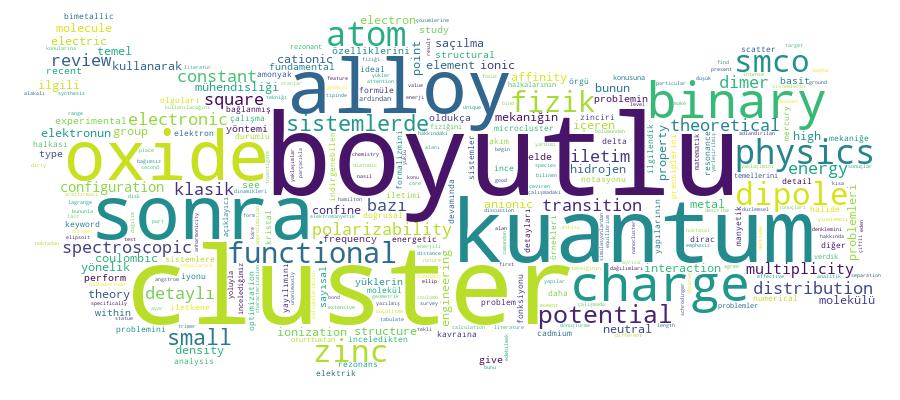
Competency Cloud

GCRIS Competency Cloud

Scholarly Output Search Results

Now showing 1 - 2 of 2
  • Article
    Citation - WoS: 1
    Citation - Scopus: 1
    On the Smco Dimer: a Detailed Density Functional Theory Analysis
    (Amer Chemical Soc, 2010) Oymak, Hueseyin; Erkoc, Sakir
    Making use of 21 different exchange-correlation functionals, we performed density functional theory calculations, within the effective core potential level, to investigate some spectroscopic and electronic features of the SmCo dimer in its ground state. A particular emphasis was placed on the (spin) multiplicity of SmCo. Most of the functionals under discussion unanimously agreed that the multiplicity of SmCo should be 10. It was observed that the nature of interaction between Sm and Co atoms to form the SmCo dirtier can be described, to a good approximation, by a Lennard-Jones curve. For the multiplicity value 10, the binding energy D, was seen to be in the range 1.08-1.77 eV, while the equilibrium separation distance and the fundamental frequency were found to be r(e) = 2.975 +/- 0.035 angstrom and omega(e) = 120 +/- 10 cm(-1), respectively.
  • Review
    Citation - WoS: 5
    Binary Alloy Clusters: Structures and Electronic Properties
    (Amer Scientific Publishers, 2014) Pekoez, Rengin; Oymak, Hueseyin; Erkoc, Akir
    Synthesis, characterization, physics, and chemistry of nanoclusters have been the focus of intense attention for the last two decades. Also, their unique statues that they are between molecule and bulk material is the central reason for the theoretical researcher to understand the transition from atom to cluster/molecule and then to solid state. In this review we restrict ourselves to the recent advances in the structural and electronic properties of binary alloy clusters. This type of clusters is particularly of importance thanks to their very availability for being tuned, by changing their sizes, according to any special needs. A brief summary of the classification of clusters as well as the experimental techniques and theoretical methods to study them, and the possible applications of alloy clusters are given in the introduction part. Several binary alloy cluster types, including semiconductor, alkali and transition metal, oxide, and ionic binary alloy clusters, are widely reviewed considering extensively the most recent articles.