Tengilimoğlu, Dilaver

Loading...
Profile Picture
Name Variants
D., Tengilimoglu
D., Tengilimoğlu
Tengilimoglu,D.
D.,Tengilimoglu
Tengilimoglu, D.
T., Dilaver
D.,Tengilimoğlu
Tengilimoglu, Dilaver
Tengilimoğlu,D.
T.,Dilaver
Dilaver, Tengilimoğlu
Dilaver, Tengilimoglu
Tengilimoglu D.
Tengilimoğlu D.
Tengilimoğlu, Dilaver
Tengilimoglu, Laver
Job Title
Profesor Doktor
Email Address
dilaver.tengilimoglu@atilim.edu.tr
Main Affiliation
Business
Status
Website
Scopus Author ID
Turkish CoHE Profile ID
Google Scholar ID
WoS Researcher ID

Sustainable Development Goals

2

ZERO HUNGER
ZERO HUNGER Logo

0

Research Products

11

SUSTAINABLE CITIES AND COMMUNITIES
SUSTAINABLE CITIES AND COMMUNITIES Logo

0

Research Products

14

LIFE BELOW WATER
LIFE BELOW WATER Logo

0

Research Products

6

CLEAN WATER AND SANITATION
CLEAN WATER AND SANITATION Logo

0

Research Products

1

NO POVERTY
NO POVERTY Logo

1

Research Products

5

GENDER EQUALITY
GENDER EQUALITY Logo

1

Research Products

9

INDUSTRY, INNOVATION AND INFRASTRUCTURE
INDUSTRY, INNOVATION AND INFRASTRUCTURE Logo

5

Research Products

16

PEACE, JUSTICE AND STRONG INSTITUTIONS
PEACE, JUSTICE AND STRONG INSTITUTIONS Logo

3

Research Products

17

PARTNERSHIPS FOR THE GOALS
PARTNERSHIPS FOR THE GOALS Logo

6

Research Products

15

LIFE ON LAND
LIFE ON LAND Logo

0

Research Products

10

REDUCED INEQUALITIES
REDUCED INEQUALITIES Logo

2

Research Products

7

AFFORDABLE AND CLEAN ENERGY
AFFORDABLE AND CLEAN ENERGY Logo

1

Research Products

8

DECENT WORK AND ECONOMIC GROWTH
DECENT WORK AND ECONOMIC GROWTH Logo

6

Research Products

4

QUALITY EDUCATION
QUALITY EDUCATION Logo

3

Research Products

12

RESPONSIBLE CONSUMPTION AND PRODUCTION
RESPONSIBLE CONSUMPTION AND PRODUCTION Logo

3

Research Products

3

GOOD HEALTH AND WELL-BEING
GOOD HEALTH AND WELL-BEING Logo

5

Research Products

13

CLIMATE ACTION
CLIMATE ACTION Logo

0

Research Products
Documents

43

Citations

417

h-index

12

WoS data could not be loaded because of an error. Please refresh the page or try again later.
Scholarly Output

116

Articles

43

Views / Downloads

679/10584

Supervised MSc Theses

66

Supervised PhD Theses

3

WoS Citation Count

168

Scopus Citation Count

216

WoS h-index

8

Scopus h-index

9

Patents

0

Projects

0

WoS Citations per Publication

1.45

Scopus Citations per Publication

1.86

Open Access Source

32

Supervised Theses

69

Google Analytics Visitor Traffic

JournalCount
Üçüncü Sektör Sosyal Ekonomi4
Hacettepe Sağlık İdaresi Dergisi3
Healthcare3
Gazi Üniversitesi İktisadi ve İdari Bilimler Fakültesi Dergisi2
Journal of Social Service Research2
Current Page: 1 / 7

Scopus Quartile Distribution

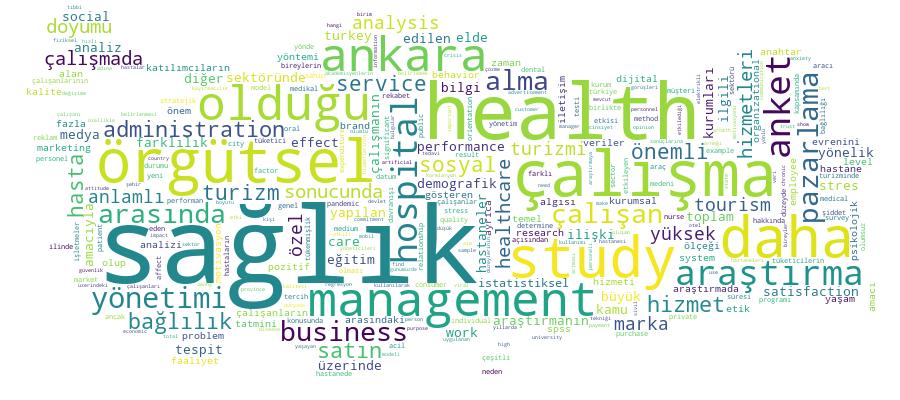
Competency Cloud

GCRIS Competency Cloud

Scholarly Output Search Results

Now showing 1 - 5 of 5
  • Article
    Citation - WoS: 8
    Citation - Scopus: 9
    Refugees' Opinions About Healthcare Services: a Case of Turkey
    (Mdpi, 2021) Tengilimoglu, Dilaver; Zekioglu, Aysu; Budak, Fatih; Eris, Hilseyin; Younis, Mustafa
    Background: Migration is one of the most important social events in human history. In recent years, Turkey hosted a high number of asylum seekers and refugees, primarily because of continuing wars and radical social changes in the Middle East. Methods: Using a random sampling method, Syrian refugees aged 18 and over, who can communicate in Turkish, were reached via personal contact and a total of 714 refugees participated in the study voluntarily. Results: Turkey has mounted with some success and to point out that even though participating refugees in both provinces are young and healthy, almost 50% have bad or worse health status, 61% have chronic diseases, and 55% need regular medication. Participating refugees living in Sanliurfa stated that 'Hospitals are very clean and tidy.' (3.80 +/- 0.80). The answers given to the following statements had the highest mean for the participating refugees living in Kilis; 'Hospitals are clean and tidy.' (3.22 +/- 1.25). Conclusion: Due to financial and human resource deficiencies, there are problems in providing preventive and therapeutic health services, especially to refugees living outside the refugee camps in bad conditions. It is important that refugees are encouraged to apply to family health and community health centers in this context.
  • Article
    Health Beliefs and Attitudes: a Comparison Between Turkey and Palestine
    (Routledge Journals, Taylor & Francis Ltd, 2018) Menawi, Wafaa Allam; Tengilimoglu, Dilaver; Dziegielewski, Sophia F.
    The purpose of this study is to identify the beliefs and attitudes that influence health-related behavior while comparing two countries that can have different political and economic structures. This study also gathers both Turkish and Palestinian citizens' beliefs and attitudes towards health determinants. To assess and compare citizens' attitudes toward health care and health determinants a total of 4,100 questionnaires were distributed, whereas 2,600 were distributed in Turkey, and another 1,500 questionnaires in the Palestine. According to the research, the individuals surveyed in Turkey noted that smoking, stress, and getting access to a medical institution were noted as the most influential determinants which affect their health; whereas, the people of Palestine thought that income status, and educational levels were the most influential factors in health. In addition, it was found that there were some statistically significant differences between participants' responses in Turkey and Palestine; however, what both samples shared was that economic factors were an important factor affecting health beliefs and attitudes, regardless of where a participant lived. Finally, comparisons and future recommendations are made to improve health-related beliefs, attitudes and behaviors in both countries.
  • Article
    Citation - WoS: 11
    Citation - Scopus: 14
    Informal Payments in Health Systems: Purpose and Occurrences in Turkey
    (Routledge Journals, Taylor & Francis Ltd, 2015) Tengilimoglu, Dilaver; Guzel, Alper; Toygar, Anil; Akinci, Fevzi; Dziegielewski, Sophia F.
    Informal payments constitute a significant portion of out-of-pocket payments in health systems, especially in developing countries. This study examined the current status of informal payments in Turkey and the opinions, attitudes, and behavior of individuals toward informal payments. To examine this concept, 1,033 residents in Ankara, the capital city of Turkey, were surveyed. The 28-item questionnaire used in data collection was developed based on previous research and expert opinions. The data analysis revealed that approximately 29% of the study participants made informal payments in return for the medical service they received. Three out of 4 people who made informal payments were from a low-income group. Informal payments were made in the form of cash prior to medical procedures and also as gifts following the procedures. Future recommendations for health policymakers include designing a new patient copay mechanism where informal payments can be effectively incorporated into the formal payment system, assistance to low-income individuals, and improvement in current medical staff salaries that would discourage taking such payments.
  • Article
    Citation - WoS: 5
    Citation - Scopus: 7
    The Problems Experienced by Employees With Chronic Disease During the Covid-19 Pandemic
    (Mdpi, 2022) Tengilimoglu, Dilaver; Tengilimoğlu, Dilaver; Goenuellue, Ugur; Isik, Oguz; Tosun, Nurperihan; Zekioglu, Aysu; Tengilimoglu, Onur; Younis, Mustafa; Tengilimoğlu, Dilaver; Business; Business
    Chronic diseases served as a silent global epidemic before the pandemic, and individuals living with chronic disease now form one of the groups most affected by COVID-19. This study aims to determine the problems that employees with chronic disease face during the COVID-19 pandemic. As part of the study, data were collected from 952 individuals who live with chronic disease in Turkey. Of these, 76.6% of respondents worked for the public sector, a large majority of whom (67.7%) have worked full time during the COVID-19 pandemic. It was found that the COVID-19 fear level of employees living with chronic disease was higher than moderate (21.061 +/- 7.607). When the variables affecting the COVID-19 fear level are listed in order of relative significance, eating problems, residing in the Mediterranean region, having asthma, and working as a female employee made the greatest impact, respectively. Necessary conditions of work should be provided to those living with chronic disease who could adapt themselves to working flexibly or working from home, so that they would not feel isolated from business life. This group should be provided with essential protective equipment, their working conditions must be reviewed and vaccination priority could be given to them.
  • Article
    Citation - WoS: 8
    Citation - Scopus: 8
    Evaluating the Factors (stress, Anxiety and Depression) Affecting the Mental Health Condition of Nurses During the Covid-19 Pandemic
    (Sage Publications inc, 2022) Isik, Oguz; Tengilimoglu, Dilaver; Tosun, Nurperihan; Zekioglu, Aysu; Tengilimoglu, Onur
    This study aimed to determine the depression, anxiety and stress levels that have negatively impacted nurses' mental health during the COVID-19 pandemic. A sample group of 826 nurses working in Turkey were asked to fill in an online questionnaire in order to evaluate their psychological responses and the related factors that have adversely affected their mental health during the COVID-19 pandemic. In total, 696 nurses (84.3%) showed symptoms of depression, 644 (78%) reported anxiety and 543 (65.74%) reported stress. This study also highlighted that the most concerning factor for the nurses was the risk of transmitting the COVID-19 infection to their household members (89.2%). The most important problems faced by the nurses during COVID-19 included equipment shortages (50.7%), administrative problems (38.5%) and issues such as accommodation and nutrition (27.4%). These were found to have a statistically significant correlation with the nurses' levels of depression, anxiety and stress. The fear of losing a household member, the inability to their household's social needs and the fear of death were among the factors that concerned nurses during the COVID-19 pandemic, significantly affecting their levels of depression, anxiety and stress. Taking the necessary measures to deal with the aforementioned problems and fears is important to protect the health, productivity and efficiency of nurses during the pandemic period.