Tengilimoğlu, Dilaver

Loading...
Profile Picture
Name Variants
D., Tengilimoglu
D., Tengilimoğlu
Tengilimoglu,D.
D.,Tengilimoglu
Tengilimoglu, D.
T., Dilaver
D.,Tengilimoğlu
Tengilimoglu, Dilaver
Tengilimoğlu,D.
T.,Dilaver
Dilaver, Tengilimoğlu
Dilaver, Tengilimoglu
Tengilimoglu D.
Tengilimoğlu D.
Tengilimoğlu, Dilaver
Tengilimoglu, Laver
Job Title
Profesor Doktor
Email Address
dilaver.tengilimoglu@atilim.edu.tr
Main Affiliation
Business
Status
Website
Scopus Author ID
Turkish CoHE Profile ID
Google Scholar ID
WoS Researcher ID

Sustainable Development Goals

2

ZERO HUNGER
ZERO HUNGER Logo

0

Research Products

11

SUSTAINABLE CITIES AND COMMUNITIES
SUSTAINABLE CITIES AND COMMUNITIES Logo

0

Research Products

14

LIFE BELOW WATER
LIFE BELOW WATER Logo

0

Research Products

6

CLEAN WATER AND SANITATION
CLEAN WATER AND SANITATION Logo

0

Research Products

1

NO POVERTY
NO POVERTY Logo

1

Research Products

5

GENDER EQUALITY
GENDER EQUALITY Logo

1

Research Products

9

INDUSTRY, INNOVATION AND INFRASTRUCTURE
INDUSTRY, INNOVATION AND INFRASTRUCTURE Logo

5

Research Products

16

PEACE, JUSTICE AND STRONG INSTITUTIONS
PEACE, JUSTICE AND STRONG INSTITUTIONS Logo

3

Research Products

17

PARTNERSHIPS FOR THE GOALS
PARTNERSHIPS FOR THE GOALS Logo

6

Research Products

15

LIFE ON LAND
LIFE ON LAND Logo

0

Research Products

10

REDUCED INEQUALITIES
REDUCED INEQUALITIES Logo

2

Research Products

7

AFFORDABLE AND CLEAN ENERGY
AFFORDABLE AND CLEAN ENERGY Logo

1

Research Products

8

DECENT WORK AND ECONOMIC GROWTH
DECENT WORK AND ECONOMIC GROWTH Logo

6

Research Products

4

QUALITY EDUCATION
QUALITY EDUCATION Logo

3

Research Products

12

RESPONSIBLE CONSUMPTION AND PRODUCTION
RESPONSIBLE CONSUMPTION AND PRODUCTION Logo

3

Research Products

3

GOOD HEALTH AND WELL-BEING
GOOD HEALTH AND WELL-BEING Logo

5

Research Products

13

CLIMATE ACTION
CLIMATE ACTION Logo

0

Research Products
Documents

43

Citations

417

h-index

12

WoS data could not be loaded because of an error. Please refresh the page or try again later.
Scholarly Output

116

Articles

43

Views / Downloads

679/10584

Supervised MSc Theses

66

Supervised PhD Theses

3

WoS Citation Count

168

Scopus Citation Count

216

WoS h-index

8

Scopus h-index

9

Patents

0

Projects

0

WoS Citations per Publication

1.45

Scopus Citations per Publication

1.86

Open Access Source

32

Supervised Theses

69

Google Analytics Visitor Traffic

JournalCount
Üçüncü Sektör Sosyal Ekonomi4
Hacettepe Sağlık İdaresi Dergisi3
Healthcare3
Gazi Üniversitesi İktisadi ve İdari Bilimler Fakültesi Dergisi2
Journal of Social Service Research2
Current Page: 1 / 7

Scopus Quartile Distribution

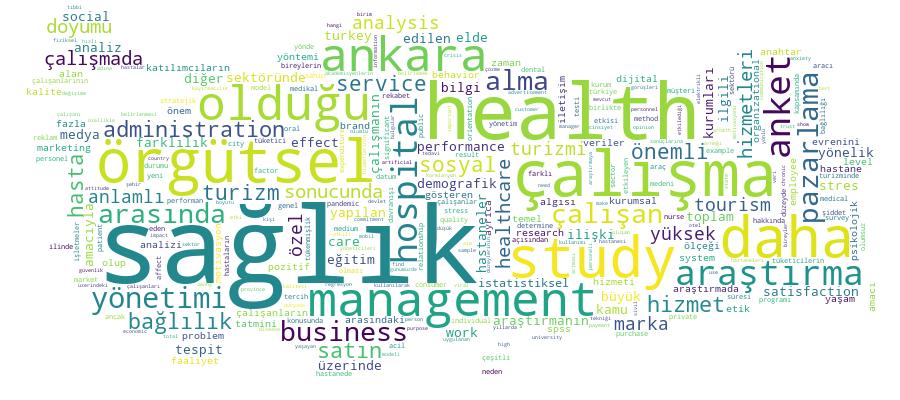
Competency Cloud

GCRIS Competency Cloud

Scholarly Output Search Results

Now showing 1 - 2 of 2
  • Article
    Citation - WoS: 3
    Evaluation of Students' Opinions Regarding Distance Learning Practices in Turkish Universities During the Covid-19 Pandemic
    (Tuba-turkish Acad Sciences, 2021) Isik, Oguz; Tengilimoglu, Dilaver; Tekin, Perihan Senel; Tosun, Nurperihan; Zekioglu, Aysu
    The purpose of this study is to identify hether students at Turkish universities are having difficulties in the distance learning process and to reveal their opinions regarding the system. Using a cross-cultural survey design, data were collected from 5052 students. Based on the collected data, 58.5% of the students have asynchronous distance learning classes in their universities. Access to distance learning classes is one of the problems, and it is attributed to computers, internet, and connectivity issues as well as with starting the lessons too early or late. A majority of participants (73.7%) found class materials uploaded by lecturers to distance learning systems to be sufficient or partially sufficient, and 36.7% stated that they had problems accessing resources regarding their homework. Students' satisfaction level with the distance learning system scored 4.4 out of 10. According to the evaluation regarding whether the level of satisfaction of participants varied across the type of university, the satisfaction level of students in public universities is generally low (score of 4.3 out of 10) compared to satisfaction in foundation universities (4.9 out of 10).
  • Article
    Citation - WoS: 13
    Citation - Scopus: 12
    Analysis of Publications on Health Information Management Using the Science Mapping Method: a Holistic Perspective
    (Mdpi, 2024) Tengilimoglu, Dilaver; Orhan, Fatih; Tekin, Perihan Senel; Younis, Mustafa
    Objective: In the age of digital transformation, there is a need for a sustainable information management vision in health. Understanding the accumulation of health information management (HIM) knowledge from the past to the present and building a new vision to meet this need reveals the importance of understanding the available scientific knowledge. With this research, it is aimed to examine the scientific documents of the last 40 years of HIM literature with a holistic approach using science mapping techniques and to guide future research. Methods: This study used a bibliometric analysis method for science mapping. Co-citation and co-occurrence document analyses were performed on 630 academic publications selected from the Web of Science core collection (WoSCC) database using the keyword "Health Information Management" and inclusion criteria. The analyses were performed using the R-based software Bibliometrix (Version 4.0; K-Synth Srl), Python (Version 3.12.1; The Python Software Foundation), and Microsoft (R) Excel (R) 2016. Results: Co-occurrence analyses revealed the themes of personal health records, clinical coding and data quality, and health information management. The HIM theme consisted of five subthemes: "electronic records", "medical informatics", "e-health and telemedicine", "health education and awareness", and "health information systems (HISs)". As a result of the co-citation analysis, the prominent themes were technology acceptance, standardized clinical coding, the success of HISs, types of electronic records, people with HIM, health informatics used by consumers, e-health, e-mobile health technologies, and countries' frameworks and standards for HISs. Conclusions: This comprehensive bibliometric study shows that structured information can be helpful in understanding research trends in HIM. This study identified critical issues in HIM, identified meaningful themes, and explained the topic from a holistic perspective for all health system actors and stakeholders who want to work in the field of HIM.