Güçlü, Anıl

Loading...
Profile Picture
Name Variants
A.,Guclu
A.,Güçlü
Anil, Guclu
G.,Anıl
G.,Anil
A., Guclu
Guclu,A.
G., Anil
Anıl, Güçlü
Güçlü,A.
Güçlü, Anıl
Guclu, Anil
Job Title
Araştırma Görevlisi
Email Address
Main Affiliation
Department of Mechatronics Engineering
Status
Former Staff
Website
ORCID ID
Scopus Author ID
Turkish CoHE Profile ID
Google Scholar ID
WoS Researcher ID

Sustainable Development Goals

SDG data is not available
This researcher does not have a Scopus ID.
This researcher does not have a WoS ID.
Scholarly Output

2

Articles

0

Views / Downloads

7/80

Supervised MSc Theses

1

Supervised PhD Theses

0

WoS Citation Count

0

Scopus Citation Count

14

WoS h-index

0

Scopus h-index

1

Patents

0

Projects

0

WoS Citations per Publication

0.00

Scopus Citations per Publication

7.00

Open Access Source

0

Supervised Theses

1

Google Analytics Visitor Traffic

JournalCount
AIAA Modeling and Simulation Technologies Conference, 2016 -- AIAA Modeling and Simulation Technologies Conference, 2016 -- 13 June 2016 through 17 June 2016 -- Washington -- 1764991
Current Page: 1 / 1

Scopus Quartile Distribution

Quartile distribution chart data is not available

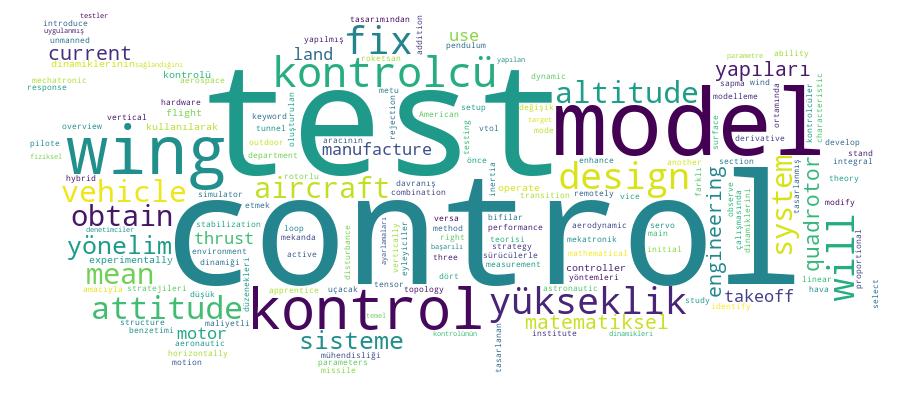
Competency Cloud

GCRIS Competency Cloud

Scholarly Output Search Results

Now showing 1 - 1 of 1
  • Conference Object
    Citation - Scopus: 14
    Attitude and Altitude Stabilization of a Fixed Wing Vtol Unmanned Air Vehicle
    (American Institute of Aeronautics and Astronautics Inc, AIAA, 2016) Güçlü,A.; Arıkan,K.B.; Kurtuluş,D.F.
    The aim of the current study is to introduce an overview about the design, manufacturing and testing of a Hybrid Air Vehicle (HAV). The designed vehicle will have the ability to vertically takeoff and landing in addition to fly horizontally as a fixed wing aircraft. A remotely piloted model aircraft (E-Flite Apprentice Model Plane) is selected for the initial tests and it is modified for the current purpose. A thrust measurement setup is used to obtain the thrust characteristics of the motors which are used in the model aircraft for system identification. Another test stand is also designed and manufactured to test the servo motor responses at the control surfaces of the HAV. Inertia tensor of the HAV is obtained experimentally by means of bifilar pendulum test method. The wing of the aircraft will be tested in the 1m x 1mtest section wind tunnel of Aerospace Engineering Department of METU to obtain aerodynamic characteristics. By means of experimentally identified system parameters, the HAV is modeled in Matlab/Simulink environment mathematically. The HAV has three main operating modes such as vertical takeoff and landing, transition to fixed wing flight or vice versa, and fixed wing flight. Combinations of a Linear Active Disturbance Rejection Controller (LADRC) and a Proportional Integral Derivative (PID) based control topologies will be designed for operating modes. To observe performance and enhance the developed system models and controllers, hardware in the loop tests will be done by means of a Flight Motion Simulator (FMS) of ROKETSAN Missile Inc. © 2016 by the American Institute of Aeronautics and Astronautics, Inc. All rights reserved.