
Yerlikaya Özkurt, Fatma
Loading...
Profile URL
Name Variants
Yerlikaya-Özkurt,F.
F., Yerlikaya Ozkurt
Y.,Fatma
Y., Fatma
Yerlikaya Özkurt,F.
Fatma Yerlikaya Özkurt
Yerlikaya Ozkurt,Fatma
Yerlikaya Ozkurt,F.
F., Yerlikaya Özkurt
Yerlikaya Ozkurt, Fatma
Fatma, Yerlikaya Özkurt
F.,Yerlikaya Özkurt
Y.Ö.Fatma
F.,Yerlikaya Ozkurt
Fatma, Yerlikaya Ozkurt
Y. Ö. Fatma
Y. O. Fatma
Yerlikaya Özkurt, Fatma
Yerlikaya-Ozkurt, Fatma
Yerlikaya-Ozkurt, Fatma
Yerlikaya-oezkurt, Fatma
Yerlikaya-Ozkurt,F.
Özkurt, Fatma Yerlikaya
Ozkurt, F. Yerlikaya
F., Yerlikaya Ozkurt
Y.,Fatma
Y., Fatma
Yerlikaya Özkurt,F.
Fatma Yerlikaya Özkurt
Yerlikaya Ozkurt,Fatma
Yerlikaya Ozkurt,F.
F., Yerlikaya Özkurt
Yerlikaya Ozkurt, Fatma
Fatma, Yerlikaya Özkurt
F.,Yerlikaya Özkurt
Y.Ö.Fatma
F.,Yerlikaya Ozkurt
Fatma, Yerlikaya Ozkurt
Y. Ö. Fatma
Y. O. Fatma
Yerlikaya Özkurt, Fatma
Yerlikaya-Ozkurt, Fatma
Yerlikaya-Ozkurt, Fatma
Yerlikaya-oezkurt, Fatma
Yerlikaya-Ozkurt,F.
Özkurt, Fatma Yerlikaya
Ozkurt, F. Yerlikaya
Job Title
Doktor Öğretim Üyesi
Email Address
fatma.yerlikaya@atilim.edu.tr
Main Affiliation
Industrial Engineering
Status
Former Staff
Website
ORCID ID
Scopus Author ID
Turkish CoHE Profile ID
Google Scholar ID
WoS Researcher ID
Sustainable Development Goals
 1
1NO POVERTY
0
Research Products
 2
2ZERO HUNGER
0
Research Products
 3
3GOOD HEALTH AND WELL-BEING
0
Research Products
 4
4QUALITY EDUCATION
0
Research Products
 5
5GENDER EQUALITY
0
Research Products
 6
6CLEAN WATER AND SANITATION
0
Research Products
 7
7AFFORDABLE AND CLEAN ENERGY
2
Research Products
 8
8DECENT WORK AND ECONOMIC GROWTH
2
Research Products
 9
9INDUSTRY, INNOVATION AND INFRASTRUCTURE
0
Research Products
 10
10REDUCED INEQUALITIES
0
Research Products
 11
11SUSTAINABLE CITIES AND COMMUNITIES
7
Research Products
 12
12RESPONSIBLE CONSUMPTION AND PRODUCTION
0
Research Products
 13
13CLIMATE ACTION
2
Research Products
 14
14LIFE BELOW WATER
0
Research Products
 15
15LIFE ON LAND
0
Research Products
 16
16PEACE, JUSTICE AND STRONG INSTITUTIONS
0
Research Products
 17
17PARTNERSHIPS FOR THE GOALS
0
Research Products

This researcher does not have a Scopus ID.

This researcher does not have a WoS ID.

Scholarly Output
18
Articles
14
Views / Downloads
52/35
Supervised MSc Theses
2
Supervised PhD Theses
0
WoS Citation Count
67
Scopus Citation Count
70
Patents
0
Projects
3
WoS Citations per Publication
3.72
Scopus Citations per Publication
3.89
Open Access Source
10
Supervised Theses
2
| Journal | Count |
|---|---|
| Natural Hazards | 2 |
| Journal of Applied Statistics | 2 |
| Journal of Industrial and Management Optimization | 2 |
| Journal of Dynamics and Games | 1 |
| Journal of Statistics and Management Systems | 1 |
Current Page: 1 / 3
Scopus Quartile Distribution
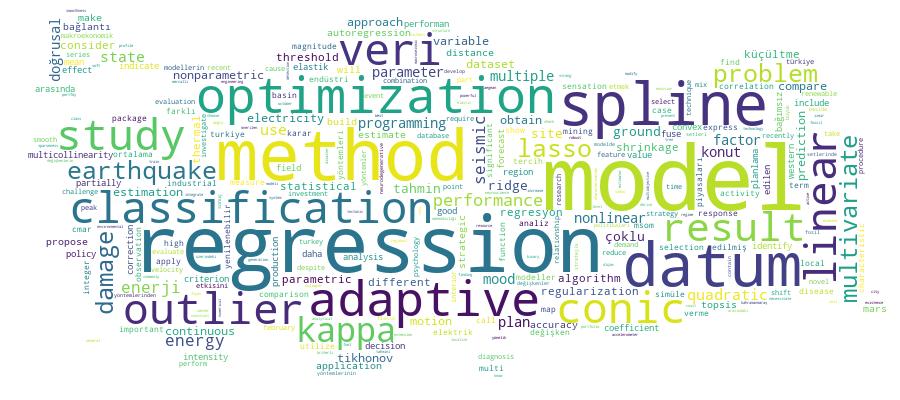
Competency Cloud
6 results
Scholarly Output Search Results
Now showing 1 - 6 of 6
Article Citation - WoS: 2Citation - Scopus: 3Modeling of Kappa Factor Using Multivariate Adaptive Regression Splines: Application To the Western Türkiye Ground Motion Dataset(Springer, 2024) Kurtulmus, Tevfik Ozgur; Yerlikaya-Ozkurt, Fatma; Askan, Aysegul; Yerlikaya–Özkurt, FatmaThe recent seismic activity on Turkiye's west coast, especially in the Aegean Sea region, shows that this region requires further attention. The region has significant seismic hazards because of its location in an active tectonic regime of North-South extension with multiple basin structures on soft soil deposits. Recently, despite being 70 km from the earthquake source, the Samos event (with a moment magnitude of 7.0 on October 30, 2020) caused significant localized damage and collapse in the Izmir city center due to a combination of basin effects and structural susceptibility. Despite this activity, research on site characterization and site response modeling, such as local velocity models and kappa estimates, remains sparse in this region. Kappa values display regional characteristics, necessitating the use of local kappa estimations from previous earthquake data in region-specific applications. Kappa estimates are multivariate and incorporate several characteristics such as magnitude and distance. In this study, we assess and predict the trend in mean kappa values using three-component strong-ground motion data from accelerometer sites with known VS30 values throughout western Turkiye. Multiple linear regression (MLR) and multivariate adaptive regression splines (MARS) were used to build the prediction models. The effects of epicentral distance Repi, magnitude Mw, and site class (VS30) were investigated, and the contributions of each parameter were examined using a large dataset containing recent seismic activity. The models were evaluated using well-known statistical accuracy criteria for kappa assessment. In all performance measures, the MARS model outperforms the MLR model across the selected sites.Article Citation - WoS: 1Citation - Scopus: 1Spline Based Sparseness and Smoothness for Partially Nonlinear Model Via C-Fused Lasso(American Institute of Mathematical Sciences, 2025) Taylan, P.; Yerlikaya-¨Ozkurt, F.; Tez, M.; Yerlikaya-Ozkurt, FatmaOne of the most beneficial and widely used models for data analysis are partially nonlinear models (PNLRM), which consists of parametric and nonparametric components. Since the model includes the coefficients of both the parametric and nonparametric parts, the complexity of the model will be high and its interpretation will be very difficult. In this study, we propose a procedure that not only achieves sparseness, but also smoothness for PNLRM to obtain a simpler model that better explains the relationship between the response and covariates. Thus, the fused Lasso problem is taken into account where nonparametric components are expressed as a spline basis function, and then the Fused Lasso estimation problem is built and expressed in terms of conic quadratic programming. Applications are conducted to evaluate the performance of the proposed method by considering commonly utilized measures. Promising results are obtained, especially in the data with nonlinearly correlated variables. © (2025), (American Institute of Mathematical Sciences). All rights reserved.Article Citation - WoS: 2Citation - Scopus: 2Enhancing Classification Modeling Through Feature Selection and Smoothness: a Conic-Fused Lasso Approach Integrated With Mean Shift Outlier Modelling(Amer inst Mathematical Sciences-aims, 2025) Yerlikaya-Ozkurt, Fatma; Taylan, PakizeOutlier detection and variable selection are among main objectives of statistical analysis. In our study, we address the outlier problem for classification by using the Mean Shift Outlier Model (CLMSOM). Since the MSOM has more coefficients than the linear regression model, the complexity of the model MSOM is high. Therefore, we consider feature selection for MSOM by using fused Lasso (FLasso), which is beneficial and helpful in the cases where the number of explanatory variables or features is greater than the sample size. FLasso is penalizing both the coefficients and their successive differences by the L-1-norm, and it allows sparsity for both of them, while Lasso only allows the coefficients by considering a nonsmooth optimization problem. In this study, we take into account Iterated Ridge approximation which enables us to use a smooth optimization for FLasso problem. Generated smooth optimization problem is solved by using one of continuous optimization techniques called Conic Quadratic Programming (CQP), which is enabling the utilization of interior point methods. The newly developed method is called Conic FLasso for classification by MSOM (C-FLasso-CLMSOM) and is applied to real world data set to show its performance.Master Thesis Elektrik Talep Tahminine Dayalı Karma Tam Sayılı Programlama ile Türkiye'nin Stratejik Enerji Üretimi Planlaması(2021) Yörük, Gökay; Baç, Uğur; Özkurt, Fatma YerlikayaBu tezde, Türkiye için enerji planlama problemi, stratejik planlama, enerji politikası, enerji güç kapasite planlaması, teknoloji seçimi ve çevre politikaları açısından ele alınmaktadır. Stratejik elektrik planlaması kapsamında; fosil yakıtlar, yenilenebilir enerji, nükleer enerji gibi alternatif teknolojileri göz önünde bulunduran karışık tam sayılı matematiksel programlama modeli önerilmiştir. Çalışmada maliyetin (yatırım, operasyon ve bakım) en küçüklenmesine ek olarak, CO2 emisyonunun sınırlandırılması, enerji kaynak paylaşımı kısıtlama politikaları ve yenilenebilir enerji teşvik politikaları gibi hususlar önerilen modelde ele alınmıştır. Planlama sürecinde elektrik talebini tahmin etmek için regresyon metotları, üstel düzeltme, Winter ve Otoregresif Entegre Hareketli Ortalama (ARIMA) yöntemleri gibi bir dizi tahmin tekniği kullanılmış ve farklı hata ölçüm kriterleri kullanılarak en iyi yöntem seçilmiştir. Modelin bir uygulaması olarak Türkiye'nin Stratejik Elektrik Planlama Problemi ele alınmış ve iki farklı (2021-2030 ve 2021-2040) planlama aralığı için çözülmüştür. Sonuçlar, yenilenebilir enerji üretim seçenekleri olan güneş, rüzgâr ve hidroelektrik alternatiflerinin kullanımının önemli ölçüde artacağını, enerji üretiminde fosil yakıtların kullanımının ise belirgin bir şekilde azalacağını göstermektedir. Sonuç olarak, bu araştırma yenilenebilir enerji yatırımlarının kademeli olarak artırılmasını ve uzun vadede fosil yakıt alternatiflerinin yerini almasını önermektedir. Bu değişiklik yalnızca yatırım, işletme ve bakım maliyetlerini düşürmekle kalmayacak, aynı zamanda emisyon seviyesini de önemli ölçüde düşürecektir.Master Thesis Çoklu Bağlantı Sorunu Durumunda Küçültme Yöntemlerinin Karşılaştırılması ve Değerlendirilmesi(2022) Kılıçoğlu, Şevval; Kılıçoğlu, Şevval; Yerlikaya Özkurt, Fatma; Kılıçoğlu, Şevval; Yerlikaya Özkurt, Fatma; Özkurt, Fatma Yerlikaya; Industrial Engineering; Industrial EngineeringMühendislik, tıp, doğa ve sosyal bilimler gibi uygulamalı bilimlerin birçok alanında veri analizi ve veri yorumlamanın kullanımı artarak önem kazanmaktadır. Bu amaç doğrultusunda veri toplamak, analiz etmek ve yorumlamak için istatistiksel yöntemler kullanılmaktadır. Basitliği ve kolay yorumlanması nedeniyle, en çok tercih edilen istatistiksel analiz yöntemlerinden biri, çoklu doğrusal regresyondur. Bu regresyon modelleri, birden fazla bağımsız değişken ile bir bağımlı değişken arasındaki ilişkiyi tanımlar. Ancak bazen çoklu doğrusal regresyon modelinin uygulanacağı veri setlerinde bağımsız değişkenler arasında çoklu doğrusal bağlantı (iç ilişki) olduğu gözlemlenebilir. Bu da, modelde tahmin edilen katsayıların varyansının büyük ve yanlılıklarının düşük olmasına neden olmaktadır. Bu gibi durumlarda model tahminleri doğru sonuç vermeyebilir ve modelin güvenilirliği düşebilir. Veri setindeki değişkenler arasında çoklu doğrusal bağlantı varsa bunun önceden belirlenmesi büyük önem taşımaktadır. Bu amaç doğrultusunda kullanılan çok sayıda çoklu doğrusal bağlantı tespit etme yöntemi ve bu sorunu çözmek için geliştirilmiş çeşitli yöntemler bulunmaktadır. Çoklu doğrusal bağlantı problemini çözmek için en popüler ve güçlü yöntemler küçültme yöntemleridir. Küçültme yöntemleri, modelde tahmin edilen parametrelerin varyansını azaltarak çoklu doğrusal bağlantı sorununu en aza indirmeyi amaçlar. En çok tercih edilen küçültme yöntemlerinden olan Ridge Regresyon, Lasso ve Elastik Net modeldeki değişkenlerin katsayılarını direkt sıfır yapar veya sıfıra çok yaklaştırır. Bu tez çalışmasında, Ridge Regresyon, Lasso ve Elastik Net, farklı özelliklere sahip dokuz farklı simüle edilmiş veri setine uygulanmıştır. Simüle edilmiş veri setlerindeki bazı bağımsız değişkenler arasında çoklu doğrusal bağlantıyı oluşturmak için Copula fonksiyonu kullanılmıştır. Daha sonra, yukarıda bahsedilen küçültme yöntemlerinin tümü, üç tane gerçek hayat veri setine de uygulanmıştır. Bu veri setleri, boyutlarına göre küçük, orta ve büyük olarak sınıflandırılan simüle edilmiş veri setleri ile eşleştirilmiştir. Simüle edilmiş veri setlerine uygulanan küçültme yöntemlerinin doğruluğunu ölçmek için 10 Katlamalı Çapraz Doğrulama yaklaşımı uygulanmıştır. Bunun yanında, gerçek hayat veri setleri için, veri setini yalnızca bir eğitim ve bir test verisine ayırmaya dayanan hold-out yöntemi tercih edilmiştir. Tüm modeller oluşturulduktan sonra, hangi özelliklere sahip veri setlerinde hangi yöntemin daha iyi sonuç verdiğini belirlemek için her bir yöntem özelinde bazı performans ölçütleri hesaplanmıştır. Ortalama kare hatası (MSE), bağımsız değişken sayısına bağlı ortalama kare hatası (PMSE), R-kare, ortalama mutlak hata (MAE) ve açıklanan varyans, karar verme aşamasında kullanılan performans ölçütleridir. Performans sonuçlarından yola çıkarak, küçültme yöntemleri çok kriterli karar verme yöntemlerinden biri olan TOPSIS ile karşılaştırılmış ve her bir veri seti için yöntemlerin tercih sırası belirlenmiştir. Tüm performans ve TOPSIS sonuçları incelendiğinde, genellikle küçük veri setlerinde en iyi sonuçları ridge regresyonunun verdiği, veri seti büyüdükçe yani karmaşıklık arttıkça küçültme yöntemlerinin tahmin edilen katsayıların varyansını azaltmak için değişken seçimi yapma eğiliminde olduğu ve bu yüzden de lasso ve elastik net modellerinin daha iyi sonuçlar verdiği görülmektedir. Modeller arasında genel bir sıralama yapılacak olursa lasso, elastik net ve ridge regresyonu olarak sıralanabilir.Article Citation - WoS: 9Citation - Scopus: 9Modeling the Mood State on Thermal Sensation With a Data Mining Algorithm and Testing the Accuracy of Mood State Correction Factor(Pergamon-elsevier Science Ltd, 2025) Yerlikaya-Ozkurt, Fatma; Ozbey, Mehmet Furkan; Turhan, CihanPsychology is proven as an influencing factor on thermal sensation. On the other hand, mood state is one of the significant parameters in psychology field. To this aim, in the literature, mood state correction factor on thermal sensation (Turhan and Ozbey coefficients) is derived utilizing with data-driven black-box model. However, novel models which present analytical form of the mood state correction factor should be derived based on the several descriptive variables on thermal sensation. Moreover, the result of this factor should also be checked with analytical model results. Therefore, this study investigates the modelling of mood state correction factor with a data mining algorithm, called Multivariate Adaptive Regression Splines (MARS). Additionally, the mood state is also taken as a thermal sensation parameter besides environmental parameters in this algorithm. The same data, which are collected from a university study hall in a temperate climate zone, are used and the model results are compared with the thermal sensation results based on mood state correction factor which is driven via black-box model. The results show that coefficient of correlation "r" between the MARS and black-box model is found as 0.9426 and 0.9420 for training and testing. Hence, the mood state is also modelled via a data mining algorithm with a high accuracy, besides the black-box model.