Demir, Mehmet Emin

Loading...
Profile Picture
Name Variants
Demir, M. E.
Mehmet Emin, Demir
Demir M.
Demir,M.E.
D.,Mehmet Emin
D., Mehmet Emin
M. E. Demir
M.E.Demir
Emin M.
Demir, Mehmet E.
M., Demir
Demir, Mehmet Emin
M.,Demir
Job Title
Doçent Doktor
Email Address
mehmet.demir@atilim.edu.tr
Main Affiliation
Internal Medical Sciences
Status
Website
ORCID ID
Scopus Author ID
Turkish CoHE Profile ID
Google Scholar ID
WoS Researcher ID

Sustainable Development Goals

2

ZERO HUNGER
ZERO HUNGER Logo

0

Research Products

14

LIFE BELOW WATER
LIFE BELOW WATER Logo

0

Research Products

17

PARTNERSHIPS FOR THE GOALS
PARTNERSHIPS FOR THE GOALS Logo

0

Research Products

5

GENDER EQUALITY
GENDER EQUALITY Logo

0

Research Products

16

PEACE, JUSTICE AND STRONG INSTITUTIONS
PEACE, JUSTICE AND STRONG INSTITUTIONS Logo

0

Research Products

8

DECENT WORK AND ECONOMIC GROWTH
DECENT WORK AND ECONOMIC GROWTH Logo

0

Research Products

4

QUALITY EDUCATION
QUALITY EDUCATION Logo

0

Research Products

6

CLEAN WATER AND SANITATION
CLEAN WATER AND SANITATION Logo

1

Research Products

7

AFFORDABLE AND CLEAN ENERGY
AFFORDABLE AND CLEAN ENERGY Logo

0

Research Products

10

REDUCED INEQUALITIES
REDUCED INEQUALITIES Logo

0

Research Products

11

SUSTAINABLE CITIES AND COMMUNITIES
SUSTAINABLE CITIES AND COMMUNITIES Logo

0

Research Products

9

INDUSTRY, INNOVATION AND INFRASTRUCTURE
INDUSTRY, INNOVATION AND INFRASTRUCTURE Logo

0

Research Products

1

NO POVERTY
NO POVERTY Logo

0

Research Products

3

GOOD HEALTH AND WELL-BEING
GOOD HEALTH AND WELL-BEING Logo

5

Research Products

12

RESPONSIBLE CONSUMPTION AND PRODUCTION
RESPONSIBLE CONSUMPTION AND PRODUCTION Logo

0

Research Products

13

CLIMATE ACTION
CLIMATE ACTION Logo

0

Research Products

15

LIFE ON LAND
LIFE ON LAND Logo

0

Research Products
Documents

30

Citations

361

h-index

8

Documents

47

Citations

501

Scholarly Output

11

Articles

10

Views / Downloads

4/0

Supervised MSc Theses

0

Supervised PhD Theses

0

WoS Citation Count

22

Scopus Citation Count

18

WoS h-index

2

Scopus h-index

2

Patents

0

Projects

0

WoS Citations per Publication

2.00

Scopus Citations per Publication

1.64

Open Access Source

10

Supervised Theses

0

Google Analytics Visitor Traffic

JournalCount
Frontiers in Immunology2
Frontiers in Public Health1
Frontiers in Systems Neuroscience1
International Journal of General Medicine1
International Urology and Nephrology1
Current Page: 1 / 2

Scopus Quartile Distribution

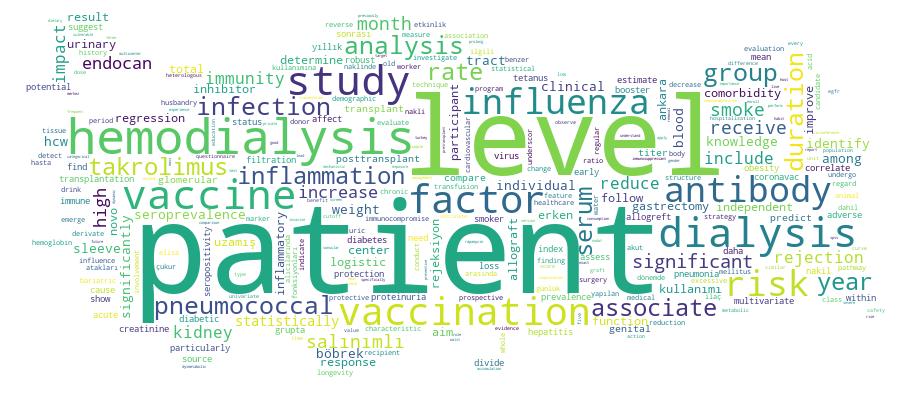
Competency Cloud

GCRIS Competency Cloud

Scholarly Output Search Results

Now showing 1 - 3 of 3
  • Article
    Böbrek Naklinde de Novo Uzamış Salınımlı Takrolimus Kullanımı Sonuçları: Tek Merkez, 1 Yıllık Sonuçlar
    (2022) Sarıyıldız, Gülçin Türkmen; Demir, Mehmet Emin; Sezer, Siren; Sozener, Ulas; Ercan, Zafer; Gulen, Merter; Özşeker, Fatma Necla
    Amaç: Böbrek nakli alıcılarında günde tek doz uzamış salınımlı takrolimus (tac-ER) kullanımı, erken salınımlı takrolimus (tac-IR) kullanımına benzer etkinlik ve daha iyi ilaç uyumu sağlaması amacıyla geliştirilmiştir. Ancak uzamış salınımlı takrolimus ile ilgili deneyimler daha çok nakil sonrası dönemde yapılan “switch” protokollerine dayanmaktadır. Bu çalışmada böbrek alıcılarında de novo tac-ER kullanımı ile ilgili deneyimlerimizi ve 1 yıllık sonuçları sunmayı amaçladık. Gereç ve Yöntem: Bu tek merkezli retrospektif çalışmaya Ocak 2022-Ocak 2021 arasında yapılan 72 de novo böbrek nakli hastası dahil edilmiştir. Hastalar tac- ER ve tac-IR alan iki gruba ayrıldı. Bir yıllık allogreft fonksiyonları ve sağ kalımları, hastaların günlük ilaç dozları ve bunların akut rejeksiyon atakları ile ilişkileri karşılaştırıldı. Allogreft fonksiyonları ve akut rejeksiyon atakları üzerine etki eden faktörler incelendi. Bulgular: Toplam 69 hastanın (uzamış salınımlı grupta 30 hasta ve erken salınımlı grupta 39 hasta) verileri incelendi. Üç hasta posttransplant erken dönemde öldüğü için analize dahil edilmedi. Nakil sonrası 12 aylık izlem boyunca her iki grup arasında serum kreatinin ve takrolimus çukur değerler bencer bulundu (p>0,05). İlk 3 ay içinde hedef takrolimus değerlere ulaşmak için, tac-ER grubunda daha yüksek günlük dozlar (milligra/gün ve milligram/gün/kg) gerekti (p<0,05). Nakil sonrası ilk 12 ay içinde her iki grupta da rejeksiyon oranları benzerdi (p=0,281). Tek değişkenli analizde posttransplant 1. aydaki takrolimus dozu (milligram/kg/gün) takrolimus çukur değerinin aksine rejeksiyon gelişimi üzerinde etkili görüldü (p=0,02). Sonuç: Böbrek naklinde uzamış salınımlı takrolimusun (Advagraf®) de novo kullanımı, erken salınımlı takrolimus kullanımına benzer etkinlik, allogreft sağ kalımı ve fonksiyonu sağlar.
  • Article
    Citation - WoS: 14
    Citation - Scopus: 15
    The Results of Sglt-2 Inhibitors Use in Kidney Transplantation: 1-Year Experiences From Two Centers
    (Springer, 2023) Demir, Mehmet Emin; Ozler, Tuba Elif; Merhametsiz, Ozgur; Sozener, Ulas; Uyar, Murathan; Ercan, Zafer; Turkmen Sariyildiz, Gulcin
    PurposeSodium-glucose co-transporter-2 inhibitor (SGLT-2i) administration is associated with some concerns in regard to the increased risk of genital and urinary tract infections (UTI) in kidney transplant recipients (KTR). In this study, we present the results of SGLT-2i use in KTR, including the early post-transplant period.MethodsParticipants were divided into two groups: SGLT-2i-free diabetic KTR (Group 1, n = 21) and diabetic KTR using SGLT-2i (Group 2, n = 36). Group 2 was further divided into two subgroups according to the posttransplant prescription day of SGLT-2i; < 3 months (Group 2a) and >= 3 months (Group 2b). Groups were compared for development of genital and urinary tract infections, glycated hemoglobin a1c (HgbA1c), estimated glomerular filtration rate (eGFR), proteinuria, weight change, and acute rejection rate during 12-month follow-up.ResultsUrinary tract infections prevalence was 21.1% and UTI-related hospitalization rate was 10.5% in our cohort. Prevalence of UTI and UTI-related hospitalization, eGFR, HgbA1c levels, and weight gain were similar between the SGLT-2i group and SGLT-2i-free group, at the 12-month follow-up. UTI prevalence was similar between groups 2a and 2b (p = 0.871). No case of genital infection was recorded. Significant proteinuria reduction was observed in Group 2 (p = 0.008). Acute rejection rate was higher in the SGLT-2i-free group (p = 0.040) and had an impact on 12-month follow-up eGFR (p = 0.003).ConclusionSGLT-2i in KTR is not associated with an increased risk of genital infection and UTI in diabetic KTR, even in the early posttransplant period. The use of SGLT-2i reduces proteinuria in KTR and has no adverse effects on allograft function at the 12-month follow-up.
  • Article
    Citation - WoS: 1
    Citation - Scopus: 1
    Factors Affecting Influenza and Pneumococcal Vaccination Rates in Hemodialysis Patients: a Multicenter Study
    (Dove Medical Press Ltd, 2025) Selen, Tamer; Merhametsiz, Ozgur; Onec, Kuersad; Ercan, Zafer; Islam, Mahmud; Altun, Gulsah; Demir, Mehmet Emin
    Purpose: In patients with end-stage renal disease (ESRD), infections, particularly pneumonias, are the most common cause of hospital admissions and death after cardiovascular diseases. It is recommended that dialysis patients receive the pneumococcal vaccine every five years and the influenza vaccine annually. Our study aims to determine the awareness and factors affecting influenza and pneumococcal vaccination rates in hemodialysis patients. Patients and Methods: This cross-sectional study was conducted on patients undergoing regular hemodialysis treatment in 10 different hemodialysis centers across 4 cities. After excluding patients with less than one year of hemodialysis duration and those under 18 years of age, 548 patients were included in the study. Patients were administered a 20-item survey via face-to-face interview and electronic medical records. Results: Out of the 548 patients, only 19 (3.5%) had knowledge about the pneumococcal vaccine, while 238 (43.4%) had knowledge about the influenza vaccine. There were 220 patients (20.1%) who had knowledge about both vaccines. Among the patients, 95 (17.3%) had received the pneumococcal vaccine, with 41.1% of them having received it five years ago or more. A significant proportion (33.7%) of the patients could not recall the timing of their vaccination. While 183 (33.4%) patients had not received the influenza vaccine, only 140 (25.5%) had been vaccinated regularly every year. The reasons for not receiving the influenza and pneumococcal vaccines were stated as "I do not feel the need because I do not get the flu" (25%) and "I do not know about the pneumonia vaccine" (36.7%), respectively. The ROC curve analysis for the influenza questionnaire score showed an AUC of 0.822 (95% CI 0.787-0.856), with a p-value of <0.001. The statistically significant cutoff value for predicting influenza vaccination was determined to be 2.5. In the univariate analysis, dialysis duration (HD duration), diabetes mellitus (DM), and vascular access type were found to be statistically significant. In the multivariate logistic regression analysis, dialysis duration and DM were identified as independent factors predicting a higher level of knowledge about the influenza vaccine (p=0.009, 0.003, and p=0.041). The ROC curve analysis for the pneumococcal questionnaire score showed an AUC of 0.920 (95% CI 0.886-0.955), with a p-value of <0.001. The statistically significant cutoff value for predicting pneumococcal vaccination was determined to be 3.5. In the univariate analysis, residence, dialysis duration, and education level were found to be statistically significant. In the multivariate logistic regression analysis, dialysis duration and education level were identified as independent factors predicting a higher level of knowledge about the pneumococcal vaccine (p=0.038, 0.040, and p=0.010). physicians, nurses and nephrologists on this issue will increase vaccination rates.