Kılıç, Hürevren

Loading...
Profile Picture
Name Variants
H., Kilic
Hürevren, Kılıç
Hurevren, Kilic
Kiliç H.
H.,Kilic
H.,Kılıç
H., Kılıç
K., Hürevren
K.,Hurevren
Kılıç,H.
Kilic,H.
Hürevren Kılıç
K.,Hürevren
K., Hurevren
Kilic H.
Kılıç H.
Kılıç, Hürevren
Kilic, Hurevren
Kilic,Hurevren
Job Title
Profesör Doktor
Email Address
hurevren.kilic@atilim.edu.tr
Main Affiliation
Computer Engineering
Status
Scopus Author ID
Turkish CoHE Profile ID
Google Scholar ID
WoS Researcher ID

Sustainable Development Goals

NO POVERTY1
NO POVERTY
0
Research Products
ZERO HUNGER2
ZERO HUNGER
0
Research Products
GOOD HEALTH AND WELL-BEING3
GOOD HEALTH AND WELL-BEING
1
Research Products
QUALITY EDUCATION4
QUALITY EDUCATION
1
Research Products
GENDER EQUALITY5
GENDER EQUALITY
0
Research Products
CLEAN WATER AND SANITATION6
CLEAN WATER AND SANITATION
2
Research Products
AFFORDABLE AND CLEAN ENERGY7
AFFORDABLE AND CLEAN ENERGY
0
Research Products
DECENT WORK AND ECONOMIC GROWTH8
DECENT WORK AND ECONOMIC GROWTH
0
Research Products
INDUSTRY, INNOVATION AND INFRASTRUCTURE9
INDUSTRY, INNOVATION AND INFRASTRUCTURE
0
Research Products
REDUCED INEQUALITIES10
REDUCED INEQUALITIES
0
Research Products
SUSTAINABLE CITIES AND COMMUNITIES11
SUSTAINABLE CITIES AND COMMUNITIES
0
Research Products
RESPONSIBLE CONSUMPTION AND PRODUCTION12
RESPONSIBLE CONSUMPTION AND PRODUCTION
0
Research Products
CLIMATE ACTION13
CLIMATE ACTION
0
Research Products
LIFE BELOW WATER14
LIFE BELOW WATER
0
Research Products
LIFE ON LAND15
LIFE ON LAND
0
Research Products
PEACE, JUSTICE AND STRONG INSTITUTIONS16
PEACE, JUSTICE AND STRONG INSTITUTIONS
0
Research Products
PARTNERSHIPS FOR THE GOALS17
PARTNERSHIPS FOR THE GOALS
1
Research Products
This researcher does not have a Scopus ID.
This researcher does not have a WoS ID.
Scholarly Output

34

Articles

8

Views / Downloads

50/0

Supervised MSc Theses

10

Supervised PhD Theses

0

WoS Citation Count

66

Scopus Citation Count

63

Patents

0

Projects

0

WoS Citations per Publication

1.94

Scopus Citations per Publication

1.85

Open Access Source

2

Supervised Theses

10

JournalCount
International Journal of Engineering Education3
Proceedings of the 2007 Inaugural IEEE-IES Digital EcoSystems and Technologies Conference, DEST 2007 -- 2007 Inaugural IEEE-IES Digital EcoSystems and Technologies Conference, DEST 2007 -- 21 February 2007 through 23 February 2007 -- Cairns -- 702542
2014 IEEE Symposium on Intelligent Agents (IA) -- DEC 09-12, 2014 -- Orlando, FL1
21st Signal Processing and Communications Applications Conference (SIU) -- APR 24-26, 2013 -- CYPRUS1
26th Annual International Symposium on Computer and Information Science -- SEP 26-28, 2011 -- Royal Soc London, London, ENGLAND1
Current Page: 1 / 5

Scopus Quartile Distribution

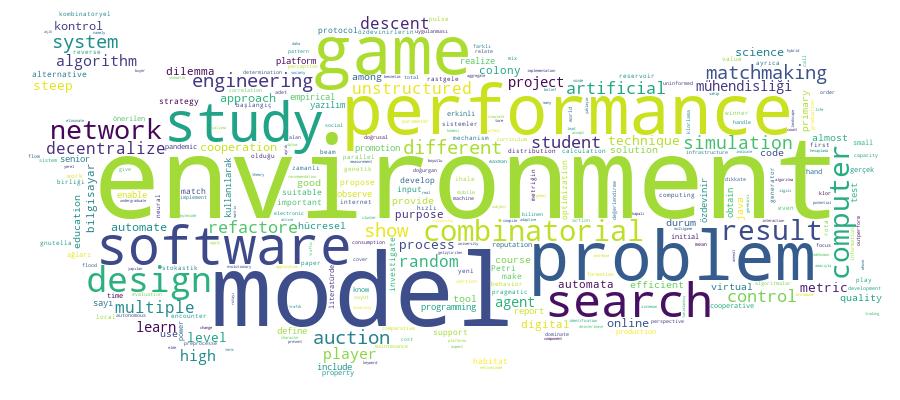
Competency Cloud

GCRIS Competency Cloud

Scholarly Output Search Results

Now showing 1 - 3 of 3
  • Conference Object
    Citation - WoS: 13
    Search-Based Parallel Refactoring Using Population-Based Direct Approaches
    (Springer-verlag Berlin, 2011) Kilic, Hurevren; Koc, Ekin; Cereci, Ibrahim
    Automated software refactoring is known to be one of the "hard" combinatorial optimization problems of the search-based software engineering field. The difficulty is mainly due to candidate solution representation, objective function description and necessity of functional behavior preservation of software. The problem is formulated as a combinatorial optimization problem whose objective function is characterized by an aggregate of object-oriented metrics or pareto-front solution description. In our recent empirical study, we have reported the results of a comparison among alternative search algorithms applied for the same problem: pure random, steepest descent, multiple first descent, simulated annealing, multiple steepest descent and artificial bee colony searches. The main goal of the study was to investigate potential of alternative multiple and population-based search techniques. The results showed that multiple steepest descent and artificial bee colony algorithms were most suitable two approaches for an efficient solution of the problem. An important observation was either with depth-oriented multiple steepest descent or breadth-oriented population-based artficial bee colony searches, better results could be obtained through higher number of executions supported by a lightweight solution representation. On the other hand different from multiple steepest descent search, population-based, scalable and being suitable for parallel execution characteristics of artificial bee colony search made the population-based choices to be the topic of this empirical study. I In this study, we report the search-based parallel refactoring results of an empirical comparative study among three population-based search techniques namely, artificial bee colony search, local beam search and stochastic beam search and a non-populated technique multiple steepest descent as the baseline. For our purpose, we used parallel features of our prototype automated refactoring tool A-CMA written in Java language. A-CMA accepts bytecode compiled Java codes as its input. It supports 20 different refactoring actions that realize searches on design landscape defined by an adhoc quality model being an aggregation of 24 object-oriented software metrics. We experimented 6 input programs written in Java where 5 of them being open source codes and one student project code. The empirical results showed that for almost all of the considered input programs with different run parameter settings, local beam search is the most suitable population-based search technique for the efficient solution of the search-based parallel refactoring problem in terms of mean and maximum normalized quality gain. However, we observed that the computational time requirement for local beam search becomes rather high when the beam size exceeds 60. On the other hand, even though it is not able to identify high quality designs for less populated search setups, time-efficiency and scalability properties of artificial bee colony search makes it a good choice for population sizes >= 200.
  • Conference Object
    On the Power Consumption of Digital Computing Systems;
    (2005) Kiliç,H.
    In this paper, the predictability of power consumption of digital computing systems is investigated by using the abstract Turing machine model which is known to be a universal computer. An upper bound for power consumption of such machine model is defined. Also, a polynomial-time algorithm that can automatically produce a two-tape Turing machine which can record power consumption of an arbitrarily given standart Turing machine, is developed. ©2005 IEEE.
  • Conference Object
    Citation - WoS: 8
    Citation - Scopus: 12
    Low-power Test Pattern Generator design for BIST via Non-Uniform Cellular Automata
    (Ieee, 2005) Kiliç, H; Öktem, L
    An efficient low-power Test Pattern Generator (TPG) design for Built-In Self-Test (BIST) is introduced. The approach uses the Non-Uniform Cellular Automata (NUCA) model. For our purpose, we designed a polynomial-time algorithm that converts the test pattern generation problem into the classical combinatorial problem called Minimum Set Covering (MSC) which is known to be NP-Complete. Solutions to the MSC problems give the low-power design topology for the test pattern sequence. Comparative analysis of the experimental results showed that even though the obtained designs lack in wiring uniformity they are promising in terms of overall performance criteria based on fault-coverage, test length, used area and dynamic power consumed.