
Konca, Erkan
Loading...
Profile URL
Name Variants
Konca E.
K., Erkan
K.,Erkan
Konca, E.
Erkan, Konca
E., Konca
Konca, E
E.,Konca
Konca, Erkan
Konca,E.
K., Erkan
K.,Erkan
Konca, E.
Erkan, Konca
E., Konca
Konca, E
E.,Konca
Konca, Erkan
Konca,E.
Job Title
Doçent Doktor
Email Address
erkan.konca@atilim.edu.tr
Main Affiliation
Metallurgical and Materials Engineering
Status
Website
ORCID ID
Scopus Author ID
Turkish CoHE Profile ID
Google Scholar ID
WoS Researcher ID
Sustainable Development Goals
5
GENDER EQUALITY

0
Research Products
14
LIFE BELOW WATER

0
Research Products
10
REDUCED INEQUALITIES

0
Research Products
3
GOOD HEALTH AND WELL-BEING

1
Research Products
2
ZERO HUNGER

0
Research Products
9
INDUSTRY, INNOVATION AND INFRASTRUCTURE

1
Research Products
16
PEACE, JUSTICE AND STRONG INSTITUTIONS

0
Research Products
11
SUSTAINABLE CITIES AND COMMUNITIES

0
Research Products
8
DECENT WORK AND ECONOMIC GROWTH

0
Research Products
13
CLIMATE ACTION

0
Research Products
4
QUALITY EDUCATION

0
Research Products
6
CLEAN WATER AND SANITATION

0
Research Products
1
NO POVERTY

0
Research Products
15
LIFE ON LAND

0
Research Products
17
PARTNERSHIPS FOR THE GOALS

0
Research Products
7
AFFORDABLE AND CLEAN ENERGY

3
Research Products
12
RESPONSIBLE CONSUMPTION AND PRODUCTION

0
Research Products

Documents
25
Citations
880
h-index
18

Documents
23
Citations
771

Scholarly Output
22
Articles
10
Views / Downloads
25/0
Supervised MSc Theses
5
Supervised PhD Theses
3
WoS Citation Count
112
Scopus Citation Count
111
WoS h-index
6
Scopus h-index
5
Patents
0
Projects
0
WoS Citations per Publication
5.09
Scopus Citations per Publication
5.05
Open Access Source
5
Supervised Theses
8
Google Analytics Visitor Traffic
| Journal | Count |
|---|---|
| Metals | 2 |
| Hittite Journal of Science and Engineering | 1 |
| International Journal of Electrochemical Science | 1 |
| International Journal of Surface Science and Engineering | 1 |
| Journal of Materials Science | 1 |
Current Page: 1 / 3
Scopus Quartile Distribution
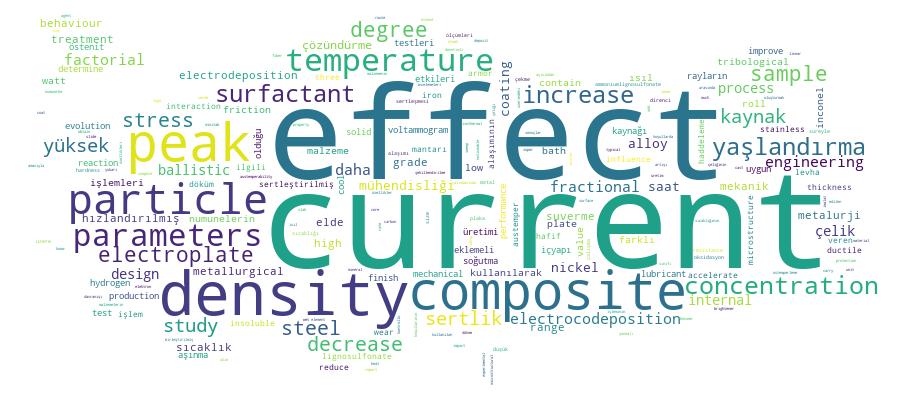
Competency Cloud
10 results
Scholarly Output Search Results
Now showing 1 - 10 of 10
Article Citation - WoS: 23Citation - Scopus: 27Effect of Electrodeposition Parameters on the Current Density of Hydrogen Evolution Reaction in Ni and Ni-mos2 Composite Coatings(Esg, 2013) Gueler, E. Saraloglu; Konca, E.; Karakaya, I.; Metallurgical and Materials EngineeringNickel composites with co-deposited insoluble, solid lubricant particles such as MoS2 have been reported to reduce friction. It is known that hydrogen evolution reaction (HER), competes with nickel deposition. The influence of the parameters and their interaction effects on the peak current density of HER during the electrodeposition of Ni and Ni-MoS2 composite coatings were studied by fractional factorial design. The parameters and their ranges studied were; MoS2 particle concentration (0-30 g/l), temperature (30-50 degrees C), pH (2-4) and two surfactants, namely; ammoniumlignosulfonate (ALS) and depramin-C (DC) (0-1 g/l). Electrodeposition processes were carried out from a typical Watts bath containing leveler, wetting agent and brightener by using a potentiostat. The peak current densities (i(p)) were extended to higher values and the peaks on linear sweep voltammograms became noticeable by increasing the scan rate from 20 mV/s to 100 mV/s over the range of 0 to 2.5 V. The peak current densities (i(p)) of HER for each experimental route were determined by fractional factorial design for two mineral processing surfactants; ammoniumlignosulfonate (ALS) and depramin-C (DC) using a statistical analysis software named Minitab [1]. Adding MoS2, decreasing temperature and increasing pH had decreasing effects on the peak current density of HER regardless of the surfactant used. On the other hand, the surfactants increased the peak current density.Article Citation - WoS: 10Citation - Scopus: 20A Comparison of the Ballistic Performances of Various Microstructures in Mil-A Armor Steel(Mdpi, 2020) Konca, ErkanDue to their advantageous properties, there is a growing interest in developing armor steels containing fully or partially bainitic microstructures. In this study, bainitic and martensitic microstructures were obtained in rolled homogeneous armor (RHA) steel samples and their ballistic protection performances were investigated. RHA (MIL-A-12560) steel samples were subjected to isothermal heat treatments at three different temperatures, where one temperature (360 degrees C) was above the martensite formation start (Ms) temperature of 336 degrees C while the other two (320 degrees C and 270 degrees C) were below. For the assessment of the ballistic protection performance, the kinetic energy losses of the 12.7 mm bullets fired at the test samples were determined. The promising nature of the bainite microstructure was confirmed as the sample isothermally treated at 360 degrees C provided approximately 10% higher ballistic protection as compared to the regular RHA sample of tempered martensite microstructure. However, the ballistic performances of the isothermally treated samples decreased as the treatment temperature went below the Ms temperature. Following the ballistic tests, hardness measurements, impact tests at -40 degrees C, and macro- and microstructural examinations of the samples were performed. No correlation was found between the hardness and impact energies of the samples and their ballistic performances.Article ÖSTENİTLEME SICAKLIĞININ EN-GJS-600-3 KÜRESEL GRAFİTLİ DÖKME DEMİRİN ÖSTEMPERLENME DAVRANIŞINA ETKİLERİNİN ARAŞTIRILMASI(2020) Konca, Erkan; Tur, K ZımBu çalışmada östenitleme sıcaklığının EN-GJS-600-3 (GGG-60) küresel grafitli dökme demirinöstemperlenme davranışına etkisi araştırılmıştır. Y bloklarına dökülen % 0,5 Cu alaşımlı EN-GJS-600-3küresel grafitli dökme demirden çıkarılan numuneler kullanılarak iki farklı östenitleme sıcaklığı (850 ve950°C) ve iki farklı östemperleme sıcaklığının (290 ve 320°C) dört ayrı kombinasyonunda östemperlemedeneyleri yapılmıştır. Östemperleme deneyleri sonrası numunelerin sertlik ölçümleri, çekme testleri ve içyapı incelemeleri gerçekleştirilmiştir. Her iki östemperleme sıcaklığında da 950°C’de östenitlenmişnumunelerde 850°C’de östenitlenmiş numunelere göre daha yüksek sertlik, akma ve çekme dayanımıdeğerlerine ulaşılmıştır. Bu sonuçlar, 950°C’de yapılan östenitlemenin 850°C’ye göre östenit matris içindehem daha çok karbonun çözünmesini hem de östenitin daha iri taneli olmasını sağlayaraköstemperlenmeye daha elverişli östenit yapısı oluşturabilmesiyle ilişkilendirilmiştir.Article Citation - WoS: 18Investigation of the Tribological Behaviour of Electrocodeposited Ni-mos2 Composite Coatings(inderscience Enterprises Ltd, 2017) Guler, Ebru Saraloglu; Konca, Erkan; Karakaya, IshakComposite electroplating of solid lubricants in a metal matrix is an effective way to lower coefficient of friction (COF) and improve wear resistance of surfaces in sliding contact. In this work, Ni-MoS2 composite coatings were deposited on AISI 304 stainless steel substrates by electroplating from Watts bath containing suspended MoS2 particles and their tribological behaviour was studied. The effects of MoS2 particle concentration (5, 10 and 30 g/l), MoS2 particle size (1.440 and 5.156 mu m), pH (2, 3 and 4), current density (3.8, 4.8 and 5.8 A/dm(2)) and the surfactant (sodium lignosulfonate, SLS) concentration (0.3 and 1 g/l) on the tribological behaviour were investigated using a ball-on-disc tribometer at ambient conditions. Lower current density, smaller particle size and higher concentration of MoS2 decreased COF. While increasing the surfactant concentration decreased the COF, its friction lowering effect was much more pronounced at relatively lower concentrations of MoS2 in the electrolyte.Article Effect of Aluminizing on the Oxidation of Inconel 718 and Inconel 738LC Superalloys at 925-1050 °C(MDPI, 2025) Telbakiroglu, Yusuf Burak; Konca, ErkanThis study was undertaken to investigate the effect of aluminizing on the oxidation of Inconel 718 and Inconel 738LC superalloys. Bare and high-activity chemical vapor deposition (CVD) aluminized Inconel 718 and Inconel 738LC samples were oxidized in air at 925, 1000, and 1050 degrees C for 200 h. Detailed cross-sectional examinations, elemental analyses, mass change measurements, and X-ray diffraction studies were performed. It was observed that the oxidation resistances of both alloys were significantly improved by the Al2O3 scale formed on the NiAl layer that was created on the surfaces of the samples during aluminizing. The beneficial effect of aluminizing was found to be more evident in the case of Inconel 738LC alloy samples which showed lower oxidation rates at all test temperatures. The results have been discussed on the basis of the differences in aluminum contents of the alloys and their effects on diffusion.Article Citation - WoS: 24Effects of Current Density, Coating Thickness, Temperature, Ph and Particle Concentration on Internal Stress During Ni-mos2 Electrocodeposition(Taylor & Francis Ltd, 2014) Guler, E. Saraloglu; Karakaya, Ishak; Konca, ErkanInternal stress in plated deposits has been a common problem that may affect the functionality of coatings. Electrodeposition parameters and insoluble particles modify the characteristics and the level of internal stress of coatings. The influence of the electrocodeposition parameters and their interaction effects on the internal stress during the electrodeposition of Ni and Ni-MoS2 composite coatings were studied by fractional factorial design. The parameters studied and their ranges were: MoS2 particle concentration (0-10 g L-1), temperature (30-50 degrees C), pH (2-4), current density (1.2-4.8 A dm(-2)), and coating thickness (25-50 mu m). MoS2 addition into Watts bath resulted in the decrease in the tensile internal stress values or even changed the stress character from tensile to compressive. Moreover, low stress values were obtained when pH was 2 and coating thickness was 50 mu m.Article Citation - WoS: 29Citation - Scopus: 34Effects of Alloying Elements (Mo, Ni, and Cu) on the Austemperability of GGG-60 Ductile Cast Iron(Mdpi, 2017) Konca, Erkan; Tur, Kazim; Koc, ErkinThe interest in austempered ductile irons (ADI) is continuously increasing due to their various advantageous properties over conventional ductile irons and some steels. This study aimed to determine the roles of alloying elements Ni, Cu, and Mo, on the austemperability of GGG-60 ductile cast iron. Two different sets of GGG-60 (EN-GJS-600-3) samples, one set alloyed with Ni and Cu and the other set alloyed with Mo, Ni, and Cu, were subjected to austempering treatments at 290 degrees C, 320 degrees C, and 350 degrees C. A custom design heat treatment setup, consisting of two units with the top unit (furnace) serving for austenitizing and the 200 L capacity bottom unit (stirred NaNO2-KNO3 salt bath) serving for isothermal treatment, was used for the experiments. It was found that austempering treatment at 290 degrees C increased the hardness of the Ni-Cu alloyed GGG-60 sample by about 44% without causing a loss in its ductility. In the case of the Mo-Ni-Cu alloyed sample, the increase in hardness due to austempering reached to almost 80% at the same temperature while some ductility was lost. Here, the microstructural investigation and mechanical testing results of the austempered samples are presented and the role of alloying elements (Mo, Ni, and Cu) on the austemperability of GGG-60 is discussed.Article Citation - Scopus: 20Investigation of the Tribological Behaviour of Electrocodeposited Ni-Mos2 Composite Coatings(Inderscience Publishers, 2017) Güler,E.S.; Konca,E.; Karakaya,I.Composite electroplating of solid lubricants in a metal matrix is an effective way to lower coefficient of friction (COF) and improve wear resistance of surfaces in sliding contact. In this work, Ni-MoS2 composite coatings were deposited on AISI 304 stainless steel substrates by electroplating from Watts bath containing suspended MoS2 particles and their tribological behaviour was studied. The effects of MoS2 particle concentration (5, 10 and 30 g/l), MoS2 particle size (1.440 and 5.156 μm), pH (2, 3 and 4), current density (3.8, 4.8 and 5.8 A/dm2) and the surfactant (sodium lignosulfonate, SLS) concentration (0.3 and 1 g/l) on the tribological behaviour were investigated using a ball-on-disc tribometer at ambient conditions. Lower current density, smaller particle size and higher concentration of MoS2 decreased COF. While increasing the surfactant concentration decreased the COF, its friction lowering effect was much more pronounced at relatively lower concentrations of MoS2 in the electrolyte. Copyright © 2017 Inderscience Enterprises Ltd.Article Production of 20 Mm Thick Api Psl 2 X60 and X70 Grade Plates From a Nb-Ti Microalloyed Steel(2020) Konca, ErkanThis study was undertaken to determine the controlled rolling and cooling conditions for the production of 20 mm thick American Petroleum Institute (API) X60 and X70 grade steel plates. Nb-Ti microalloyed steel slabs of 200 mm thickness were rolled at fourdifferent finish rolling temperatures (conventional, 950°C, 850°C and 800°C). In some trials, a water table was employed to provide accelerated cooling just after finish rolling. Mechanical tests (tensile, impact and drop weight tear-DWTT) and microstructural examinations were performed on the samples taken from the trial production plates. Fine grainedand essentially ferritic microstructures with strength values satisfying the minimum yieldstrength requirement of 415 MPa for the API X60 grade were easily obtained in all rollingconditions. However, the minimum yield strength requirement of 485 MPa for the APIX70 grade was reached only when accelerated cooling was applied after finish rolling. Theminimum 85% shear fracture required by the DWTT of the API PSL 2 specification couldbe met when the finish rolling temperature was lowered or when accelerated cooling wasapplied regardless of the finish rolling temperature.Article Citation - WoS: 8Citation - Scopus: 9Mechanical Behavior of Anodic Alumina Coatings Reinforced With Carbon Nanofibers(Springer, 2009) Kothari, Abhishek K.; Konca, Erkan; Sheldon, Brian W.; Jian, Kengqing; Li, Hao; Xia, Zhenhai; Hurt, RobertAnodic alumina was reinforced with three types of carbon nanofibers differing in the orientation of their graphene structure-perpendicular to the fiber axis, and parallel to the fiber axis both with dense core and hollow core (i.e., nanotubes). This study was designed to identify potential toughening and damage tolerant mechanisms in these nanoscale fiber-reinforced composite coatings. The dense carbon fibers improved contact damage resistance and reduced frictional resistance in sliding contacts. The hollow core reinforcements were much more promising for improving the fracture toughness of the composite coatings.
