
Konca, Erkan
Loading...
Profile URL
Name Variants
Konca E.
K., Erkan
K.,Erkan
Konca, E.
Erkan, Konca
E., Konca
Konca, E
E.,Konca
Konca, Erkan
Konca,E.
K., Erkan
K.,Erkan
Konca, E.
Erkan, Konca
E., Konca
Konca, E
E.,Konca
Konca, Erkan
Konca,E.
Job Title
Doçent Doktor
Email Address
erkan.konca@atilim.edu.tr
Main Affiliation
Metallurgical and Materials Engineering
Status
Website
ORCID ID
Scopus Author ID
Turkish CoHE Profile ID
Google Scholar ID
WoS Researcher ID
Sustainable Development Goals
 1
1NO POVERTY
0
Research Products
 2
2ZERO HUNGER
0
Research Products
 3
3GOOD HEALTH AND WELL-BEING
1
Research Products
 4
4QUALITY EDUCATION
0
Research Products
 5
5GENDER EQUALITY
0
Research Products
 6
6CLEAN WATER AND SANITATION
0
Research Products
 7
7AFFORDABLE AND CLEAN ENERGY
3
Research Products
 8
8DECENT WORK AND ECONOMIC GROWTH
0
Research Products
 9
9INDUSTRY, INNOVATION AND INFRASTRUCTURE
1
Research Products
 10
10REDUCED INEQUALITIES
0
Research Products
 11
11SUSTAINABLE CITIES AND COMMUNITIES
0
Research Products
 12
12RESPONSIBLE CONSUMPTION AND PRODUCTION
0
Research Products
 13
13CLIMATE ACTION
0
Research Products
 14
14LIFE BELOW WATER
0
Research Products
 15
15LIFE ON LAND
0
Research Products
 16
16PEACE, JUSTICE AND STRONG INSTITUTIONS
0
Research Products
 17
17PARTNERSHIPS FOR THE GOALS
0
Research Products

Documents
25
Citations
880
h-index
18

Documents
23
Citations
771

Scholarly Output
23
Articles
10
Views / Downloads
25/0
Supervised MSc Theses
6
Supervised PhD Theses
3
WoS Citation Count
112
Scopus Citation Count
111
Patents
0
Projects
0
WoS Citations per Publication
4.87
Scopus Citations per Publication
4.83
Open Access Source
5
Supervised Theses
9
| Journal | Count |
|---|---|
| Metals | 2 |
| Hittite Journal of Science and Engineering | 1 |
| International Journal of Electrochemical Science | 1 |
| International Journal of Surface Science and Engineering | 1 |
| Journal of Materials Science | 1 |
Current Page: 1 / 3
Scopus Quartile Distribution
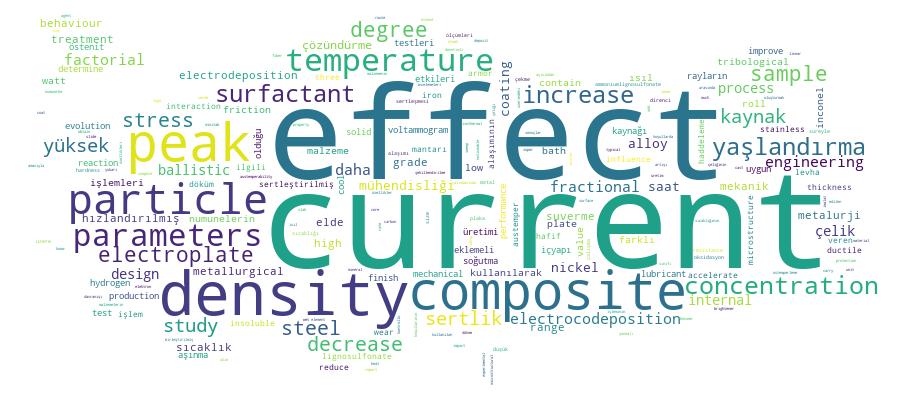
Competency Cloud
10 results
Scholarly Output Search Results
Now showing 1 - 10 of 10
Conference Object Effect of Electroplating Parameters on "her" Current Density in Ni-mos2 Composite Plating(Minerals, Metals & Materials Soc, 2012) Guler, Ebru Saraloglu; Karakaya, Ishak; Konca, ErkanNickel composites with co-deposited insoluble, solid lubricant particles such as MoS2 have been reported to reduce friction. It is known that hydrogen evolution reaction (HER), competes with nickel deposition. The influence of the electroplating parameters and their interaction effects on the peak current density for HER were studied by fractional factorial design. The parameters and their ranges were; MoS2 concentration (0-30 g/l), temperature (30-50 degrees C), pH (2-4) and surfactants (0-1 g/l). Electrodeposition processes were carried out from a typical Watts bath containing leveler, wetting agent and brightener by using a potentiostat. The peak currents (I-p) were extended to higher values and the peaks on linear sweep voltammograms became noticeable by increasing the scan rate from 20 mV/s to 100 mV/s over the range 0 to 2.5 V. The peak current densities (i(p)) for each experimental route were determined by fractional factorial design for three types of mineral processing surfactants; sodiumlignosulfonate (SLS), depramin-C (DC) and ammoniumlignosulfonate (ALS) using Minitab program [1]. Adding MoS2, decreasing temperature and increasing pH has decreasing effect on peak current density for all surfactants. ALS and DC have increasing effect whereas SLS has descending effect on peak current.Conference Object Effect of Electroplating Parameters on "her" Current Density in Ni-Mos2 Composite Plating(Minerals, Metals and Materials Society, 2012) Güler,E.S.; Karakaya,I.; Konca,E.; Saraloǧlu Güler, EbruNickel composites with co-deposited insoluble, solid lubricant particles such as MoS2 have been reported to reduce friction. It is known that hydrogen evolution reaction (HER), competes with nickel deposition. The influence of the electroplating parameters and their interaction effects on the peak current density for HER were studied by fractional factorial design. The parameters and their ranges were; MoS2 concentration (0-30 g/l), temperature (30-50°C), pH (2-4) and surfactants (0-1 g/l). Electrodeposition processes were carried out from a typical Watts bath containing leveler, wetting agent and brightener by using a potentiostat. The peak currents (I p) were extended to higher values and the peaks on linear sweep voltammograms became noticeable by increasing the scan rate from 20 mV/s to 100 mV/s over the range 0 to 2.5 V. The peak current densities (ip) for each experimental route were determined by fractional factorial design for three types of mineral processing surfactants; sodiumlignosulfonate (SLS), depramin-C (DC) and ammoniumlignosulfonate (ALS) using Minitab program [1]. Adding MoS2, decreasing temperature and increasing pH has decreasing effect on peak current density for all surfactants. ALS and DC have increasing effect whereas SLS has descending effect on peak current.Article Citation - WoS: 23Citation - Scopus: 27Effect of Electrodeposition Parameters on the Current Density of Hydrogen Evolution Reaction in Ni and Ni-mos2 Composite Coatings(Esg, 2013) Gueler, E. Saraloglu; Konca, E.; Karakaya, I.; Saralog̀lu Güler, E.; Metallurgical and Materials EngineeringNickel composites with co-deposited insoluble, solid lubricant particles such as MoS2 have been reported to reduce friction. It is known that hydrogen evolution reaction (HER), competes with nickel deposition. The influence of the parameters and their interaction effects on the peak current density of HER during the electrodeposition of Ni and Ni-MoS2 composite coatings were studied by fractional factorial design. The parameters and their ranges studied were; MoS2 particle concentration (0-30 g/l), temperature (30-50 degrees C), pH (2-4) and two surfactants, namely; ammoniumlignosulfonate (ALS) and depramin-C (DC) (0-1 g/l). Electrodeposition processes were carried out from a typical Watts bath containing leveler, wetting agent and brightener by using a potentiostat. The peak current densities (i(p)) were extended to higher values and the peaks on linear sweep voltammograms became noticeable by increasing the scan rate from 20 mV/s to 100 mV/s over the range of 0 to 2.5 V. The peak current densities (i(p)) of HER for each experimental route were determined by fractional factorial design for two mineral processing surfactants; ammoniumlignosulfonate (ALS) and depramin-C (DC) using a statistical analysis software named Minitab [1]. Adding MoS2, decreasing temperature and increasing pH had decreasing effects on the peak current density of HER regardless of the surfactant used. On the other hand, the surfactants increased the peak current density.Conference Object Citation - Scopus: 1Effect of Electroplating Parameters on Internal Stress in Ni-Mos 2 Composite Plating(2013) Saraloǧlu Güler,E.; Konca,E.; Karakaya,I.[No abstract available]Book Part Effect of Electroplating Parameters on Internal Stress in Ni-M0s2 Composite Plating(Wiley Blackwell, 2013) Güler,E.S.; Konca,E.; Karakaya,I.[No abstract available]Article Citation - WoS: 18Investigation of the Tribological Behaviour of Electrocodeposited Ni-mos2 Composite Coatings(inderscience Enterprises Ltd, 2017) Guler, Ebru Saraloglu; Konca, Erkan; Karakaya, IshakComposite electroplating of solid lubricants in a metal matrix is an effective way to lower coefficient of friction (COF) and improve wear resistance of surfaces in sliding contact. In this work, Ni-MoS2 composite coatings were deposited on AISI 304 stainless steel substrates by electroplating from Watts bath containing suspended MoS2 particles and their tribological behaviour was studied. The effects of MoS2 particle concentration (5, 10 and 30 g/l), MoS2 particle size (1.440 and 5.156 mu m), pH (2, 3 and 4), current density (3.8, 4.8 and 5.8 A/dm(2)) and the surfactant (sodium lignosulfonate, SLS) concentration (0.3 and 1 g/l) on the tribological behaviour were investigated using a ball-on-disc tribometer at ambient conditions. Lower current density, smaller particle size and higher concentration of MoS2 decreased COF. While increasing the surfactant concentration decreased the COF, its friction lowering effect was much more pronounced at relatively lower concentrations of MoS2 in the electrolyte.Article Citation - WoS: 24Effects of Current Density, Coating Thickness, Temperature, Ph and Particle Concentration on Internal Stress During Ni-mos2 Electrocodeposition(Taylor & Francis Ltd, 2014) Guler, E. Saraloglu; Karakaya, Ishak; Konca, ErkanInternal stress in plated deposits has been a common problem that may affect the functionality of coatings. Electrodeposition parameters and insoluble particles modify the characteristics and the level of internal stress of coatings. The influence of the electrocodeposition parameters and their interaction effects on the internal stress during the electrodeposition of Ni and Ni-MoS2 composite coatings were studied by fractional factorial design. The parameters studied and their ranges were: MoS2 particle concentration (0-10 g L-1), temperature (30-50 degrees C), pH (2-4), current density (1.2-4.8 A dm(-2)), and coating thickness (25-50 mu m). MoS2 addition into Watts bath resulted in the decrease in the tensile internal stress values or even changed the stress character from tensile to compressive. Moreover, low stress values were obtained when pH was 2 and coating thickness was 50 mu m.Article Citation - WoS: 29Citation - Scopus: 34Effects of Alloying Elements (Mo, Ni, and Cu) on the Austemperability of GGG-60 Ductile Cast Iron(Mdpi, 2017) Konca, Erkan; Tur, Kazim; Koc, ErkinThe interest in austempered ductile irons (ADI) is continuously increasing due to their various advantageous properties over conventional ductile irons and some steels. This study aimed to determine the roles of alloying elements Ni, Cu, and Mo, on the austemperability of GGG-60 ductile cast iron. Two different sets of GGG-60 (EN-GJS-600-3) samples, one set alloyed with Ni and Cu and the other set alloyed with Mo, Ni, and Cu, were subjected to austempering treatments at 290 degrees C, 320 degrees C, and 350 degrees C. A custom design heat treatment setup, consisting of two units with the top unit (furnace) serving for austenitizing and the 200 L capacity bottom unit (stirred NaNO2-KNO3 salt bath) serving for isothermal treatment, was used for the experiments. It was found that austempering treatment at 290 degrees C increased the hardness of the Ni-Cu alloyed GGG-60 sample by about 44% without causing a loss in its ductility. In the case of the Mo-Ni-Cu alloyed sample, the increase in hardness due to austempering reached to almost 80% at the same temperature while some ductility was lost. Here, the microstructural investigation and mechanical testing results of the austempered samples are presented and the role of alloying elements (Mo, Ni, and Cu) on the austemperability of GGG-60 is discussed.Article Citation - Scopus: 20Investigation of the Tribological Behaviour of Electrocodeposited Ni-Mos2 Composite Coatings(Inderscience Publishers, 2017) Güler,E.S.; Konca,E.; Karakaya,I.Composite electroplating of solid lubricants in a metal matrix is an effective way to lower coefficient of friction (COF) and improve wear resistance of surfaces in sliding contact. In this work, Ni-MoS2 composite coatings were deposited on AISI 304 stainless steel substrates by electroplating from Watts bath containing suspended MoS2 particles and their tribological behaviour was studied. The effects of MoS2 particle concentration (5, 10 and 30 g/l), MoS2 particle size (1.440 and 5.156 μm), pH (2, 3 and 4), current density (3.8, 4.8 and 5.8 A/dm2) and the surfactant (sodium lignosulfonate, SLS) concentration (0.3 and 1 g/l) on the tribological behaviour were investigated using a ball-on-disc tribometer at ambient conditions. Lower current density, smaller particle size and higher concentration of MoS2 decreased COF. While increasing the surfactant concentration decreased the COF, its friction lowering effect was much more pronounced at relatively lower concentrations of MoS2 in the electrolyte. Copyright © 2017 Inderscience Enterprises Ltd.Article Citation - WoS: 8Citation - Scopus: 9Mechanical Behavior of Anodic Alumina Coatings Reinforced With Carbon Nanofibers(Springer, 2009) Kothari, Abhishek K.; Konca, Erkan; Sheldon, Brian W.; Jian, Kengqing; Li, Hao; Xia, Zhenhai; Hurt, RobertAnodic alumina was reinforced with three types of carbon nanofibers differing in the orientation of their graphene structure-perpendicular to the fiber axis, and parallel to the fiber axis both with dense core and hollow core (i.e., nanotubes). This study was designed to identify potential toughening and damage tolerant mechanisms in these nanoscale fiber-reinforced composite coatings. The dense carbon fibers improved contact damage resistance and reduced frictional resistance in sliding contacts. The hollow core reinforcements were much more promising for improving the fracture toughness of the composite coatings.
