
Nazlıoğlu, Selma
Loading...
Profile URL
Name Variants
Suloglu, Selma
Nazlioglu S.
S.,Nazlioglu
Selma, Nazlioglu
S., Nazlioglu
Nazlioğlu, Selma
N.,Selma
S.,Nazlioğlu
Selma, Nazlioğlu
Nazlıoğlu, Selma
Nazlioglu,S.
Nazlıoğlu,S.
S., Nazlıoğlu
Nazlioglu, Selma
Selma, Nazlıoğlu
N., Selma
S.,Nazlıoğlu
S., Nazlioğlu
Süloğlu, Selma
Süloğlu, S.
Nazlioglu S.
S.,Nazlioglu
Selma, Nazlioglu
S., Nazlioglu
Nazlioğlu, Selma
N.,Selma
S.,Nazlioğlu
Selma, Nazlioğlu
Nazlıoğlu, Selma
Nazlioglu,S.
Nazlıoğlu,S.
S., Nazlıoğlu
Nazlioglu, Selma
Selma, Nazlıoğlu
N., Selma
S.,Nazlıoğlu
S., Nazlioğlu
Süloğlu, Selma
Süloğlu, S.
Job Title
Doktor Öğretim Üyesi
Email Address
selma.suloglu@atilim.edu.tr
Main Affiliation
Software Engineering
Status
Website
ORCID ID
Scopus Author ID
Turkish CoHE Profile ID
Google Scholar ID
WoS Researcher ID
Sustainable Development Goals
 1
1NO POVERTY
0
Research Products
 2
2ZERO HUNGER
0
Research Products
 3
3GOOD HEALTH AND WELL-BEING
0
Research Products
 4
4QUALITY EDUCATION
0
Research Products
 5
5GENDER EQUALITY
0
Research Products
 6
6CLEAN WATER AND SANITATION
0
Research Products
 7
7AFFORDABLE AND CLEAN ENERGY
0
Research Products
 8
8DECENT WORK AND ECONOMIC GROWTH
0
Research Products
 9
9INDUSTRY, INNOVATION AND INFRASTRUCTURE
0
Research Products
 10
10REDUCED INEQUALITIES
0
Research Products
 11
11SUSTAINABLE CITIES AND COMMUNITIES
2
Research Products
 12
12RESPONSIBLE CONSUMPTION AND PRODUCTION
0
Research Products
 13
13CLIMATE ACTION
0
Research Products
 14
14LIFE BELOW WATER
0
Research Products
 15
15LIFE ON LAND
0
Research Products
 16
16PEACE, JUSTICE AND STRONG INSTITUTIONS
0
Research Products
 17
17PARTNERSHIPS FOR THE GOALS
0
Research Products

Documents
6
Citations
6
h-index
1

Documents
9
Citations
28

Scholarly Output
13
Articles
4
Views / Downloads
28/0
Supervised MSc Theses
6
Supervised PhD Theses
0
WoS Citation Count
4
Scopus Citation Count
8
Patents
0
Projects
0
WoS Citations per Publication
0.31
Scopus Citations per Publication
0.62
Open Access Source
3
Supervised Theses
6
| Journal | Count |
|---|---|
| 16th European Conference on Software Architecture (ECSA) -- SEP 19-23, 2022 -- Prague, CZECH REPUBLIC | 1 |
| Afet ve Risk Dergisi | 1 |
| Applied Sciences | 1 |
| IEEE Software | 1 |
| International Conference on Computer Science and Engineering, UBMK -- 10th International Conference on Computer Science and Engineering, UBMK 2025 -- 2025-09-17 Through 2025-09-21 -- Istanbul -- 214243 | 1 |
Current Page: 1 / 2
Scopus Quartile Distribution
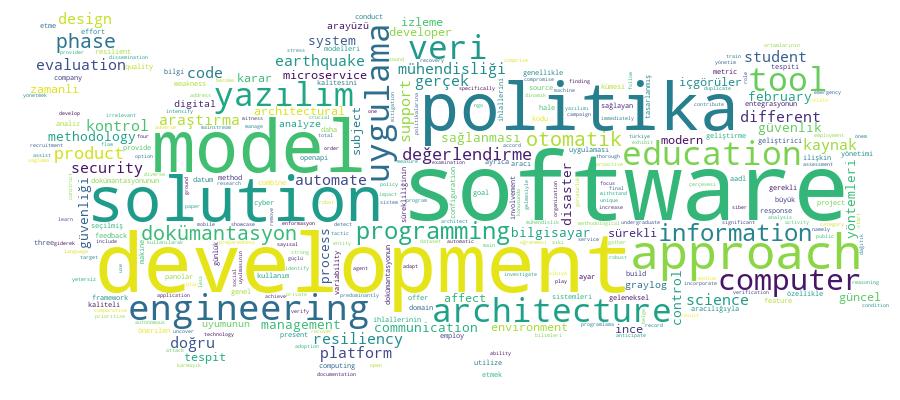
Competency Cloud
8 results
Scholarly Output Search Results
Now showing 1 - 8 of 8
Master Thesis AR Mobil Uygulamaları İçin Erişilebilirlik Test Çerçevesi(2024) Zeb, Fatıma Anwer; Nazlıoğlu, SelmaBu tezde, Artırılmış Gerçeklik (AR) uygulamalarının kapsayıcılığını artırmak için birleşik bir mobil öncelikli erişilebilirlik test çerçevesi olan Erişilebilirlik Doğrulayıcısı'nı öneriyoruz. Mevcut AR sistemleri genellikle ekran okuyucu desteği, hareket tanıma, bilişsel uyarlanabilirlik ve sesli komutlar gibi temel erişilebilirlik özelliklerinden yoksundur ve bu da onları engelli kullanıcılar için zorlu hale getirir. Bu boşlukları gidermek için Erişilebilirlik Doğrulayıcısı çerçevesi, uyumluluğu ve kullanılabilirliği değerlendirmek için TalkBack ve VoiceOver gibi yerel erişilebilirlik araçlarından yararlanarak manuel ve otomatik test yaklaşımlarını entegre eder. Özel donanıma dayanan geleneksel yöntemlerin aksine, bu yaklaşım akıllı telefonlar ve dizüstü bilgisayarlar gibi yaygın olarak bulunan cihazlara öncelik vererek erişilebilirlik testini daha ölçeklenebilir ve pratik hale getirir. AR erişilebilirliğini sistematik olarak değerlendirerek ve iyileştirerek. Bu araştırma, kapsayıcı tasarımı teşvik etmeyi, AR kullanılabilirliğini artırmayı ve gelecekteki erişilebilirlik standartlarının geliştirilmesine katkıda bulunmayı amaçlamaktadır.Article Digital Solutions for Disaster Management: Analyzing the Impact of the February 2023 Earthquake in Türkiye(Ankara University, 2024) Nazlıoğlu, Selma; Kalem, Güler; Yazıcı, AliThis research investigates the involvement of information technologies, including communication platforms and social media solutions, in managing earthquake disasters, specifically focusing on the February 2023 earthquake in Türkiye. In order to achieve this, a comparative framework is constructed, which incorporates four main categories, namely goal, providers, target phase, and platform. The data is gathered from diverse sources, and a total of 130 solutions are identified immediately following the February 2023 earthquake in Türkiye. After conducting a thorough examination of these solutions and removing any duplicates and irrelevant options, the final dataset comprises 89 unique solutions sourced from 82 providers. According to the study's findings, the solutions employed in mitigation and preparedness phases prioritize proactive measures and planning, while the ones in response phase witnesses a significant increase in activities related to aid campaigns, emergency response, information dissemination, and support services. The solutions in recovery phase further intensifies support services to aid affected communities. Web-based platforms are predominantly used during different phases of disaster management, with mobile platforms playing a crucial role in communication and on-the-ground activities. Private organizations exhibit strong involvement in developing IT platforms, while public entities and NGOs contribute to a lesser extent.Article Citation - Scopus: 1Digital Solutions for Disaster Management: Analyzing the Impact of the February 2023 Earthquake in Türkiye(Ankara University, 2024) Nazlıoğlu, S.; Kalem, G.; Yazıcı, A.This research investigates the involvement of information technologies, including communication platforms and social media solutions, in managing earthquake disasters, specifically focusing on the February 2023 earthquake in Türkiye. In order to achieve this, a comparative framework is constructed, which incorporates four main categories, namely goal, providers, target phase, and platform. The data is gathered from diverse sources, and a total of 130 solutions are identified immediately following the February 2023 earthquake in Türkiye. After conducting a thorough examination of these solutions and removing any duplicates and irrelevant options, the final dataset comprises 89 unique solutions sourced from 82 providers. According to the study's findings, the solutions employed in mitigation and preparedness phases prioritize proactive measures and planning, while the ones in response phase witnesses a significant increase in activities related to aid campaigns, emergency response, information dissemination, and support services. The solutions in recovery phase further intensifies support services to aid affected communities. Web-based platforms are predominantly used during different phases of disaster management, with mobile platforms playing a crucial role in communication and on-the-ground activities. Private organizations exhibit strong involvement in developing IT platforms, while public entities and NGOs contribute to a lesser extent. © 2024, Ankara University. All rights reserved.Conference Object Prompting for Security: A Cross-Model Evaluation of Code Generation in LLMs(Institute of Electrical and Electronics Engineers Inc., 2025) Saleem, W.; Nazlioglu, S.The security of AI-generated code has become a growing concern as Large Language Models (LLMs) like GPT-4, Gemini, DeepSeek, and LLaMA are increasingly integrated into software development pipelines. While prior research has primarily focused on GPT-family models, the security performance of newer open models under structured prompting remains underexplored. This study evaluates the ability of modern LLMs to generate secure code using six established prompting strategies across 150 Python tasks (LLMSecEval). Generated code was assessed using two static analysis tools (Bandit and CodeQL) to detect Common Weakness Enumeration (CWE) vulnerabilities. Findings showed that Recursive Criticism and Improvement (RCI) prompting significantly improves security outcomes across all models. Notably, LLaMA produced over 15,800 lines of vulnerability-free code under RCI. Gemini and DeepSeek also showed notable improvements under guided prompting. From a tool-specific perspective, Bandit and Cod-eQL produced divergent results, with CodeQL exposing deeper or more complex vulnerabilities. These results highlight the necessity of prompt-aware security evaluations and multi-tool static analysis to ensure reliable, secure code generation from LLMs. This study offers practical insights into secure code generation for developers and researchers. © 2025 IEEE.Conference Object Citation - WoS: 1Citation - Scopus: 2A Methodological Approach To Verify Architecture Resiliency(Springer international Publishing Ag, 2023) Santos, Joanna C. S.; Suloglu, Selma; Catano, Nestor; Mirakhorli, MehdiArchitecture-first approach to address software resiliency is becoming the mainstream development method for mission-critical and software-intensive systems. In such approach, resiliency is built into the system from the ground up, starting with a robust software architecture design. As a result, a flaw in the design of a resilient architecture affects the system's ability to anticipate, withstand, recover from, and adapt to adverse conditions, stresses, attacks, or compromises on cyber-resources. In this paper, we present an architecture-centric reasoning and verification methodology for detecting design weaknesses in resilient systems. Our goal is to assist software architects in building sound architectural models of their systems. We showcase our approach with the aid of an Autonomous Robot modeled in AADL, in which we use our methodology to uncover three architectural weaknesses in the adoption of three architectural tactics.Conference Object Citation - Scopus: 1Ace-Pe: an Automated Code Evaluation Software Tool for Programming Education(Institute of Electrical and Electronics Engineers Inc., 2023) Alper,B.; Nazlioglu,S.; Kilic,H.An automated code evaluation tool that combines the usage of software quality metrics and object-oriented programming teaching subjects is designed and developed. The tool (called ACE-PE) gives flexibility to instructors to assess student assignments at the level of precision of specific subjects which reveals the degree of student's understanding of covered subjects, and to observe his/her own effort, as well. Provision of content-aware automated fast feedback to students to improve quality of their products and development efforts is another outcome of the proposed solution. © 2023 IEEE.Master Thesis Open Policy Agent İlke Uyumunun İzlemesinin Graylog Kullanılarak İyileştirilmesi(2024) Shıbanı, Ahmed Salem Ahmed; Nazlıoğlu, SelmaModern BT ortamlarının giderek daha karmaşık hale gelmesiyle güvenlik politikalarına sıkı sıkıya uyulmasının sağlanması önem kazanmaktadır. Geleneksel izleme yöntemleri, dinamik ve dağıtık sistemleri yönetmek için gerekli görünürlük ve gerçek zamanlı içgörüler sağlama konusunda genellikle yetersiz kalmaktadır. Bu araştırma, Graylog'un güçlü günlük yönetim yeteneklerinden yararlanarak OPA karar günlüklerini izleyip analiz ederek bu zorluklara çözüm bulmayı amaçlamaktadır. Bu sayede, politika ihlallerinin tespiti ve yönetimi iyileştirilmektedir. Bu çalışmanın temel amacı, politika uygulama faaliyetlerinin görünürlüğünü ve yönetimini artıran bir izleme çözümü geliştirmektir. Bu araştırma ile politika ihlallerini tespit etmek için gerekli olan OPA karar günlüklerinin içerisindeki kritik veri unsurları çıkarılmış ve bir OPA Karar Günlüğü Ayrıştırıcı ve Veri Çıkarıcı geliştirilmiştir. Graylog'un OPA ile entegrasyonu sayesinde,, politika uyumuna ilişkin gerçek zamanlı içgörüler sağlayan ve güvenlik sorunlarına proaktif yanıtlar verilmesini mümkün kılan panolar ve uyarı mekanizmaları tasarlanmış ve uygulanmıştır. Ayrıca, politika izleme çözümlerinin Graylog ve OPA toplulukları tarafından daha geniş çapta benimsenmesini ve etkili bir şekilde kullanılmasını kolaylaştıracak paylaşımlı bir içerik paketi ortaya çıkarılmıştır. Önerilen çözümün etkinliği, üç kullanım durumu aracılığıyla doğrulanmıştır. Her uygulama, sistemin politika ihlallerini doğru ve verimli bir şekilde tespit etme yeteneğini göstererek, entegrasyonun çeşitli operasyonel ortamlardaki faydasını doğrulamaktadır. Entegrasyonun, gerçek zamanlı politika uyumunun izlemesini önemli ölçüde artırdığı, politika ihlallerinin tespiti ve uyarılmasını iyileştirdiği ve özelleştirilebilir panolar aracılığıyla uygulanabilir içgörüler sağladığı tespit edilmiştir. Gelecek araştırma konuları arasında kullanım durumlarının diğer konteyner düzenleme platformlarına uygulaması ile genişletilmesi, ileri analiz ve makine öğrenimi tekniklerinin dahil edilmesi ve OPA'nın günlük kaydı yeteneklerinin yapılandırılması ve kullanılması için detaylı kullanıcı kılavuzlarının geliştirilmesi yer almaktadır.Article Citation - WoS: 3Citation - Scopus: 4MSDeveloper: A Variability-Guided Methodology for Microservice-Based Development(Mdpi, 2022) Dolu, Betul Kuruoglu; Cetinkaya, Anil; Kaya, M. Cagri; Nazlioglu, Selma; Dogru, Ali H.; Kuruoglu Dolu, BetulThis article presents a microservice-based development approach, MSDeveloper (Microservices Developer), employing variability management for product configuration through a low-code development environment. The purpose of this approach is to offer a general-purpose environment for the easier development of families of products for different domains: a domain-oriented development environment is suggested, where domain developers and product developers can utilize the environment as a software ecosystem. Thus, genericity is offered through supporting different domains. A domain is populated with feature and process models and microservices in a layered architecture. Feature models drive the product configuration, which affects the process model and the microservice layer. An experimental study was conducted to validate the applicability of the approach and the usability of the development environment. Students from different courses were assigned system modeling projects where they utilized helper tools supporting the provided methodology. Furthermore, professional software developers were consulted about this recommended domain-oriented development environment. Feedback from student projects and professionals' remarks are analyzed and discussed.
