Şimşir, Caner

Loading...
Profile Picture
Name Variants
C.,Simsir
Simsir, Caner
Şimşir, Caner
C., Simsir
Simsir,C.
C.,Şimşir
S.,Caner
S., Caner
Caner, Simsir
Şimşir,C.
Caner, Şimşir
Ş.,Caner
Simsir, C.
Job Title
Doktor Öğretim Üyesi
Email Address
caner.simsir@atilim.edu.tr
Main Affiliation
Manufacturing Engineering
Status
Former Staff
Website
ORCID ID
Scopus Author ID
Turkish CoHE Profile ID
Google Scholar ID
WoS Researcher ID

Sustainable Development Goals

NO POVERTY1
NO POVERTY
0
Research Products
ZERO HUNGER2
ZERO HUNGER
0
Research Products
GOOD HEALTH AND WELL-BEING3
GOOD HEALTH AND WELL-BEING
2
Research Products
QUALITY EDUCATION4
QUALITY EDUCATION
0
Research Products
GENDER EQUALITY5
GENDER EQUALITY
0
Research Products
CLEAN WATER AND SANITATION6
CLEAN WATER AND SANITATION
0
Research Products
AFFORDABLE AND CLEAN ENERGY7
AFFORDABLE AND CLEAN ENERGY
0
Research Products
DECENT WORK AND ECONOMIC GROWTH8
DECENT WORK AND ECONOMIC GROWTH
0
Research Products
INDUSTRY, INNOVATION AND INFRASTRUCTURE9
INDUSTRY, INNOVATION AND INFRASTRUCTURE
3
Research Products
REDUCED INEQUALITIES10
REDUCED INEQUALITIES
0
Research Products
SUSTAINABLE CITIES AND COMMUNITIES11
SUSTAINABLE CITIES AND COMMUNITIES
0
Research Products
RESPONSIBLE CONSUMPTION AND PRODUCTION12
RESPONSIBLE CONSUMPTION AND PRODUCTION
0
Research Products
CLIMATE ACTION13
CLIMATE ACTION
0
Research Products
LIFE BELOW WATER14
LIFE BELOW WATER
0
Research Products
LIFE ON LAND15
LIFE ON LAND
0
Research Products
PEACE, JUSTICE AND STRONG INSTITUTIONS16
PEACE, JUSTICE AND STRONG INSTITUTIONS
0
Research Products
PARTNERSHIPS FOR THE GOALS17
PARTNERSHIPS FOR THE GOALS
0
Research Products
This researcher does not have a Scopus ID.
This researcher does not have a WoS ID.
Scholarly Output

33

Articles

14

Views / Downloads

150/1612

Supervised MSc Theses

12

Supervised PhD Theses

0

WoS Citation Count

176

Scopus Citation Count

228

Patents

0

Projects

0

WoS Citations per Publication

5.33

Scopus Citations per Publication

6.91

Open Access Source

6

Supervised Theses

12

JournalCount
Computational Materials Science3
Materialwissenschaft und Werkstofftechnik3
Hittite Journal of Science and Engineering2
Materials Performance and Characterization2
International Conference on the Technology of Plasticity (ICTP) -- SEP 17-22, 2017 -- Cambridge, ENGLAND1
Current Page: 1 / 3

Scopus Quartile Distribution

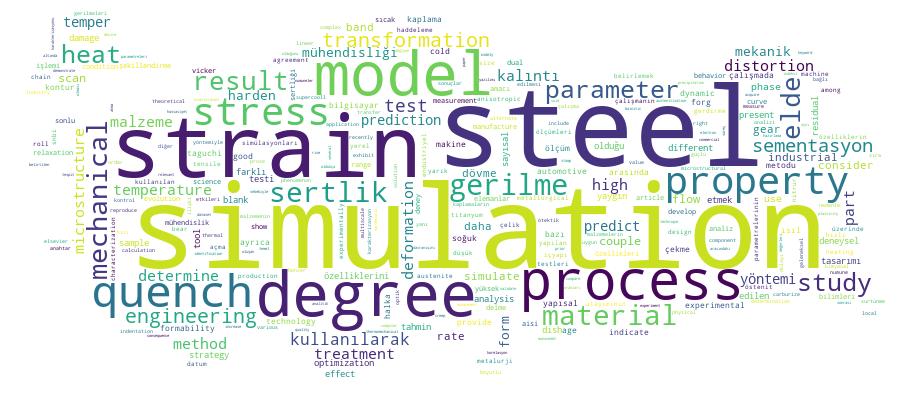
Competency Cloud

GCRIS Competency Cloud

Scholarly Output Search Results

Now showing 1 - 2 of 2
  • Article
    Citation - Scopus: 2
    Simulation Trends in Quenching Technology for Automotive Components
    (Maney Publishing, 2014) Felde,I.; Simsir,C.
    Quenching technology is widely used in automotive industry from a simple immersion quenching of gears up to the complex production technology of press hardening. The selection of process parameters to develop the desired properties is challenging due to the complexity of the physical phenomena occurring during the manufacturing cycle. In the last decades several computational methods have been applied successful to optimise the heat treatment processes. This paper is focusing on some examples demonstrating the state of the art of the simulation tools, including the physical phenomena of quenching, the theoretical background of the coupled models used for estimation the microstructure, mechanical properties and deformation of heat treated automotive components. © 2014 IHTSE Partnership.
  • Article
    Citation - WoS: 10
    Citation - Scopus: 11
    A Comprehensive Study of the Effect of Scanning Strategy on In939 Fabricated by Powder Bed Fusion-Laser Beam
    (Elsevier, 2024) Dogu, Merve Nur; Ozer, Seren; Yalcin, Mustafa Alp; Davut, Kemal; Obeidi, Muhannad Ahmed; Simsir, Caner; Brabazon, Dermot
    This study provides a comprehensive investigation into the effects of different scanning strategies on the material properties of IN939 fabricated using the PBF-LB process. The scanning strategies examined included alternating bi-directional scanning with rotation angles of 0 degrees, 45 degrees, 67 degrees, and 90 degrees between adjacent layers (named as shown), as well as alternating chessboard scanning with rotation angles of 67 degrees and 90 degrees (named as Q67 degrees and Q90 degrees). The results revealed that the 45 degrees and 67 degrees samples had the highest relative density, while the 0 degrees and Q67 degrees samples showed the highest average porosity. Moreover, various types of cracks, including solidification, solid-state, and oxide-induced cracks, were observed. Among the bi-directional scan samples, the 0 degrees sample displayed the most extensive cracking and the highest sigma max residual stress values in both XZ and XY planes. Conversely, the 45 degrees and 67 degrees samples exhibited fewer cracks. Notably, the lowest sigma max residual stress in the XZ planes among the bidirectional scan samples was observed in the 67 degrees sample. Additionally, microstructural analyses indicated differences in grain size and morphology, among the samples. Texture analysis indicated that the 0 degrees and 90 degrees samples exhibited strong cube textures, whereas the texture intensity weakened for the 45 degrees and 67 degrees samples. Moreover, the alternating chessboard scanning strategy led to rougher surfaces (higher Sa and Sz values) compared to the alternating bi-directional scanning strategy, regardless of the rotation angles. Furthermore, the microhardness values among the samples showed minimal variance, ranging between 321 + 14 HV and 356+ 7 HV.