Tülek, Necla

Loading...
Profile Picture
Name Variants
Tülek,N.
N.,Tulek
Tülek, Necla
Eren Tülek N.
T., Necla
Tulek,Necla
Necla, Tulek
Necla, Tülek
N., Tülek
Necla Tülek
Tulek,N.
Tulek, Necla
Tulek N.
T.,Necla
N., Tulek
Tülek N.
N.,Tülek
Job Title
Profesör Doktor
Email Address
necla.tulek@atilim.edu.tr
Main Affiliation
Basic Sciences
Status
Scopus Author ID
Turkish CoHE Profile ID
Google Scholar ID
WoS Researcher ID

Sustainable Development Goals

NO POVERTY1
NO POVERTY
0
Research Products
ZERO HUNGER2
ZERO HUNGER
0
Research Products
GOOD HEALTH AND WELL-BEING3
GOOD HEALTH AND WELL-BEING
13
Research Products
QUALITY EDUCATION4
QUALITY EDUCATION
0
Research Products
GENDER EQUALITY5
GENDER EQUALITY
0
Research Products
CLEAN WATER AND SANITATION6
CLEAN WATER AND SANITATION
0
Research Products
AFFORDABLE AND CLEAN ENERGY7
AFFORDABLE AND CLEAN ENERGY
0
Research Products
DECENT WORK AND ECONOMIC GROWTH8
DECENT WORK AND ECONOMIC GROWTH
0
Research Products
INDUSTRY, INNOVATION AND INFRASTRUCTURE9
INDUSTRY, INNOVATION AND INFRASTRUCTURE
0
Research Products
REDUCED INEQUALITIES10
REDUCED INEQUALITIES
0
Research Products
SUSTAINABLE CITIES AND COMMUNITIES11
SUSTAINABLE CITIES AND COMMUNITIES
0
Research Products
RESPONSIBLE CONSUMPTION AND PRODUCTION12
RESPONSIBLE CONSUMPTION AND PRODUCTION
0
Research Products
CLIMATE ACTION13
CLIMATE ACTION
0
Research Products
LIFE BELOW WATER14
LIFE BELOW WATER
0
Research Products
LIFE ON LAND15
LIFE ON LAND
0
Research Products
PEACE, JUSTICE AND STRONG INSTITUTIONS16
PEACE, JUSTICE AND STRONG INSTITUTIONS
0
Research Products
PARTNERSHIPS FOR THE GOALS17
PARTNERSHIPS FOR THE GOALS
0
Research Products
This researcher does not have a Scopus ID.
Documents

125

Citations

1704

Scholarly Output

17

Articles

12

Views / Downloads

76/107

Supervised MSc Theses

0

Supervised PhD Theses

0

WoS Citation Count

19

Scopus Citation Count

19

Patents

0

Projects

0

WoS Citations per Publication

1.12

Scopus Citations per Publication

1.12

Open Access Source

13

Supervised Theses

0

JournalCount
Indian Pediatrics3
Flora the Journal of Infectious Diseases and Clinical Microbiology2
Clinical Microbiology and Infection1
Flora İnfeksiyon Hastalıkları ve Klinik Mikrobiyoloji Dergisi1
Infectious Diseases and Clinical Microbiology1
Current Page: 1 / 3

Scopus Quartile Distribution

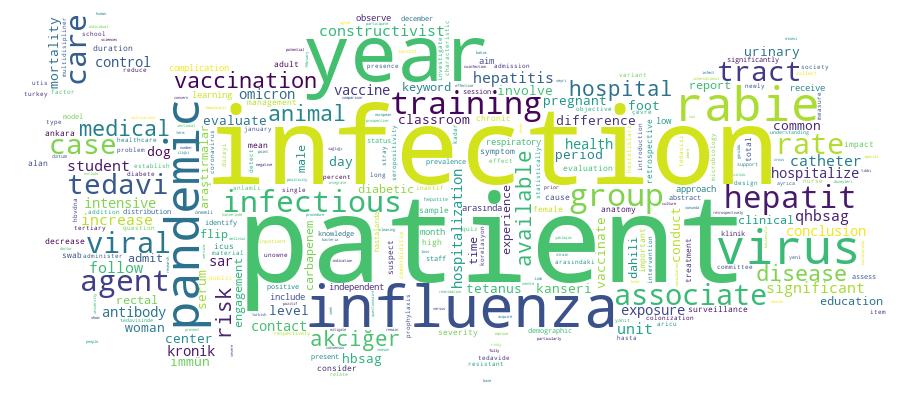
Competency Cloud

GCRIS Competency Cloud

Scholarly Output Search Results

Now showing 1 - 2 of 2
  • Article
    The Effect Of Constructivist Training On The Rate Of Catheter-Associated Urinary Tract Infections in The Intensive Care Unit
    (Anestezi Dergisi, 2025) Yarimoglu, Saliha; Erdinç, Fatma Şebnem; Kaymak, Çetin; Tulek, Eren, N.; Basa̧r, Hulya; Tuncer-Ertem, Günay,; Kinikli, Sami; Tulek, Necla; Ertem, Gunay Tuncer
    Objective: Catheter-associated urinary tract infections (CA-UTIs) are common healthcare-associated infections. Constructivist training is based on integrating new knowledge with previously learned knowledge. The aim of this study was to evaluate the effects of constructivist training on the rate of CA-UTIs in the Anesthesia and Reanimation Intensive Care Units (ARICU). Methods: This study was a retrospective-prospective intervention study. Over the period of one month, a total of 62 healthcare staff (seven doctors, 38 nurses, and 17 cleaning staff) working in ARICUs were organized into groups of 4-5 people and received forty-five minutes of constructivist training on preventing CA-UTI. Personnel from each of three ICUs participated in the same number of training sessions. Comparisons were made of the rates of CA-UTI and catheter use in the six-month periods before and after the training. A 4-item questionnaire was administered to the study participants six months after completion of the training. Results: The catheter-associated urinary tract infection rates before and after training were observed to be 8.3 and 8.7 per 1000 catheter days, respectively in ARICU-1, 7.0 and 8.1 per 1000 catheter days in ARICU-2, and 7.3 and 9.9 per 1000 catheter days in ARICU-3. No statistically significant difference was observed in the CA-UTI rate in each unit after constructivist training compared to the pre-training period. The intervention of constructivist training alone did not reduce the CA-UTI rates in the ICUs. According to the results of the survey conducted six months later, 92% of the nurses and 88% of the cleaning staff stated that constructivist training had positive effects. Conclusion: The intervention of constructivisit training alone did not reduce the rates of CA-UTIs in the ARICUs, but an increase was observed in the awareness of ICU nurses and cleaning staff. © 2025 Elsevier B.V., All rights reserved.
  • Article
    Tedavi Alan Kronik Hepatit B Hastalarında Serum Kantitatif Hbsag Düzeyi ile Viral Yük Arasındaki İlişkinin Araştırılması
    (Pamukkale University, 2020) Demirelli, Meryem; Tülek, Necla; Temoçin, Fatih; Yücel, Doğan; Erdinç, Fatma Şebnem; Ertem, Günay; Erdinc, Sebnem
    Amaç: Yakın geçmişe kadar HBsAg sadece hepatit B enfeksiyonun tanısında kullanılırken, günümüzde serum HBsAg kantitasyonu (qHBsAg)’nun, hepatit B virüsü (HBV) enfeksiyonunun viral monitörizasyonunda kullanılabileceğine dair veriler artmaya başlamıştır. Bu çalışmada inaktif hepatit B taşıyıcıları ile kronik aktif hepatit B hastaları arasındaki qHBsAg ile HBV DNA düzeyleri karşılaştırılmış ve tedavi başlanmış hastalarda tedavi süresince qHBsAg ile HBVDNA seyri izlenerek aralarındaki ilişki değerlendirilmiştir. Gereç ve yöntem: Çalışma Ankara Eğitim ve Araştırma Hastanesi Enfeksiyon Hastalıkları ve Klinik Mikrobiyoloji Kliniği’nde yapılmıştır. Kronik hepatit B (KHB) tanısıyla tedavi alan 71 hasta ve inaktif HBsAg taşıyıcısı 74 hasta çalışmaya dahil edildi. Bu hastalarda serum qHBsAg düzeyleri Elecsys HBsAg II cihazı ile çalışıldı. Bulgular: Nükleoz(t)id analoğu ile tedavi edilen hastalarda 6. ve 12. aydaki serum qHBsAg düzeyi ile HBVDNA arasında pozitif yönde bir korelasyon görüldü ve her iki parametrenin altı ay ve bir yıllık izlemindeki düşüş istatiksel olarak anlamlı bulundu (qHBsAg 6ay p=0,03, qHBsAg 12 ay p=0,001, HBV DNA 6 ay p=0,001, HBV DNA 12 ay p=0,001). Peg-IFN tedavisi alan kronik hepatit B hastalarında ise serum qHBsAg düzeyi ile HBVDNA arasında tedavi başlangıcı ve 6. ayında anlamlı bir ilişki olmayıp tedavi sonunda pozitif yönde korelasyon görüldü. PEG-IFN tedavisi alan hasta grubunda ise qHBsAg seviyeleri ile HBV DNA arasındaki korelasyon tedavi sonunda anlamlı (p=0,01) olarak saptandı.