Melikoğlu, Mehmet

Loading...
Profile Picture
Name Variants
M.,Melikoğlu
M., Melikoglu
Melikoglu,M.
Melikoğlu, Mehmet
Melikoğlu,M.
M.,Mehmet
M.,Melikoglu
Melikoglu, Mehmet
Mehmet, Melikoglu
Mehmet, Melikoğlu
M., Mehmet
Job Title
Doktor Öğretim Üyesi
Email Address
Main Affiliation
Energy Systems Engineering
Status
Former Staff
Website
ORCID ID
Scopus Author ID
Turkish CoHE Profile ID
Google Scholar ID
WoS Researcher ID

Sustainable Development Goals

NO POVERTY1
NO POVERTY
0
Research Products
ZERO HUNGER2
ZERO HUNGER
0
Research Products
GOOD HEALTH AND WELL-BEING3
GOOD HEALTH AND WELL-BEING
0
Research Products
QUALITY EDUCATION4
QUALITY EDUCATION
0
Research Products
GENDER EQUALITY5
GENDER EQUALITY
0
Research Products
CLEAN WATER AND SANITATION6
CLEAN WATER AND SANITATION
0
Research Products
AFFORDABLE AND CLEAN ENERGY7
AFFORDABLE AND CLEAN ENERGY
7
Research Products
DECENT WORK AND ECONOMIC GROWTH8
DECENT WORK AND ECONOMIC GROWTH
5
Research Products
INDUSTRY, INNOVATION AND INFRASTRUCTURE9
INDUSTRY, INNOVATION AND INFRASTRUCTURE
1
Research Products
REDUCED INEQUALITIES10
REDUCED INEQUALITIES
1
Research Products
SUSTAINABLE CITIES AND COMMUNITIES11
SUSTAINABLE CITIES AND COMMUNITIES
3
Research Products
RESPONSIBLE CONSUMPTION AND PRODUCTION12
RESPONSIBLE CONSUMPTION AND PRODUCTION
2
Research Products
CLIMATE ACTION13
CLIMATE ACTION
6
Research Products
LIFE BELOW WATER14
LIFE BELOW WATER
0
Research Products
LIFE ON LAND15
LIFE ON LAND
0
Research Products
PEACE, JUSTICE AND STRONG INSTITUTIONS16
PEACE, JUSTICE AND STRONG INSTITUTIONS
0
Research Products
PARTNERSHIPS FOR THE GOALS17
PARTNERSHIPS FOR THE GOALS
1
Research Products
This researcher does not have a Scopus ID.
This researcher does not have a WoS ID.
Scholarly Output

11

Articles

9

Views / Downloads

22/0

Supervised MSc Theses

0

Supervised PhD Theses

0

WoS Citation Count

814

Scopus Citation Count

923

Patents

0

Projects

0

WoS Citations per Publication

74.00

Scopus Citations per Publication

83.91

Open Access Source

1

Supervised Theses

0

JournalCount
Renewable and Sustainable Energy Reviews3
Renewable Energy2
Food and Bioproducts Processing1
Food Industry Wastes1
3rd International Conference on Nuclear and Renewable Energy Resources (NURER) -- MAY 20-23, 2012 -- Istanbul, TURKEY1
Current Page: 1 / 2

Scopus Quartile Distribution

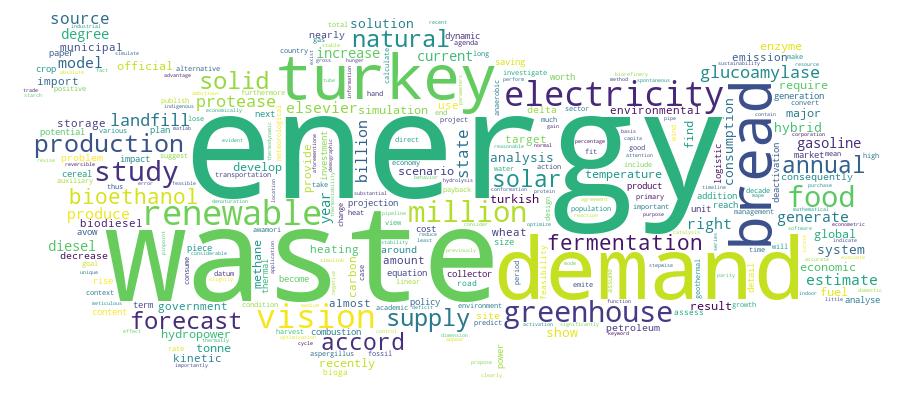
Competency Cloud

GCRIS Competency Cloud

Scholarly Output Search Results

Now showing 1 - 2 of 2
  • Review
    Citation - WoS: 39
    Citation - Scopus: 43
    Hydropower in Turkey: Analysis in the View of Vision 2023
    (Pergamon-elsevier Science Ltd, 2013) Melikoglu, Mehmet
    Turkey is a recently developed country, a regional power in the Middle East and an economic powerhouse of the region. Turkey's electricity demand is continuously increasing due to fast economic growth coupled with the country's vibrant young population. It is envisaged that this demand would keep on increasing almost exponentially in the next decade according to the recently avowed Vision 2023 agenda. According to which, the Turkish government ambitiously wants to provide 30.0% of the country's electricity demand from renewable energy sources by 2023. Turkey has vast renewable energy potential including hydro, geothermal, solar and wind. However, historically there is only one playmaker that is hydropower. Thus a detailed review of the current status and future prospects of Turkish hydropower market is urgently needed to generate a roadmap for the Vision 2023 agenda. This paper was intended to provide that vital information. Currently, more than 25.0% or 57.5 TWh of the country's electricity demand is supplied from hydropower. According to official projections this would increase to approximately 116.0 TWh in 2023. In this study, hydropower's supply rate of Turkey's annual electricity demand was assessed based on the official projections and a forecast was generated. Results showed that between 22.0% and 27.0% of Turkey's annual electricity demand should be supplied from hydropower in 2023. Therefore, between 22.5 TWh and 45.0 TWh of electricity should be generated from renewable energy sources other than hydropower to provide a total of 30.0% renewable energy based electricity generation in 2023. (C) 2013 Elsevier Ltd. All rights reserved.
  • Review
    Citation - WoS: 88
    Citation - Scopus: 96
    Vision 2023: Forecasting Turkey's Natural Gas Demand Between 2013 and 2030
    (Pergamon-elsevier Science Ltd, 2013) Melikoglu, Mehmet
    Natural gas is the primary source for electricity production in Turkey. However, Turkey does not have indigenous resources and imports more than 98.0% of the natural gas it consumes. In 2011, more than 20.0% of Turkey's annual trade deficit was due to imported natural gas, estimated at US$ 20.0 billion. Turkish government has very ambitious targets for the country's energy sector in the next decade according to the Vision 2023 agenda. Previously, we have estimated that Turkey's annual electricity demand would be 530,000 GWh at the year 2023. Considering current energy market dynamics it is almost evident that a substantial amount of this demand would be supplied from natural gas. However, meticulous analysis of the Vision 2023 goals clearly showed that the information about the natural gas sector is scarce. Most importantly there is no demand forecast for natural gas in the Vision 2023 agenda. Therefore, in this study the aim was to generate accurate forecasts for Turkey's natural gas demand between 2013 and 2030. For this purpose, two semi-empirical models based on econometrics, gross domestic product (GDP) at purchasing power parity (PPP) per capita, and demographics, population change, were developed. The logistic equation, which can be used for long term natural gas demand forecasting, and the linear equation, which can be used for medium term demand forecasting, fitted to the timeline series almost seamlessly. In addition, these two models provided reasonable fits according to the mean absolute percentage error, MAPE %, criteria. Turkey's natural gas demand at the year 2030 was calculated as 76.8 billion m(3) using the linear model and 83.8 billion m(3) based on the logistic model. Consequently, found to be in better agreement with the official Turkish petroleum pipeline corporation (BOTAS) forecast, 76.4 billion m(3), than results published in the literature. (C) 2013 Elsevier Ltd. All rights reserved.