Topallı, Damla

Loading...
Profile Picture
Name Variants
D.,Topallı
Topallı,D.
Damla, Topalli
Topalli, D.
D., Topalli
Topallı, Damla
D.,Topalli
T.,Damla
Topalli,D.
Damla, Topallı
D., Topallı
Topalli, Damla
T., Damla
Job Title
Doktor Öğretim Üyesi
Email Address
damla.topalli@atilim.edu.tr
Main Affiliation
Information Systems Engineering
Status
Website
ORCID ID
Scopus Author ID
Turkish CoHE Profile ID
Google Scholar ID
WoS Researcher ID

Sustainable Development Goals

NO POVERTY1
NO POVERTY
0
Research Products
ZERO HUNGER2
ZERO HUNGER
0
Research Products
GOOD HEALTH AND WELL-BEING3
GOOD HEALTH AND WELL-BEING
0
Research Products
QUALITY EDUCATION4
QUALITY EDUCATION
11
Research Products
GENDER EQUALITY5
GENDER EQUALITY
0
Research Products
CLEAN WATER AND SANITATION6
CLEAN WATER AND SANITATION
0
Research Products
AFFORDABLE AND CLEAN ENERGY7
AFFORDABLE AND CLEAN ENERGY
0
Research Products
DECENT WORK AND ECONOMIC GROWTH8
DECENT WORK AND ECONOMIC GROWTH
1
Research Products
INDUSTRY, INNOVATION AND INFRASTRUCTURE9
INDUSTRY, INNOVATION AND INFRASTRUCTURE
0
Research Products
REDUCED INEQUALITIES10
REDUCED INEQUALITIES
0
Research Products
SUSTAINABLE CITIES AND COMMUNITIES11
SUSTAINABLE CITIES AND COMMUNITIES
0
Research Products
RESPONSIBLE CONSUMPTION AND PRODUCTION12
RESPONSIBLE CONSUMPTION AND PRODUCTION
0
Research Products
CLIMATE ACTION13
CLIMATE ACTION
0
Research Products
LIFE BELOW WATER14
LIFE BELOW WATER
0
Research Products
LIFE ON LAND15
LIFE ON LAND
0
Research Products
PEACE, JUSTICE AND STRONG INSTITUTIONS16
PEACE, JUSTICE AND STRONG INSTITUTIONS
0
Research Products
PARTNERSHIPS FOR THE GOALS17
PARTNERSHIPS FOR THE GOALS
1
Research Products
Documents

14

Citations

266

h-index

6

Documents

0

Citations

0

Scholarly Output

39

Articles

12

Views / Downloads

98/206

Supervised MSc Theses

12

Supervised PhD Theses

4

WoS Citation Count

195

Scopus Citation Count

268

Patents

0

Projects

0

WoS Citations per Publication

5.00

Scopus Citations per Publication

6.87

Open Access Source

5

Supervised Theses

16

JournalCount
9th Annual International Conference of Education, Research and Innovation (iCERi) -- NOV 14-16, 2016 -- Seville, SPAIN4
9th International Conference on Education and New Learning Technologies (EDULEARN) -- JUL 03-05, 2017 -- Barcelona, SPAIN2
2016 Medical Technologies National Conference, TIPTEKNO 2016 -- 2016 Medical Technologies National Conference, TIPTEKNO 2016 -- 27 October 2016 through 29 October 2016 -- Antalya -- 1266332
Journal of Eye Movement Research2
Medical Technologies National Conference (TIPTEKNO) -- OCT 27-29, 2016 -- Antalya, TURKEY2
Current Page: 1 / 3

Scopus Quartile Distribution

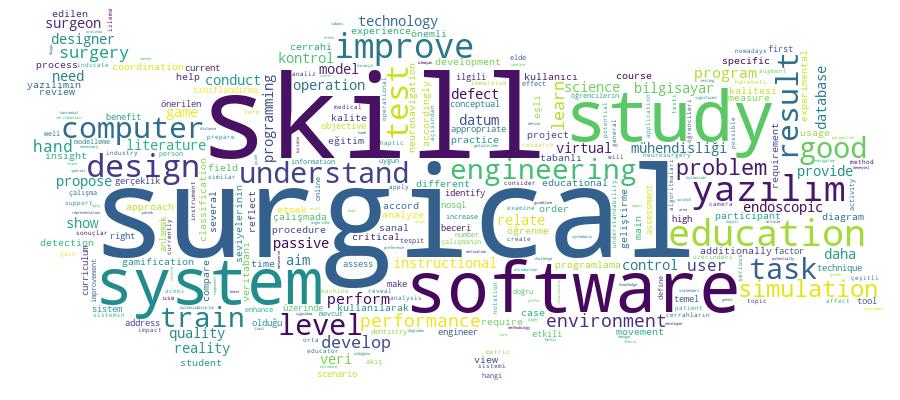
Competency Cloud

GCRIS Competency Cloud

Scholarly Output Search Results

Now showing 1 - 4 of 4
  • Article
    Citation - WoS: 7
    Citation - Scopus: 7
    Classification of Intermediate and Novice Surgeons' Skill Assessment Through Performance Metrics
    (Sage Publications inc, 2019) Topalli, Damla; Cagiltay, Nergiz Ercil
    Background. Endoscopic surgeries have become an alternative for open procedures whenever possible. For such types of operations, surgeons are required to gain several skills, whose development needs hands-on practice. Accordingly, gaining these skills today is a challenge for surgical education programs. Despite the development of several technology-enhanced training environments, there are still problems to better integrate these technologies into educational programs. For an appropriate integration, it is critical to assess the skill levels and adapt the training content according to the trainees' requirements. In the literature, there exist several methods for assessing these skill levels. However, there are still problems in practice for objective and repetitive assessment. Methods. The present study aims to estimate the skill levels of participants in surgical training programs in an objective manner by collecting experimental data from residents in an endoscopic surgical simulation environment and gathering performance metrics. Results. It is shown that, by comparing the results of a number of classification algorithms for the best accuracy estimation and feature set, the "novice" and "intermediate" skill levels can be estimated with an accuracy of 86%. Conclusions. The outcomes help surgical educators and instructional system designers to better assess the skill levels of the trainees and guide them accordingly. In addition, objective assessments as highlighted in this study can be beneficial when designing technology-enhanced adaptive learning environments.
  • Conference Object
    Using Intelligent Support Systems for Endoscopic Surgery Training: Analysis of Hand Motion
    (Iated-int Assoc Technology Education & development, 2017) Topalli, D.; Cagiltay, N. E.
    The use of simulation techniques in medical education is an emerging topic in surgical training process, and there are limited number of studies found in this field in our country and the world. Recently, using the machine learning techniques in surgical training constitutes a new area of research. By using these techniques, cost-efficient educational tools will be developed in order to improve education efficiency and patient safety. In this scope, it is aimed to develop an intelligent support system by examining the hand movements of the experienced surgeons during a surgical education process and guide less-experienced surgeons. In order to develop this system, previously developed surgical simulation system infrastructure in ECE Project supported by Tubitak-1001 program will be used. The hand movements' data of experts obtained by special tactile devices (haptics) are analyzed with an experimental study. The results of this study aimed to improve the surgical simulation training process with the machine learning algorithm developed and therefore, provide a significant contribution to the surgical training process.
  • Conference Object
    Simulation Based Surgical Education Programs and Hand Performance
    (Ieee, 2015) Eyuboglu, Burak Gokberk; Topallı, Damla; Topalli, Damla; Çağıltay, Nergiz; Cagiltay, Nergiz Ercil; Tonbul, Gokcen; Topallı, Damla; Çağıltay, Nergiz; Information Systems Engineering; Software Engineering; Information Systems Engineering; Software Engineering
    The performance of the left-and right-hands of a person may be different from each other. In general, people use one hand with a superior performance compared to the other hand where that hand is preferred for performing daily activities. It is critical to understand their preference for right or left hand use, especially in cases where the skills should be improved to use both hands precisely in activities required special abilities such as endoscopic surgical operations. A better understanding of these cases will improve the quality of existing surgical education programs, and make a major contribution specifically in designing, improving and managing of simulation-based instructional technologies. In this study, the right-and left-hand preferences (handedness) of people are analyzed from the literature and a simulation-based experimental study is conducted in order to examine the performance differences of the participants while using their right and left hands. The results of this study aimed to guide the curriculum designers and instructional system developers for better designing and developing simulation-based surgical education programs.
  • Conference Object
    Simulation Based Surgical Education Programs and Hand Performance;
    (Institute of Electrical and Electronics Engineers Inc., 2017) Eyuboglu,B.G.; Topalli,D.; Cagiltay,N.E.; Tonbul,G.
    The performance of the left- and right-hands of a person may be different from each other. In general, people use one hand with a superior performance compared to the other hand where that hand is preferred for performing daily activities. It is critical to understand their preference for right or left hand use, especially in cases where the skills should be improved to use both hands precisely in activities required special abilities such as endoscopic surgical operations. A better understanding of these cases will improve the quality of existing surgical education programs, and make a major contribution specifically in designing, improving and managing of simulation-based instructional technologies. In this study, the right- and left-hand preferences (handedness) of people are analyzed from the literature and a simulation-based experimental study is conducted in order to examine the performance differences of the participants while using their right and left hands. The results of this study aimed to guide the curriculum designers and instructional system developers for better designing and developing simulation-based surgical education programs. © 2016 IEEE.