Orhan, Melike

Loading...
Profile Picture
Name Variants
O.,Melike
M.,Orhan
Orhan, M.
Melike, Orhan
O., Melike
Orhan, Melike
Orhan M.
Orhan,M.
M., Orhan
Job Title
Doktor Öğretim Üyesi
Email Address
melike.orhan@atilim.edu.tr
Main Affiliation
Department of Architecture
Status
Website
Scopus Author ID
Turkish CoHE Profile ID
Google Scholar ID
WoS Researcher ID

Sustainable Development Goals

14

LIFE BELOW WATER
LIFE BELOW WATER Logo

0

Research Products

2

ZERO HUNGER
ZERO HUNGER Logo

0

Research Products

11

SUSTAINABLE CITIES AND COMMUNITIES
SUSTAINABLE CITIES AND COMMUNITIES Logo

3

Research Products

1

NO POVERTY
NO POVERTY Logo

0

Research Products

12

RESPONSIBLE CONSUMPTION AND PRODUCTION
RESPONSIBLE CONSUMPTION AND PRODUCTION Logo

1

Research Products

7

AFFORDABLE AND CLEAN ENERGY
AFFORDABLE AND CLEAN ENERGY Logo

0

Research Products

5

GENDER EQUALITY
GENDER EQUALITY Logo

0

Research Products

3

GOOD HEALTH AND WELL-BEING
GOOD HEALTH AND WELL-BEING Logo

0

Research Products

9

INDUSTRY, INNOVATION AND INFRASTRUCTURE
INDUSTRY, INNOVATION AND INFRASTRUCTURE Logo

0

Research Products

13

CLIMATE ACTION
CLIMATE ACTION Logo

0

Research Products

6

CLEAN WATER AND SANITATION
CLEAN WATER AND SANITATION Logo

0

Research Products

10

REDUCED INEQUALITIES
REDUCED INEQUALITIES Logo

0

Research Products

4

QUALITY EDUCATION
QUALITY EDUCATION Logo

1

Research Products

15

LIFE ON LAND
LIFE ON LAND Logo

0

Research Products

16

PEACE, JUSTICE AND STRONG INSTITUTIONS
PEACE, JUSTICE AND STRONG INSTITUTIONS Logo

0

Research Products

17

PARTNERSHIPS FOR THE GOALS
PARTNERSHIPS FOR THE GOALS Logo

0

Research Products

8

DECENT WORK AND ECONOMIC GROWTH
DECENT WORK AND ECONOMIC GROWTH Logo

0

Research Products
This researcher does not have a Scopus ID.
Documents

2

Citations

8

Scholarly Output

5

Articles

2

Views / Downloads

0/0

Supervised MSc Theses

1

Supervised PhD Theses

0

WoS Citation Count

8

Scopus Citation Count

13

WoS h-index

1

Scopus h-index

2

Patents

0

Projects

0

WoS Citations per Publication

1.60

Scopus Citations per Publication

2.60

Open Access Source

2

Supervised Theses

1

Google Analytics Visitor Traffic

JournalCount
5th Cyprus International Conference on Educational Research (CYICER) -- MAR 31-APR 02, 2016 -- Univ Kyrenia, Kyrenia, CYPRUS1
Advances in Science, Technology and Innovation -- 5th International Conference on Urban Planning and Architectural Design for Sustainable Development, UPADSD 2020 -- 8 July 2020 through 10 July 2020 -- Virtual, Online -- 2795591
Cypriot Journal of Educational Sciences1
Journal of Environmental Protection and Ecology1
Current Page: 1 / 1

Scopus Quartile Distribution

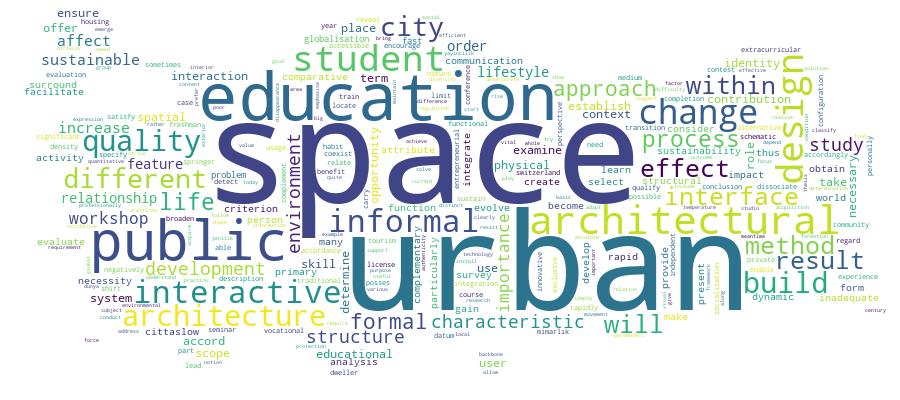
Competency Cloud

GCRIS Competency Cloud

Scholarly Output Search Results

Now showing 1 - 4 of 4
  • Conference Object
    Citation - Scopus: 6
    The Use of Semi-Public Spaces as Urban Space and Evaluation in Terms of Urban Space Quality
    (Springer Nature, 2022) Orhan,M.
    The rapid physical change and increase in density of today’s cities lead to changes in urban space usage and habits in urban life. This change negatively affects the description and use of public spaces as socialisation spaces, which are one of the most significant urban components. As a result, city dwellers satisfy their need for public spaces with the use of different urban spaces. Urban life shifts from urban public spaces to semi-public spaces. Semi-public spaces are qualified and accessible spaces that ensure transition between private spaces (buildings) and public spaces. These spaces gain different attributes according to the characteristics (commerce, housing, tourism, etc.) of the urban spaces they coexist within and to the functions and designs of the structures surrounding them. These attributes determine their configuration as integrated or dissociated with the city and thus specify their relationship with the city. This relationship changes ‘city–space–structure–human’ interaction, and this change affects urban quality with the spatial quality of semi-public spaces. The aim of this study is to present how and related to which characteristics the use of semi-public spaces as urban spaces has changed, to detect the effects of this change on the urban environment and to establish the role of semi-public spaces in terms of urban quality. In conclusion, semi-public spaces with different characteristics located in different urban spaces will be examined as regards physical, schematic, functional characteristics and use within the scope of this study. In accordance with the data obtained by comparative analysis method, approaches to facilitate their use as urban spaces and to ensure their integration with the city will be introduced. Accordingly, criteria that semi-public spaces should possess in order to increase and sustain urban space quality will be determined. © 2022, The Author(s), under exclusive license to Springer Nature Switzerland AG.
  • Article
    Citation - WoS: 7
    Citation - Scopus: 6
    Different Approach To Forming Sustainable Cities: Cittaslow
    (Scibulcom Ltd, 2017) Orhan, M.; Architecture
    Today, many cities can not adapt to 'urban deformation' escalated by globalisation and to the changes that develop accordingly. 'Fast' evolving lifestyles of the people bring a new identity and structure to cities. In the meantime, these lifestyles also deteriorate basic structural identities quite rapidly. While global processes force the whole world to follow a fast lifestyle, they also affect local lives and give rise to the rapid disappearance of urban differences and authenticities. 'Areas of poor quality with no identity and distinct characteristic features' have thus become the biggest problem of cities. Various urban approaches have started to be shown to solve these problems. One of these approaches is 'sustainable cities' that has emerged for a better environment and social life for the communities. Within the scope of this study, 'Cittaslow' is addressed as a different approach to building sustainable cities. Within this context, by ensuring the notion of 'Cittaslow' is clearly understood, urban parameters suggested by 'Cittaslow' within the framework of sustainability as a solution to modern-day urban problems have been determined. This urban movement, which strives for the protection of authenticity against the impact of globalisation, resists and scrutinises fast lifestyle and its effects on cities and the quality of urban life.
  • Article
    Citation - Scopus: 1
    The Place and Importance of Informal Education in the Freshman Year Experience of Architectural Education
    (Birlesik Dunya Yenilik Arastirma ve Yayıncilik Merkezi, 2020) Orhan,M.
    Formal architectural education is inadequate for students in the current dynamic world where visual content and speed have become determinative. Particularly, freshman-year architecture students have difficulties in this process. In order to facilitate this process, dynamic methods, in which the student is interactive, should be included more in formal education. Informal education methods should be used complementary to formal education in terms of achieving the required skills and development along with knowledge. The aim of this study is to emphasise the requirement, importance and practice methods of informal education to make the education process more efficient for freshman-year architecture students. The quantitative research method is used in the study, and a survey is conducted with the sample group of selected freshman-year architecture students. With the results of the survey, it is tried to determine which informal learning the students preferred and found useful in the process of obtaining information. As a result, informal education methods, their contribution to the education of freshman-year architecture students, the results of this contribution and the student learning outcomes are evaluated. © 2020 Birlesik Dunya Yenilik Arastirma ve Yayincilik Merkezi.
  • Conference Object
    Citation - WoS: 1
    The Role and Importance of Workshops in the Architectural Design Education; Case of "self Made Architecture I-Ii"
    (Sciencepark Sci, Organization & Counseling Ltd, 2017) Orhan, Melike
    In formal education context, architectural education and methods, sometimes inadequate for architectural students who will take part in the architectural community which are rapidly evolving and changing, that reveals the necessity of informal education for vocational training of students for the completion of their developments and shortcomings. At present, the traditional education system, provide limited educational opportunities for students. In architecture education primary aim is to be able to broaden student's perspectives and design skills which are our primary aim is only possible by providing an independent medium of expression. Therefore, during the student's educational process, in order to gain the necessary skills and development with more innovative and entrepreneurial alternatives, it is necessary for the students to be encouraged and to benefit from the informal education such as workshops, seminars, conferences, contests and excavations. In the architectural educational process "formal-informal integrated education network" that will be formed and carried out each other as a complement enables students to develop personally and professionally by allowing them acquire the necessary skills. The subject of this study is necessity, importance and impact of the informal education, which plays a complementary role rather than support in the architectural design studios which is a backbone of architectural education. In this context, particularly in informal education, workshops will be focused and their contributions, results and student acquisitions will be evaluated.