Eroğlu, Aylin Konez

Loading...
Profile Picture
Name Variants
Eroğlu,A.K.
Aylin Konez, Eroğlu
Eroğlu, Aylin Konez
A.K.Eroğlu
A.K.Eroglu
E.,Aylin Konez
Aylin Konez, Eroglu
E., Aylin Konez
A.,Eroğlu
A., Eroglu
Eroglu, Aylin Konez
Eroglu,A.K.
Job Title
Doktor
Email Address
Main Affiliation
Department of Mechatronics Engineering
Status
Former Staff
Website
ORCID ID
Scopus Author ID
Turkish CoHE Profile ID
Google Scholar ID
WoS Researcher ID

Sustainable Development Goals

SDG data is not available
This researcher does not have a Scopus ID.
This researcher does not have a WoS ID.
Scholarly Output

4

Articles

1

Views / Downloads

18/185

Supervised MSc Theses

0

Supervised PhD Theses

1

WoS Citation Count

6

Scopus Citation Count

12

Patents

0

Projects

0

WoS Citations per Publication

1.50

Scopus Citations per Publication

3.00

Open Access Source

0

Supervised Theses

1

JournalCount
18th International Conference on Engineering Design (ICED) -- AUG 15-18, 2011 -- Tech Univ Denmark (DTU), Copenhagen, DENMARK1
Control Engineering and Applied Informatics1
ICED 11 - 18th International Conference on Engineering Design - Impacting Society Through Engineering Design -- 18th International Conference on Engineering Design, ICED 11 -- 15 August 2011 through 18 August 2011 -- Copenhagen -- 890921
Current Page: 1 / 1

Scopus Quartile Distribution

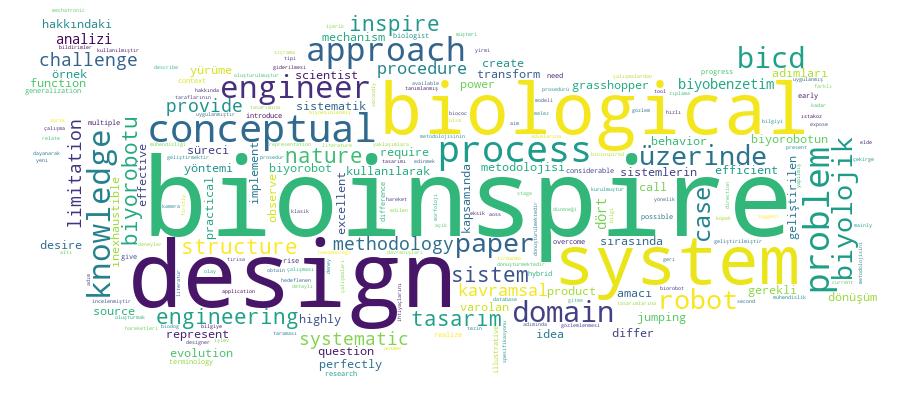
Competency Cloud

GCRIS Competency Cloud

Scholarly Output Search Results

Now showing 1 - 2 of 2
  • Conference Object
    Citation - Scopus: 4
    Bioinspired Conceptual Design (bicd): Conceptual Design of a Grasshopper-Like Jumping Mechanism as a Case Study
    (Design Soc, 2011) Eroglu,A.K.; Erden,Z.; Erden,A.
    The evolution process of nature creates highly effective, power efficient, and perfectly structured biological systems. These excellent systems provide an inexhaustible source for engineers and scientists who desire to inspire ideas, processes, structures, functions, and behaviors from biological domain and implement them into engineering domain. This approach is called "Bioinspired" and challenging for engineers. However, some problems of the practical approaches are observed. One of the problems is "ad hoc" nature of the process. Each bioinspired design product has resulted in a differing design process and a generalization was not possible. Another problem rises due to the terminology difference between engineers and biologists. To overcome these problems, a need for a systematic bioinspired design (BID) process was realized in early 2000s and since then, considerable research on the BID methodology has been progressed. Within the context of BID, this paper introduces a new approach on bioinspired conceptual design (BICD) procedure for hybrid bioinspired robots which can be inspired from multiple biological systems. An illustrative case study is given in the paper.
  • Conference Object
    Citation - WoS: 1
    BIOINSPIRED CONCEPTUAL DESIGN (BICD): CONCEPTUAL DESIGN OF A GRASSHOPPER-LIKE JUMPING MECHANISM AS A CASE STUDY
    (design Soc, 2011) Eroglu, Aylin Konez; Erden, Zuhal; Erden, Abdulkadir
    The evolution process of nature creates highly effective, power efficient, and perfectly structured biological systems. These excellent systems provide an inexhaustible source for engineers and scientists who desire to inspire ideas, processes, structures, functions, and behaviors from biological domain and implement them into engineering domain. This approach is called "Bioinspired" and challenging for engineers. However, some problems of the practical approaches are observed. One of the problems is "ad hoc" nature of the process. Each bioinspired design product has resulted in a differing design process and a generalization was not possible. Another problem rises due to the terminology difference between engineers and biologists. To overcome these problems, a need for a systematic bioinspired design (BID) process was realized in early 2000s and since then, considerable research on the BID methodology has been progressed. Within the context of BID, this paper introduces a new approach on bioinspired conceptual design (BICD) procedure for hybrid bioinspired robots which can be inspired from multiple biological systems. An illustrative case study is given in the paper.