Ronganakis, Rengin Peköz

Loading...
Profile Picture
Name Variants
R.,Rengin Peköz
R.P.Ronganakis
R., Ronganakis
R.,Rengin Pekoz
R.,Ronganakis
Ronganakis, Rengin Peköz
Ronganakis,R.P.
R., Rengin Pekoz
Rengin Pekoz, Ronganakis
Ronganakis, Rengin Pekoz
Rengin Peköz, Ronganakis
Pekoz, Rengin
Pekoz, R.
Job Title
Doçent Doktor
Email Address
rengin.pekoz@atilim.edu.tr
Main Affiliation
Department of Electrical & Electronics Engineering
Status
Former Staff
Website
ORCID ID
Scopus Author ID
Turkish CoHE Profile ID
Google Scholar ID
WoS Researcher ID

Sustainable Development Goals

SDG data is not available
This researcher does not have a Scopus ID.
This researcher does not have a WoS ID.
Scholarly Output

7

Articles

7

Views / Downloads

1/0

Supervised MSc Theses

0

Supervised PhD Theses

0

WoS Citation Count

134

Scopus Citation Count

37

WoS h-index

4

Scopus h-index

2

Patents

0

Projects

0

WoS Citations per Publication

19.14

Scopus Citations per Publication

5.29

Open Access Source

4

Supervised Theses

0

Google Analytics Visitor Traffic

JournalCount
ACS Omega1
Computational Materials Science1
International Journal of Modern Physics B1
Physical Chemistry Chemical Physics1
Surface Science1
Current Page: 1 / 2

Scopus Quartile Distribution

Competency Cloud

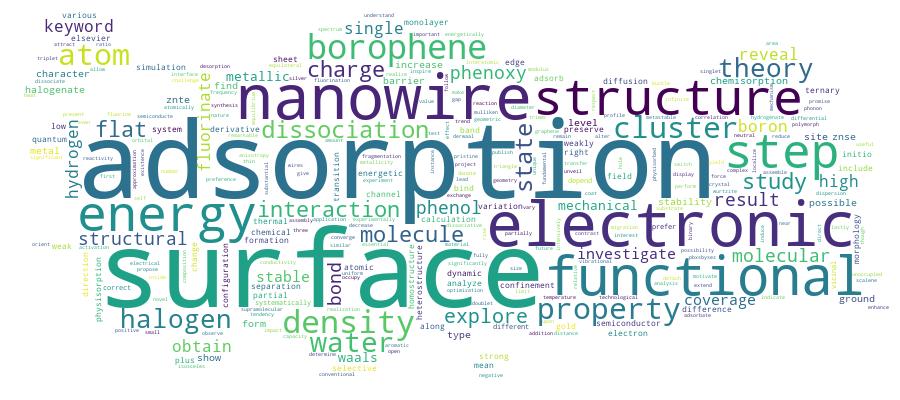
GCRIS Competency Cloud

Scholarly Output Search Results

Now showing 1 - 3 of 3
  • Article
    Citation - WoS: 1
    Citation - Scopus: 1
    Ab Initio Study of Structural and Electronic Properties of Single Crystal and Core/Shell Ii-Vi Semiconductor Nanowires
    (Elsevier, 2016) Pekoz, R.
    Structural and electronic properties of pristine and H-passivated wurtzite type ZnSe, ZnTe nanowires and ZnX/ZnY (X = Se(Te) and Y = Te(Se)) core/shell nanowires oriented along the [0001] direction have been investigated using first-principles calculations. The changes in the electronic structure of the nanowires due to the quantum confinement and morphology have been searched. Quantum confinement increases the band gap energy as the diameters of ZnSe and ZnTe nanowires decrease. Both homostructured and heterostructured nanowires are found to show a semiconducting character with direct band gaps at Gamma-point. Changing the morphology from homostructured nanowires to heterostructured core/shell nanowires has an important impact on the electronic structure. For instance, the charge separation of electrons and holes along the infinite direction of core/shell nanowires shows a strong preference for electron(hole) states localized inside ZnSe(ZnTe) regions. (C) 2016 Elsevier B.V. All rights reserved.
  • Article
    A Density Functional Theory Study on the Structural and Electronic Properties of Pbx< (x Plus y Plus z=2, 3) Clusters
    (World Scientific Publ Co Pte Ltd, 2018) Pekoz, Rengin; Erkoc, Sakir
    The structural and electronic properties of neutral ternary PbxSbySez clusters (x y + z = 2, 3) in their ground states have been explored by means of density functional theory calculations. The geometric structures and binding energies are systematically explored and for the most stable configurations of each cluster type vibrational frequencies, charges on atoms, energy difference between highest occupied and lowest unoccupied molecular orbitals, and the possible dissociations channels have been analyzed. Depending on being binary or ternary cluster and composition, the most energetic structures have singlet, doublet or triplet ground states, and trimers prefer to form isosceles, equilateral or scalene triangle structure.
  • Article
    Citation - WoS: 2
    Citation - Scopus: 3
    Selective Adsorption of a Supramolecular Structure on Flat and Stepped Gold Surfaces
    (Elsevier, 2018) Pekoz, Rengin; Donadio, Davide
    Halogenated aromatic molecules assemble on surfaces forming both hydrogen and halogen bonds. Even though these systems have been intensively studied on flat metal surfaces, high-index vicinal surfaces remain challenging, as they may induce complex adsorbate structures. The adsorption of 2,6-dibromoanthraquinone (2,6-DBAQ) on flat and stepped gold surfaces is studied by means of van der Waals corrected density functional theory. Equilibrium geometries and corresponding adsorption energies are systematically investigated for various different adsorption configurations. It is shown that bridge sites and step edges are the preferred adsorption sites for single molecules on flat and stepped surfaces, respectively. The role of van der Waals interactions, halogen bonds and hydrogen bonds are explored for a monolayer coverage of 2,6-DBAQ molecules, revealing that molecular flexibility and intermolecular interactions stabilize two-dimensional networks on both flat and stepped surfaces. Our results provide a rationale for experimental observation of molecular carpeting on high-index vicinal surfaces of transition metals. (C) 2017 Elsevier B.V. All rights reserved.