Qasrawı, Atef Fayez Hasan

Loading...
Profile Picture
Name Variants
Qasrawi, Atef Fayez
Atef Fayez Hasan, Qasrawı
Qasrawı,A.F.H.
Qasrawi,A.F.H.
Q., Atef Fayez Hasan
Q.,Atef Fayez Hasan
Atef Fayez Hasan, Qasrawi
Qasrawi, Atef Fayez Hasan
A.F.H.Qasrawı
A.F.H.Qasrawi
A., Qasrawi
A.,Qasrawı
Qasrawı, Atef Fayez Hasan
Qasrawi, A. F.
Qasrawi,A.F.
Qasrawi, AF
Qasrawi, Atef F.
Qasrawi, Atef A.
Qasrawi, Atef Fayez
Qasrawi, Atef F.
Qasrawi, Atef A.
Qasrawi, Atef
Job Title
Doçent Doktor
Email Address
atef.qasrawi@atilim.edu.tr
Main Affiliation
Department of Electrical & Electronics Engineering
Status
Former Staff
Website
ORCID ID
Scopus Author ID
Turkish CoHE Profile ID
Google Scholar ID
WoS Researcher ID

Sustainable Development Goals

NO POVERTY1
NO POVERTY
0
Research Products
ZERO HUNGER2
ZERO HUNGER
0
Research Products
GOOD HEALTH AND WELL-BEING3
GOOD HEALTH AND WELL-BEING
0
Research Products
QUALITY EDUCATION4
QUALITY EDUCATION
0
Research Products
GENDER EQUALITY5
GENDER EQUALITY
0
Research Products
CLEAN WATER AND SANITATION6
CLEAN WATER AND SANITATION
0
Research Products
AFFORDABLE AND CLEAN ENERGY7
AFFORDABLE AND CLEAN ENERGY
17
Research Products
DECENT WORK AND ECONOMIC GROWTH8
DECENT WORK AND ECONOMIC GROWTH
0
Research Products
INDUSTRY, INNOVATION AND INFRASTRUCTURE9
INDUSTRY, INNOVATION AND INFRASTRUCTURE
0
Research Products
REDUCED INEQUALITIES10
REDUCED INEQUALITIES
0
Research Products
SUSTAINABLE CITIES AND COMMUNITIES11
SUSTAINABLE CITIES AND COMMUNITIES
0
Research Products
RESPONSIBLE CONSUMPTION AND PRODUCTION12
RESPONSIBLE CONSUMPTION AND PRODUCTION
0
Research Products
CLIMATE ACTION13
CLIMATE ACTION
0
Research Products
LIFE BELOW WATER14
LIFE BELOW WATER
0
Research Products
LIFE ON LAND15
LIFE ON LAND
0
Research Products
PEACE, JUSTICE AND STRONG INSTITUTIONS16
PEACE, JUSTICE AND STRONG INSTITUTIONS
1
Research Products
PARTNERSHIPS FOR THE GOALS17
PARTNERSHIPS FOR THE GOALS
0
Research Products
This researcher does not have a Scopus ID.
This researcher does not have a WoS ID.
Scholarly Output

226

Articles

222

Views / Downloads

87/0

Supervised MSc Theses

0

Supervised PhD Theses

0

WoS Citation Count

1984

Scopus Citation Count

2000

Patents

0

Projects

0

WoS Citations per Publication

8.78

Scopus Citations per Publication

8.85

Open Access Source

17

Supervised Theses

0

JournalCount
Crystal Research and Technology16
Journal of Electronic Materials15
physica status solidi (a)12
Materials Science in Semiconductor Processing11
Journal of Alloys and Compounds11
Current Page: 1 / 11

Scopus Quartile Distribution

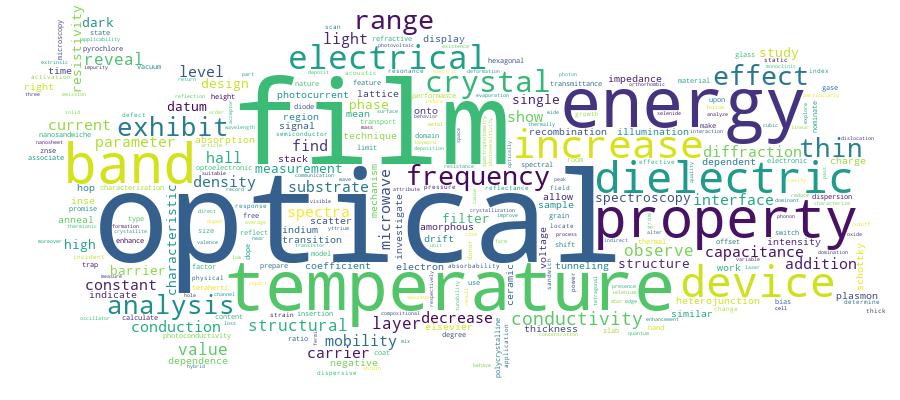
Competency Cloud

GCRIS Competency Cloud

Scholarly Output Search Results

Now showing 1 - 4 of 4
  • Article
    Citation - Scopus: 1
    Samarium and Yttrium Doping Induced Phase Transitions and Their Effects on the Structural, Optical and Electrical Properties of Nd2sn2< Ceramics
    (Iop Publishing Ltd, 2019) Saleh, Adli A.; Qasrawi, A. F.; Hamamera, Hanan Z.; Khanfar, Hazem K.; Yumusak, G.
    In this work, the effects of Sm+3 and Y+3 doping onto the structural, optical and electrical properties of Nd2Sn2O7 are investigated. An atomic content of 3.49% and 4.29% of Sm and Y, respectively, were sufficient to alter the physical properties of the Nd2Sn2O7. Particularly, the Y+3 ionic substitution decreased the lattice constant, narrows the energy band gap, changed the conductivity type from n- to p- type and increased the electrical conductivity by 73 times without changing the cubic nature of structure of the pyrochlore ceramics. On the other hand, Sm+3 ionic substitutions changed the cubic structure to hexagonal or trigonal and forced optical transitions in the infrared range of light. The energy band gap shrunk from 3.40 to 1.40 eV, the defect density is reduced and the electrical conductivity increased by 47 times via Sm doping. These doping agents' makes the neodymium stannate pyrochlore ceramics more appropriates for optoelectronic applications.
  • Article
    Citation - WoS: 14
    Citation - Scopus: 13
    Enhancement of Electrical Performance of Znse Thin Films Via Au Nanosandwiching
    (Sciendo, 2020) Qasrawi, A. F.; Taleb, Maram F.
    In this work, we report the effect of sandwiching of Au nanosheets on the structural and electrical properties of ZnSe thin films. The ZnSe films which are grown by the thermal evaporation technique onto glass and yttrium thin film substrates exhibit lattice deformation accompanied with lattice constant extension, grain size reduction and increased defect density upon Au nanosandwiching. The temperature dependent direct current conductivity analysis has shown that the 70 nm thick Au layers successfully increased the electrical conductivity by three orders of magnitude without causing degeneracy. On the other hand, the alternating current conductivity studies in the frequency domain of 10 MHz to 1800 MHz have shown that the alternating current conduction in ZnSe is dominated by both of quantum mechanical tunneling and correlated barrier hopping of electrons over the energy barriers formed at the grain boundaries. The Au nanosheets are observed to increase the density of localized states near Fermi level and reduce the average hopping energy by similar to 5 times. The conductivity, capacitance, impedance and reflection coefficient spectral analyses have shown that the nanosandwiching of Au between two layers of ZnSe makes the zinc selenide more appropriate for electronic applications and for applications which need microwave cavities.
  • Article
    Citation - WoS: 3
    Citation - Scopus: 3
    Enhancement of the Performance of the Cu2se Band Filters Via Yb Nanosandwiching
    (Wiley, 2019) Khusayfan, Najla M.; Qasrawı, Atef Fayez Hasan; Qasrawi, A. F.; Khanfar, Hazem K.; Qasrawı, Atef Fayez Hasan; Department of Electrical & Electronics Engineering; Department of Electrical & Electronics Engineering
    In this article, we report the experimental and theoretical modeling on the band pass filters that are made of two thin film layers of Cu2Se coated onto aluminum substrates and nanosandwiched with 50 nm ytterbium layers. The nanosandwiching of Yb between two layers of Cu2Se is found to decrease the lattice constant, the defect density, and the strain and increase the grain size in the Cu2Se. Electrically, it is observed that, Al/Cu2Se/Al structure exhibits wave trap characteristics with notch frequency of 1.31 GHz. The Yb-layers improved the performance of the band pass filters by increasing the amplitude of the reflection coefficients, increasing the return loss values and decreasing the voltage standing wave ratios. The calculated conduction and wave trapping parameters nominate the Yb-nanosandwiched Cu2Se films for use in communication technology as they exhibit negative capacitance effect and narrow band pass range.
  • Article
    Citation - WoS: 8
    Citation - Scopus: 8
    Effects of Photoexcitation on the Current Transport Mechanism in Amorphous Indium Selenide Thin Films
    (Taylor & Francis Ltd, 2010) Qasrawi, A. F.
    The effect of photoexcitation on the current transport mechanism in amorphous indium selenide thin films was studied by means of dark and illuminated conductivity measurements as a function of temperature. Analysis of the dark electrical conductivity in the temperature range 110-320 K reveals behaviour characteristic of carriers excited to the conduction band and thermally assisted variable-range hopping (VRH) at the Fermi level above 280 K and below 220 K, respectively. In the temperature range 220-280 K, a mixed conduction mechanism was observed. A conductivity activation energy of 300 meV (above 280 K), a density of localised states (evaluated assuming a localisation length of 5 angstrom) of 1.08 x 1021 cm-3 eV-1, an average hopping distance of 20.03 angstrom (at 120 K) and an average hopping energy of 27.64 meV have been determined from the dark electrical measurements. When the sample was exposed to illumination at a specific excitation flux and energy, the values of the conductivity activation energy, the average hopping energy and the average hopping range were significantly decreased. On the other hand, the density of localised states near the Fermi level increased when the light flux was increased. Such behaviour was attributed to a reversible Fermi level shift on photoexcitation.