Gökçay, Erhan

Loading...
Profile Picture
Name Variants
Gokcay, E
E.,Gökçay
Gökçay,E.
E., Gökçay
G.,Erhan
Gokcay E.
Goekcay, Erhan
Gokcay, Erhan
Erhan, Gokcay
Gökçay, Erhan
E., Gokcay
GOKCAY, E
Erhan, Gökçay
Gokcay,E.
Gökçay E.
G., Erhan
E.,Gokcay
Job Title
Doktor Öğretim Üyesi
Email Address
erhan.gokcay@atilim.edu.tr
Main Affiliation
Software Engineering
Status
Website
Scopus Author ID
Turkish CoHE Profile ID
Google Scholar ID
WoS Researcher ID

Sustainable Development Goals

5

GENDER EQUALITY
GENDER EQUALITY Logo

0

Research Products

14

LIFE BELOW WATER
LIFE BELOW WATER Logo

0

Research Products

10

REDUCED INEQUALITIES
REDUCED INEQUALITIES Logo

0

Research Products

3

GOOD HEALTH AND WELL-BEING
GOOD HEALTH AND WELL-BEING Logo

1

Research Products

2

ZERO HUNGER
ZERO HUNGER Logo

0

Research Products

9

INDUSTRY, INNOVATION AND INFRASTRUCTURE
INDUSTRY, INNOVATION AND INFRASTRUCTURE Logo

1

Research Products

16

PEACE, JUSTICE AND STRONG INSTITUTIONS
PEACE, JUSTICE AND STRONG INSTITUTIONS Logo

0

Research Products

11

SUSTAINABLE CITIES AND COMMUNITIES
SUSTAINABLE CITIES AND COMMUNITIES Logo

0

Research Products

8

DECENT WORK AND ECONOMIC GROWTH
DECENT WORK AND ECONOMIC GROWTH Logo

0

Research Products

13

CLIMATE ACTION
CLIMATE ACTION Logo

0

Research Products

4

QUALITY EDUCATION
QUALITY EDUCATION Logo

0

Research Products

6

CLEAN WATER AND SANITATION
CLEAN WATER AND SANITATION Logo

0

Research Products

1

NO POVERTY
NO POVERTY Logo

0

Research Products

15

LIFE ON LAND
LIFE ON LAND Logo

0

Research Products

17

PARTNERSHIPS FOR THE GOALS
PARTNERSHIPS FOR THE GOALS Logo

0

Research Products

7

AFFORDABLE AND CLEAN ENERGY
AFFORDABLE AND CLEAN ENERGY Logo

0

Research Products

12

RESPONSIBLE CONSUMPTION AND PRODUCTION
RESPONSIBLE CONSUMPTION AND PRODUCTION Logo

0

Research Products
Documents

16

Citations

395

h-index

7

Documents

15

Citations

293

Scholarly Output

20

Articles

6

Views / Downloads

2/0

Supervised MSc Theses

5

Supervised PhD Theses

2

WoS Citation Count

36

Scopus Citation Count

52

WoS h-index

3

Scopus h-index

3

Patents

0

Projects

0

WoS Citations per Publication

1.80

Scopus Citations per Publication

2.60

Open Access Source

4

Supervised Theses

7

Google Analytics Visitor Traffic

JournalCount
Multimedia Tools and Applications3
2017 IEEE 1st Ukraine Conference on Electrical and Computer Engineering, UKRCON 2017 - Proceedings -- 1st IEEE Ukraine Conference on Electrical and Computer Engineering, UKRCON 2017 -- 29 May 2017 through 2 June 2017 -- Kyiv -- 1317631
24th IEEE International Conference on Electronics, Circuits and Systems (ICECS) -- DEC 05-08, 2017 -- Batumi, GEORGIA1
7th International Conference on Cloud Computing and Services Science (CLOSER) -- APR 24-26, 2017 -- Porto, PORTUGAL1
8th International Conference on Cloud Computing and Services Science (CLOSER) -- MAR 19-21, 2018 -- Funchal, PORTUGAL1
Current Page: 1 / 3

Scopus Quartile Distribution

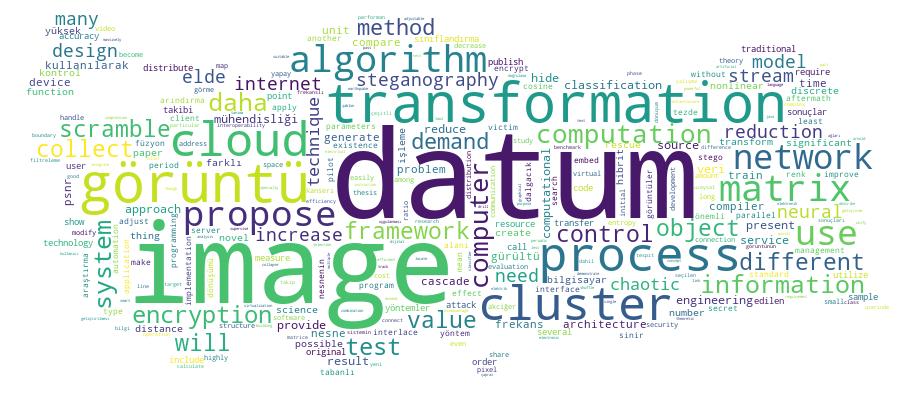
Competency Cloud

GCRIS Competency Cloud

Scholarly Output Search Results

Now showing 1 - 2 of 2
  • Article
    Entropy Based Streaming Big-Data Reduction With Adjustable Compression Ratio
    (Springer, 2023) Gokcay, Erhan
    The Internet of Things is a novel concept in which numerous physical devices are linked to the internet to collect, generate, and distribute data for processing. Data storage and processing become more challenging as the number of devices increases. One solution to the problem is to reduce the amount of stored data in such a way that processing accuracy does not suffer significantly. The reduction can be lossy or lossless, depending on the type of data. The article presents a novel lossy algorithm for reducing the amount of data stored in the system. The reduction process aims to reduce the volume of data while maintaining classification accuracy and properly adjusting the reduction ratio. A nonlinear cluster distance measure is used to create subgroups so that samples can be assigned to the correct clusters even though the cluster shape is nonlinear. Each sample is assumed to arrive one at a time during the reduction. As a result of this approach, the algorithm is suitable for streaming data. The user can adjust the degree of reduction, and the reduction algorithm strives to minimize classification error. The algorithm is not dependent on any particular classification technique. Subclusters are formed and readjusted after each sample during the calculation. To summarize the data from the subclusters, representative points are calculated. The data summary that is created can be saved and used for future processing. The accuracy difference between regular and reduced datasets is used to measure the effectiveness of the proposed method. Different classifiers are used to measure the accuracy difference. The results show that the nonlinear information-theoretic cluster distance measure improves the reduction rates with higher accuracy values compared to existing studies. At the same time, the reduction rate can be adjusted as desired, which is a lacking feature in the current methods. The characteristics are discussed, and the results are compared to previously published algorithms.
  • Article
    Citation - WoS: 3
    Citation - Scopus: 3
    An Information-Theoretic Instance-Based Classifier
    (Elsevier Science inc, 2020) Gokcay, Erhan
    Classification algorithms are used in many areas to determine new class labels given a training set. Many classification algorithms, linear or not, require a training phase to determine model parameters by using an iterative optimization of the cost function for that particular model or algorithm. The training phase can adjust and fine-tune the boundary line between classes. However, the process may get stuck in a local optimum, which may or may not be close to the desired solution. Another disadvantage of training processes is that upon arrival of a new sample, a retraining of the model is necessary. This work presents a new information-theoretic approach to an instance-based supervised classification. The boundary line between classes is calculated only by the data points without any external parameters or weights, and it is given in closed-form. The separation between classes is nonlinear and smooth, which reduces memorization problems. Since the method does not require a training phase, classified samples can be incorporated in the training set directly, simplifying a streaming classification operation. The boundary line can be replaced with an approximation or regression model for parametric calculations. Features and performance of the proposed method are discussed and compared with similar algorithms. (C) 2020 Elsevier Inc. All rights reserved.