Cihanoğlu, Mine

Loading...
Profile Picture
Name Variants
M.,Cihanoğlu
M.,Cihanoglu
M., Cihanoglu
Mine, Cihanoğlu
C., Mine
Cihanoğlu,M.
Mine, Cihanoglu
C.,Mine
Cihanoglu,M.
Cihanoğlu, Mine
Cihanoglu, Mine
Job Title
Doktor Öğretim Üyesi
Email Address
mine.ogul@atilim.edu.tr
Main Affiliation
Department of Psychology
Status
Former Staff
Website
ORCID ID
Scopus Author ID
Turkish CoHE Profile ID
Google Scholar ID
WoS Researcher ID

Sustainable Development Goals

SDG data is not available
This researcher does not have a Scopus ID.
This researcher does not have a WoS ID.
Scholarly Output

4

Articles

3

Views / Downloads

7/0

Supervised MSc Theses

0

Supervised PhD Theses

0

WoS Citation Count

2

Scopus Citation Count

2

WoS h-index

1

Scopus h-index

1

Patents

0

Projects

0

WoS Citations per Publication

0.50

Scopus Citations per Publication

0.50

Open Access Source

0

Supervised Theses

0

Google Analytics Visitor Traffic

JournalCount
Evaluation and Program Planning1
Journal of Loss and Trauma1
Current Page: 1 / 1

Scopus Quartile Distribution

Competency Cloud

GCRIS Competency Cloud

Scholarly Output Search Results

Now showing 1 - 1 of 1
  • Review
    Citation - WoS: 2
    Citation - Scopus: 2
    School-based psychosocial and educational interventions for children and adolescents after the 1999 Marmara earthquakes in Turkey: A review on lessons learned
    (Pergamon-elsevier Science Ltd, 2024) Cihanoglu, Mine; Vatansever, Merve; Erden, Gulsen
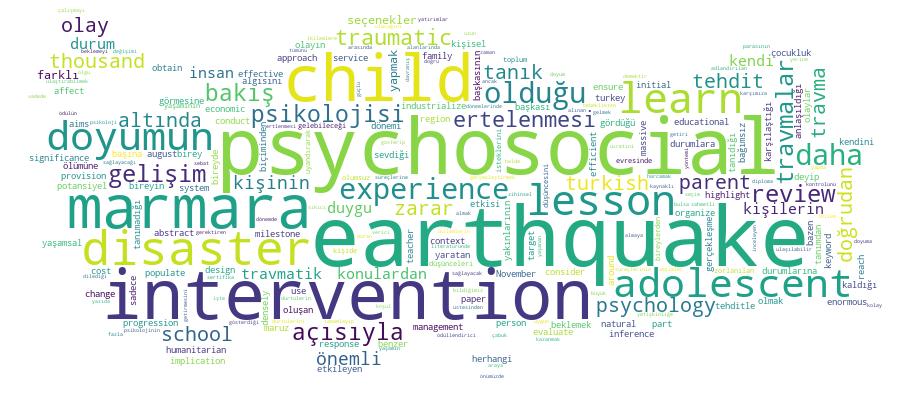
    The massive earthquakes experienced in August and November 1999 affected thousands of people in the Marmara region, the most densely populated and industrialized part of Turkey. The humanitarian and economic cost was so enormous, and these earthquakes have changed the Turkish disaster management system and the Turkish people's approach to disasters. Marmara earthquakes are also considered as a milestone in the provision of psychosocial services for disaster victims. This paper aims to review the psychosocial interventions targeting children, adolescents, and their families after the 1999 earthquakes in Turkey. The progression from initial responses to more organized psychosocial interventions is outlined. Conducting the interventions at schools has ensured that thousands of children, teachers, and parents are reached in the most efficient and effective way possible. The significance of the school context in designing psychosocial interventions is highlighted and implications of the lessons learned for traumatic experiences of children and parents are also explored. It is evaluated that these inferences obtained from the Marmara earthquake in Turkey can be used in disasters around the world.