Arıkan, Kutluk Bilge

Loading...
Profile Picture
Name Variants
K.B.Arikan
Kutluk Bilge, Arıkan
K., Arikan
Arıkan,K.B.
Arıkan, Kutluk Bilge
K.B.Arıkan
Kutluk Bilge, Arikan
Arikan, Kutluk Bilge
K.,Arıkan
A., Kutluk Bilge
Arikan,K.B.
A.,Kutluk Bilge
Arikan, K. B.
Job Title
Doktor Öğretim Üyesi
Email Address
kutluk.arikan@atilim.edu.tr
Main Affiliation
Department of Mechatronics Engineering
Status
Former Staff
Website
ORCID ID
Scopus Author ID
Turkish CoHE Profile ID
Google Scholar ID
WoS Researcher ID

Sustainable Development Goals

NO POVERTY1
NO POVERTY
1
Research Products
ZERO HUNGER2
ZERO HUNGER
0
Research Products
GOOD HEALTH AND WELL-BEING3
GOOD HEALTH AND WELL-BEING
1
Research Products
QUALITY EDUCATION4
QUALITY EDUCATION
0
Research Products
GENDER EQUALITY5
GENDER EQUALITY
0
Research Products
CLEAN WATER AND SANITATION6
CLEAN WATER AND SANITATION
0
Research Products
AFFORDABLE AND CLEAN ENERGY7
AFFORDABLE AND CLEAN ENERGY
0
Research Products
DECENT WORK AND ECONOMIC GROWTH8
DECENT WORK AND ECONOMIC GROWTH
0
Research Products
INDUSTRY, INNOVATION AND INFRASTRUCTURE9
INDUSTRY, INNOVATION AND INFRASTRUCTURE
1
Research Products
REDUCED INEQUALITIES10
REDUCED INEQUALITIES
0
Research Products
SUSTAINABLE CITIES AND COMMUNITIES11
SUSTAINABLE CITIES AND COMMUNITIES
1
Research Products
RESPONSIBLE CONSUMPTION AND PRODUCTION12
RESPONSIBLE CONSUMPTION AND PRODUCTION
0
Research Products
CLIMATE ACTION13
CLIMATE ACTION
0
Research Products
LIFE BELOW WATER14
LIFE BELOW WATER
0
Research Products
LIFE ON LAND15
LIFE ON LAND
0
Research Products
PEACE, JUSTICE AND STRONG INSTITUTIONS16
PEACE, JUSTICE AND STRONG INSTITUTIONS
0
Research Products
PARTNERSHIPS FOR THE GOALS17
PARTNERSHIPS FOR THE GOALS
0
Research Products
This researcher does not have a Scopus ID.
This researcher does not have a WoS ID.
Scholarly Output

38

Articles

11

Views / Downloads

238/2968

Supervised MSc Theses

14

Supervised PhD Theses

7

WoS Citation Count

159

Scopus Citation Count

208

Patents

0

Projects

0

WoS Citations per Publication

4.18

Scopus Citations per Publication

5.47

Open Access Source

3

Supervised Theses

21

JournalCount
Journal of Petroleum Science and Engineering2
20th Annual International Conference on Mechatronics and Machine Vision in Practice, M2VIP 2013 -- 20th Annual International Conference on Mechatronics and Machine Vision in Practice, M2VIP 2013 -- 20 September 2013 through 20 September 2013 -- Ankara -- 1022762
Adaptive Behavior1
AIAA Modeling and Simulation Technologies Conference, 2016 -- AIAA Modeling and Simulation Technologies Conference, 2016 -- 13 June 2016 through 17 June 2016 -- Washington -- 1764991
AIAA SciTech Forum - 55th AIAA Aerospace Sciences Meeting -- 55th AIAA Aerospace Sciences Meeting -- 9 January 2017 through 13 January 2017 -- Grapevine -- 1264231
Current Page: 1 / 3

Scopus Quartile Distribution

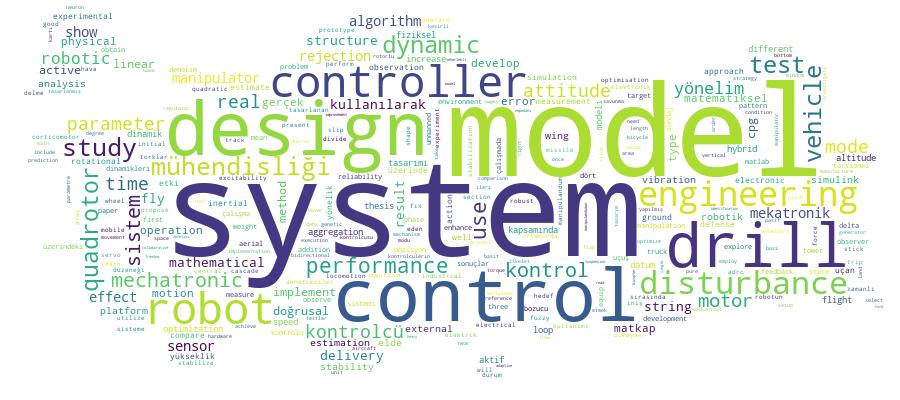
Competency Cloud

GCRIS Competency Cloud

Scholarly Output Search Results

Now showing 1 - 3 of 3
  • Article
    Citation - WoS: 7
    Citation - Scopus: 8
    Robust and Adaptive Control Design of a Drilling Rig During the Operating Modes
    (Sage Publications Ltd, 2019) Sadeghi, Amir Nobahar; Arikan, Kutluk Bilge; Ozbek, Mehmet Efe; Baranoglu, Besim; Nobahar Sadeghi, Amir
    Oil well drilling towers have different operating modes during a real operation, like drilling, tripping, and reaming. Each mode involves certain external disturbances and uncertainties. In this study, using the nonlinear model for the modes of the operation, robust and/or adaptive control systems are designed based on the models. These control strategies include five types of controllers: cascaded proportional-integral-derivative, active disturbance rejection controller, loop shaping, feedback error learning, and sliding mode controller. The study presents the design process of these controllers and evaluates the performances of the proposed control systems to track the reference signal and reject the uncertain forces including the parametric uncertainties and the external disturbances. This comparison is based on the mathematical performance measures and energy consumption. In addition, three architectures are presented to control the weight on bit during drilling process, and also to maintain a preset constant weight on bit, two control approaches are designed and presented.
  • Article
    Citation - WoS: 25
    Citation - Scopus: 34
    Modelling and Controlling of Drill String Stick Slip Vibrations in an Oil Well Drilling Rig
    (Elsevier, 2022) Sadeghi, Amir Noabahar; Arikan, Kutluk Bilge; Ozbek, Mehmet Efe; Noabahar Sadeghi, Amir
    Mitigating of drill string vibrations, plays a distinctive role in increase of rate of penetration and consequently decrease of the operation costs, prevent of severe damages to drill string and bit, increase of drilling operation quality and safety, and enhance the performances of the controllers. This study deals with modelling and controlling of drill string vibrations with focus on stick slip vibrations in vertical wells. The approach taken to subdivide the drill string into smaller torsional sections and model the complete system dynamically and employ the extracted torsional model to model the stick slip vibrations mathematically. To mitigate and or active control of stick slip vibrations, three architectures are developed and proposed, manipulation of the rotational speed, manipulation of the weight on bit, and increasing of the damping in the bottom of the drill string. The performance of each strategy is analysed individually as well as relative to each other, using a mathematical measure when the drill string length is divided into smaller torsional sections. By the aid of the simulations and mathematical measures, it is shown that manipulation of rotational speeds at the surface may not be an effective solution to reduce the stick slip vibrations, however manipulation of weight on bit and increasing of damping at the bottom of string can be two effective solutions to mitigate these kinds of vibrations. As a general conclusion, it is proved that the manipulation of bottom side drilling parameters is more effective than the manipulation of surface drilling parameters.
  • Article
    Citation - WoS: 7
    Citation - Scopus: 7
    Torsional Model of the Drill String, and Real-Time Prediction of the Bit Rotational Speed and the Torque on Bit, in an Oil Well Drilling Tower
    (Elsevier, 2020) Sadeghi, Amir Noabahar; Arikan, Kutluk Bilge; Ozbek, Mehmet Efe
    In an oil well drilling tower, the Bottom Hole Assembly (BHA) data is needed to optimize the controllable variables such as weight on bit and bit rotational speed for obtaining the optimum drilling rate. In order to acquire the data of the BHA, a simple and low-cost method, can be predicting of these parameters. In this study, first the torsional modelling of the drill string is implemented by dividing its length to some equal sections, then the effects of dividing on the estimation accuracy are evaluated. Using an ADRC (Active Disturbance Rejection Controller) in the vertical and rotational motions dynamics, some proper observers to predict the bit rotational speed, rock stiffness and torque on bit, in real-time are designed and presented. Dividing the drill string length to more sections, leads to design high order observer, so the performance of the designed observers with different orders, are compared and analysed. Employing the integral square error analysis, it is revealed, dividing the drill string length to more sections, leads more accurate in the prediction of bit rotational speed, but not more effect on the estimated rock stiffness, and torque on bit. Also it is shown that increasing of the observer bandwidth, leads to more accurate in the estimation, but concludes the estimation be more sensitive to the sensor noise. Employing the presented observers in this study to estimate the BHA data, in addition to enhance the drill quality and safety, the controllable variables are optimized, and consequently the whole drilling process can be robustly controlled, with no needs to the expensive measurement systems at the BHA.